
How to Identify the Kenya 40 Shillings
A collector's guide to identifying the bimetallic Kenya 40 shillings by its portrait-and-value obverse, coat-of-arms reverse, two-tone build, and look-alikes.
Read the full Kenya 40 Shillings encyclopedia entry →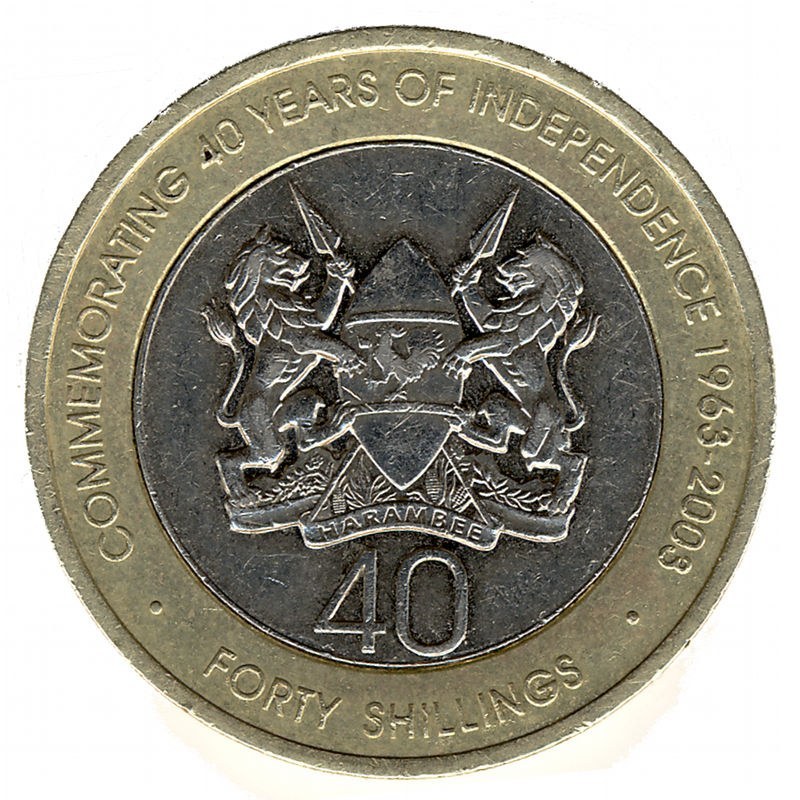
What This Coin Is
The Kenya 40 shillings is a modern ringed bimetallic commemorative coin of the Republic of Kenya, its round-number value tied to the fortieth anniversary of Kenyan independence (1963). Identifying one begins with recognising a two-tone coin that shows a portrait and the 40-shilling denomination on one side and the Kenyan coat of arms on the other.
Reading the Obverse
The obverse pairs a portrait with the denomination. Confirm that the stated value reads as 40 shillings — this high, round figure is itself a strong clue, since Kenya's everyday coins are denominated 1, 5, 10, and 20 shillings and in cents. Read the surrounding legend to confirm the issuing country and any anniversary wording rather than judging by the portrait alone.
Reading the Reverse
The reverse carries the Kenyan coat of arms: two lions supporting a shield and crossed spears, set above the national motto. This armorial device is the core attribution point that marks the coin as Kenyan and separates it from other African bimetallic coins that use different national emblems. Check that the arms are the Kenyan design specifically, not merely a generic shield.
Size, Metal, and Construction
This is a ringed bimetallic coin: a central disc of one base alloy is set inside an outer ring of a contrasting colour, giving a clear two-tone appearance and a defined seam between centre and ring. It carries no precious metal. Weigh and measure any candidate and compare against published specifications for the type; a genuine piece has a firm bond between the two parts, and a loose, mismatched, or single-metal coin claiming this denomination should be treated with suspicion.
Look-Alikes and Authentication Cautions
Many countries issue similar two-tone commemoratives, so the surest way to confirm this type is to read the denomination and verify the Kenyan coat of arms together — appearance alone is not enough. Watch for altered denominations, mismatched centre-and-ring pairs assembled from other coins, and cast copies showing seams, bubbles, or soft detail. For any example of value, match the coin to a standard catalogue of modern Kenyan coinage and, where warranted, seek professional authentication.
Frequently asked questions
How do I know a two-tone coin is Kenyan?
Read the reverse for the Kenyan coat of arms — two lions holding a shield and spears above the national motto — and confirm the shilling denomination; both together identify a Kenyan issue.
How is the 40 shillings different from ordinary Kenyan coins?
Its high, round 40-shilling value and ringed bimetallic construction set it apart from Kenya's standard single-metal 1, 5, 10, and 20 shilling and cent coins, marking it as a commemorative.
Does the coin contain gold or silver?
No. It is a base-metal bimetallic coin with two contrasting alloys, so its interest is as a collectible rather than for any precious-metal content.
What are common signs of a fake or altered coin?
A loose or mismatched centre and ring, casting seams or bubbles, soft detail, incorrect weight or diameter, and altered denominations or dates are all warning signs worth checking on a bimetallic coin.