
How to Identify the Jackie Robinson Silver Dollar
A collector's checklist for confirming a 1997 Jackie Robinson silver dollar — action portrait, eagle reverse, silver specs, the 'P' mint mark, and authentication cautions.
Read the full Jackie Robinson Silver Dollar encyclopedia entry →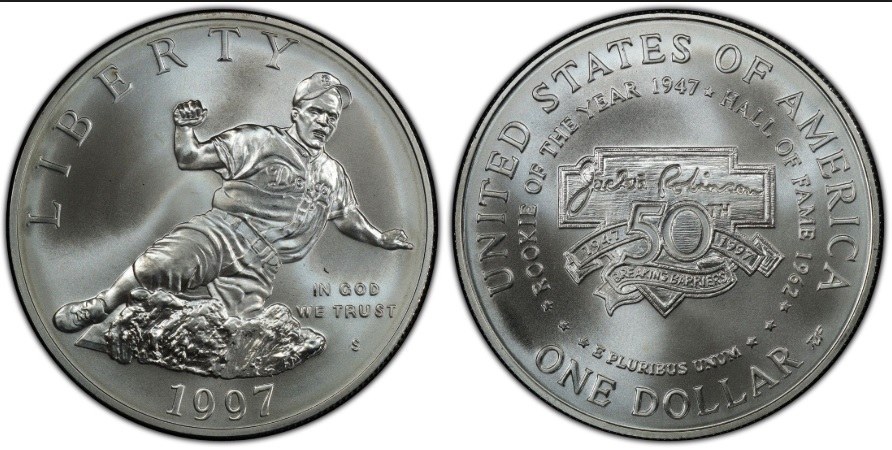
Start with the obverse subject and date. A genuine Jackie Robinson Silver Dollar shows Robinson as a ballplayer in action — a sliding, athletic figure — together with LIBERTY, IN GOD WE TRUST, and the date 1997. An action portrait of a baseball player is unusual on a U.S. dollar and is the fastest way to separate this commemorative from circulating dollars or other silver commemoratives.
Check the reverse for the anniversary dating. The reverse of this coin carries an American bald eagle with a shield along with the dates 1947–1997 and the statutory lettering ONE DOLLAR and E PLURIBUS UNUM. The 1947–1997 span is the diagnostic that ties the piece specifically to the fiftieth anniversary of Robinson's major-league debut; a silver dollar without that anniversary dating is a different type.
Verify the physical specifications. The coin is a full-size silver dollar: roughly 38.1 mm in diameter and about 26.7 grams, struck in 90% silver with a reeded edge. A calibrated scale and calipers are the best tools here — a piece that is noticeably off in weight, diameter, or edge reeding for a 90% silver dollar is a warning sign. Confirm the 'P' Philadelphia mint mark, which genuine examples carry.
Distinguish finish and packaging. The program was issued in proof and uncirculated versions, often supplied in a Mint capsule with a certificate of authenticity. Because the uncirculated finish was made in smaller numbers, correctly identifying finish matters for value — proof coins show mirror-like fields and frosted devices, while uncirculated coins have a satiny or brilliant surface without the deep mirror.
Be cautious with authentication. Modern commemoratives are less often counterfeited than rare classic coins, but low-mintage, higher-value pieces can attract altered labels, spurious grades, or coins removed from original packaging. For any significant purchase, rely on reputable dealers and third-party grading (PCGS, NGC) rather than eye appeal, and match the weight, diameter, silver color, and 'P' mint mark before concluding.
Frequently asked questions
How do I tell this from an ordinary silver dollar?
Look for the Jackie Robinson action portrait and 1997 date on the obverse and the 1947–1997 anniversary dates on the reverse. Those features mark it as a commemorative, unlike circulating dollars or bullion Silver Eagles.
What should a genuine example weigh and measure?
About 26.7 grams and roughly 38.1 mm in diameter, in 90% silver with a reeded edge. Figures that don't match a standard silver dollar are a counterfeit warning sign.
How can I tell a proof from an uncirculated example?
Proof coins have deeply mirrored fields with frosted raised devices; uncirculated coins have a satiny or brilliant finish without the mirror. Finish affects value because the uncirculated version had a lower mintage.
Does a genuine coin have a mint mark?
Yes. Genuine Jackie Robinson dollars were struck at Philadelphia and carry a 'P' mint mark. Confirm it along with the weight, diameter, and anniversary dating when authenticating.