
How to Identify the Isabella Quarter
A collector's guide to confirming a genuine 1893 Isabella Quarter by its designs, date, specifications, and authentication cautions.
Read the full Isabella Quarter encyclopedia entry →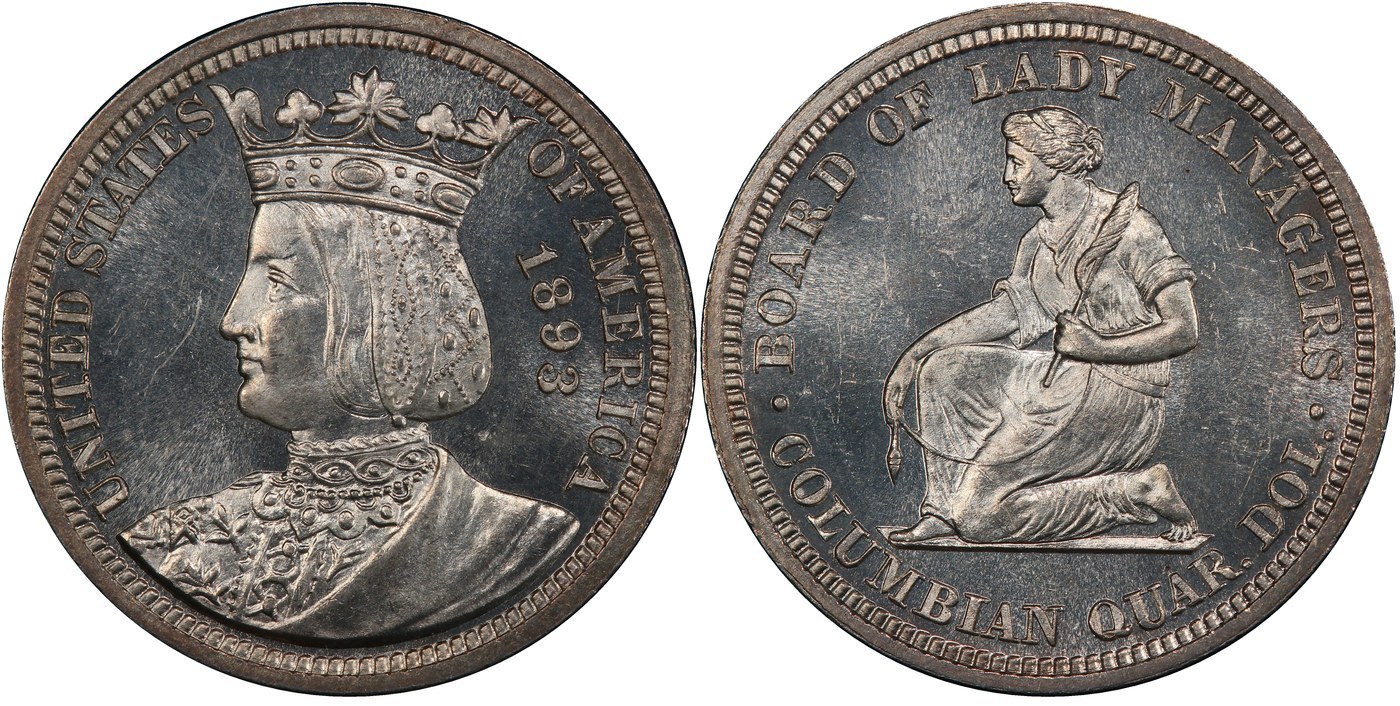
Begin with the date and theme, which are unmistakable. A genuine Isabella Quarter is dated 1893 and no other year. The obverse must show a left-facing, crowned bust of Queen Isabella of Spain with UNITED STATES OF AMERICA above and 1893 below; the reverse shows a kneeling woman holding a distaff and spindle, the allegory of women's industry, not an eagle or a seated Liberty. If the coin shows a Barber Liberty head or an eagle reverse, it is an ordinary Barber quarter, not the commemorative.
Check the physical specifications, which should match a standard silver quarter of the era: about 24.3 mm diameter, roughly 6.25 g in weight, a 90% silver alloy, and a reeded edge. A caliper, a scale, and a check for a plain (non-reeded) or off-weight edge will screen out many altered or counterfeit pieces. The coin should be non-magnetic.
Note the mint mark: there is none. Every genuine Isabella Quarter was struck at Philadelphia in a single year, so any specimen bearing a D, S, or other mint mark is wrong. Also look for the designer's initial B on the bust truncation.
Because this is a high-value single issue, it is a target for counterfeits, added details, and cleaning. Watch for tooled or re-engraved features, unnatural surfaces from harsh cleaning, and altered dates on host coins. For any purchase of consequence, favor a coin encapsulated by PCGS or NGC, and compare the portrait and reverse figure against authenticated reference images.
Frequently asked questions
How do I tell an Isabella Quarter from a regular Barber quarter?
The Isabella Quarter shows a crowned Queen Isabella bust and a kneeling woman with a distaff on the reverse, dated 1893. A regular Barber quarter shows a Liberty head and a heraldic eagle instead.
Does the Isabella Quarter have a mint mark?
No. It was struck only at Philadelphia in 1893, so genuine examples carry no mint mark. Any mint mark is a red flag for a fake or altered coin.
What are the correct specifications?
About 24.3 mm in diameter, roughly 6.25 g, struck in 90% silver with a reeded edge, and non-magnetic. Off-weight, undersized, or plain-edge pieces should be treated with suspicion.
How can I authenticate a valuable example?
Match both designs, date, and specifications exactly, then rely on third-party certification from PCGS or NGC. Because the coin is scarce and valuable, professional authentication is strongly recommended.