
How to Identify the Iowa Centennial Half Dollar
A collector's checklist for confirming a 1946 Iowa Centennial half dollar — the Old Stone Capitol, the state eagle, silver specs, and authentication cautions.
Read the full Iowa Centennial Half Dollar encyclopedia entry →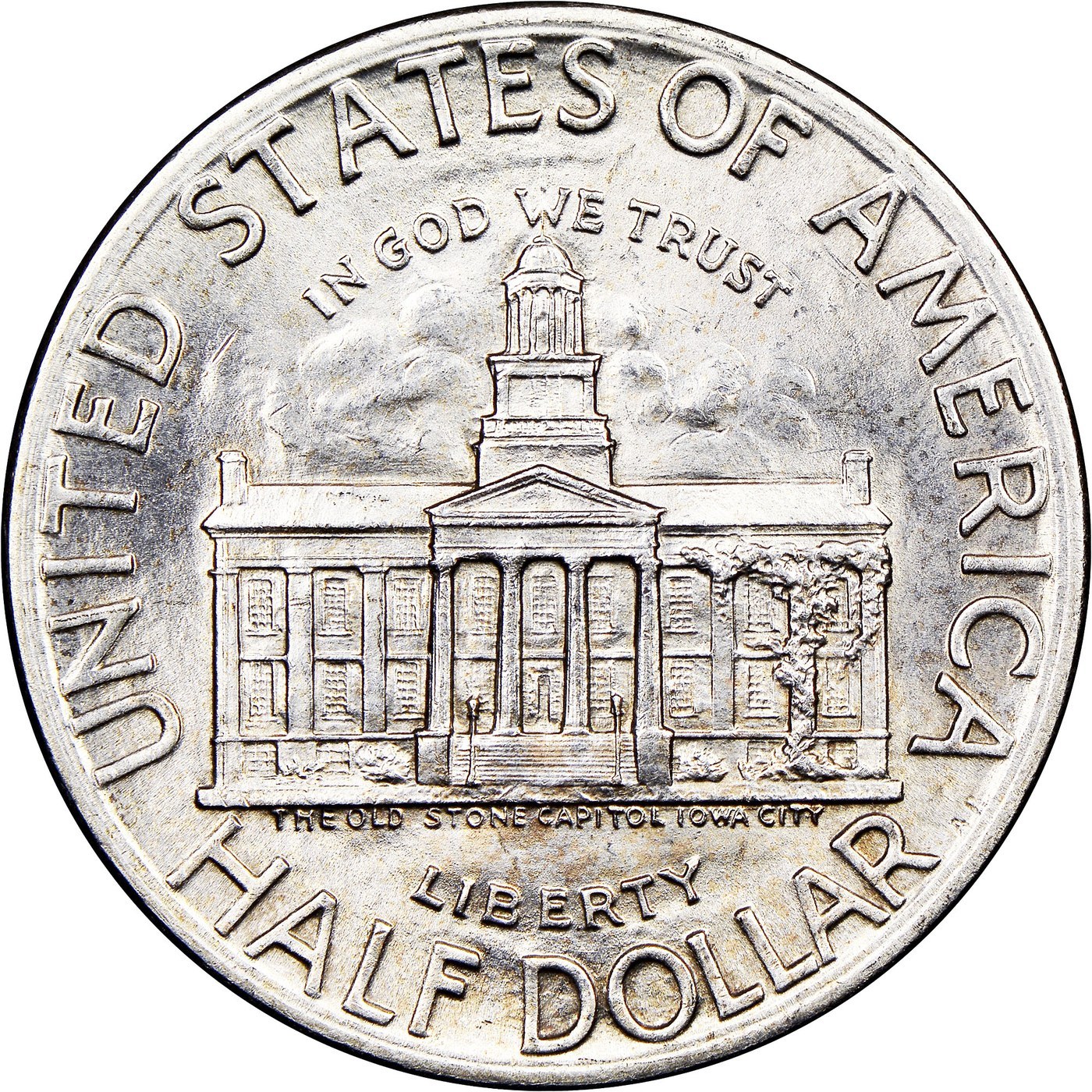
Start with the obverse image and lettering. A genuine Iowa Centennial Half Dollar shows a rectangular stone government building — the Old Stone Capitol — with the inscription "THE OLD STONE CAPITOL IOWA CITY" and the two anniversary dates 1846 and 1946. This architectural design is the fastest way to separate it from the 1946 Walking Liberty half dollar, which shows a striding Liberty figure rather than a building.
Check the reverse next. It carries an eagle with outstretched wings, adapted from Iowa's state seal and flag, together with a ribbon bearing the state motto and the standard national and denomination lettering. The eagle-and-motto reverse is distinctive to this type and will not be confused with the eagle on a circulating Walking Liberty half, which is posed on a rock among pine.
Verify the physical specifications. The coin is a standard half dollar: roughly 30.6 mm in diameter, about 12.5 grams, struck in 90% silver with a reeded edge. A calibrated scale and calipers are the best tools here; a piece that is off in weight, diameter, or edge reeding for a silver half dollar is a warning sign.
Expect no mint mark and only one date of manufacture. Every genuine example was struck at Philadelphia in 1946, so the absence of a mint mark is normal. Any Iowa Centennial half dollar bearing a mint mark, or a date other than the 1846/1946 pairing, should be treated as suspect.
Be cautious with authentication and grading. Because much of the mintage survives in high grade, most value is tied to condition, so cleaned surfaces, polishing, or artificial toning can significantly affect worth. Watch for mushy or doubled lettering, incorrect weight, or a color that does not match 90% silver. For any higher-value or high-grade purchase, rely on reputable dealers and third-party grading (PCGS, NGC) rather than eye appeal alone.
Frequently asked questions
How do I tell it apart from a 1946 Walking Liberty half dollar?
The commemorative shows the Old Stone Capitol building and Iowa centennial lettering on the obverse and an Iowa state eagle on the reverse. The circulating Walking Liberty half instead shows a striding Liberty figure and a differently posed eagle.
What should a genuine example weigh and measure?
About 12.5 grams and roughly 30.6 mm in diameter, in 90% silver with a reeded edge. Figures that don't match those of a standard silver half dollar are a counterfeit warning sign.
Should the coin have a mint mark?
No. All were struck at the Philadelphia Mint in 1946 with no mint mark. A mint mark, or any date other than the 1846/1946 centennial dates, indicates a problem and warrants caution.
Why does condition matter so much for this coin?
Because it was well distributed and widely saved, many examples survive in mint state, so grade and originality drive value. Cleaning, polishing, or artificial toning can meaningfully reduce a coin's worth, making third-party grading useful.