
How to Identify the Hawaii State Quarter
A collector's checklist for confirming a 2008 Hawaii State Quarter by its Kamehameha reverse, Hawaiian motto, mint mark, and clad edge.
Read the full Hawaii State Quarter encyclopedia entry →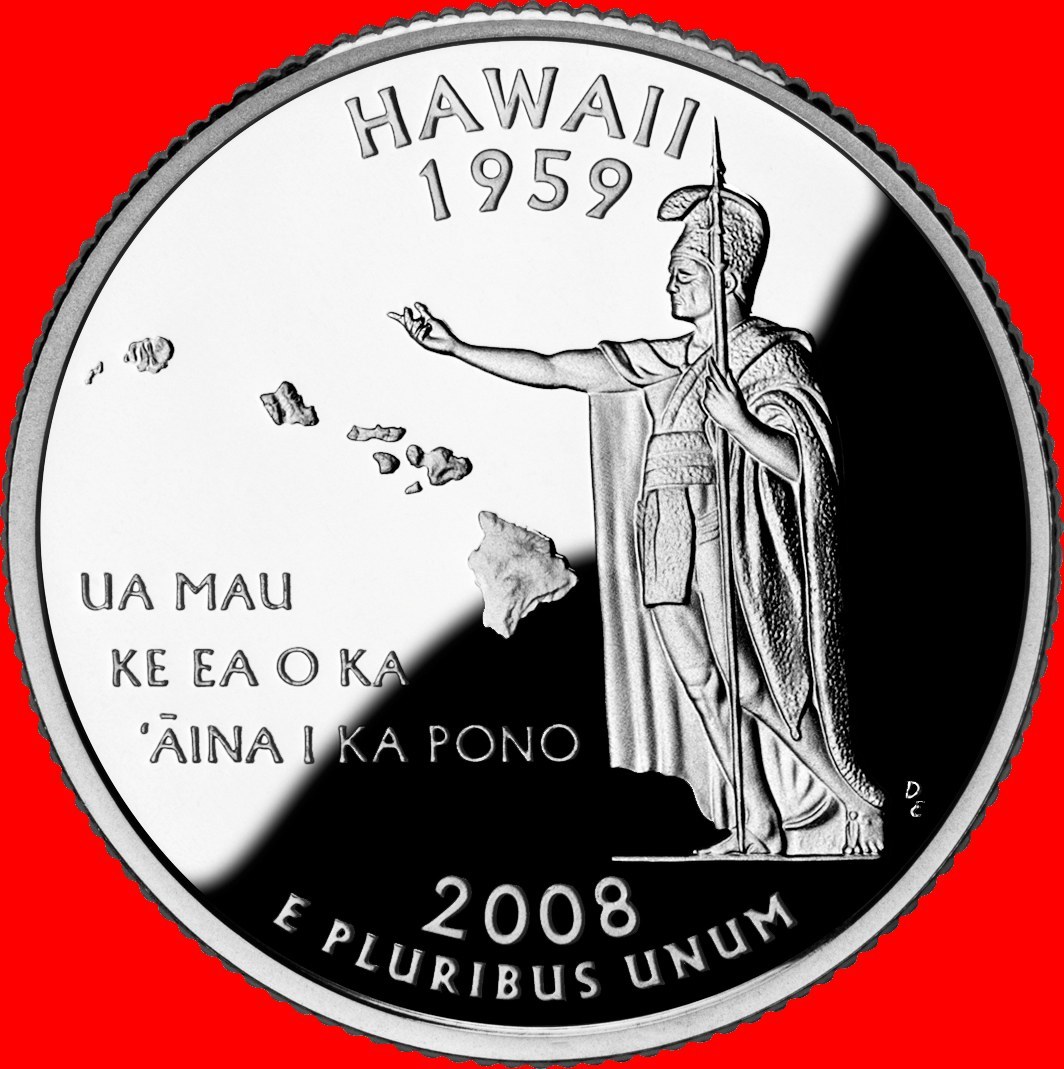
Begin with the reverse, which is the design unique to this coin. You should see a standing figure of King Kamehameha I in a cloak and helmet, one arm outstretched over a row of Hawaiian islands, the name HAWAII, and the date 2008. The single most reliable confirmation is the motto in the Hawaiian language — UA MAU KE EA O KA ʻĀINA I KA PONO — which no other quarter carries. If you see English state-park or landmark imagery instead, it is a different program coin.
Check the obverse to confirm it is a state-quarter-era piece: the right-facing George Washington bust with QUARTER DOLLAR, UNITED STATES OF AMERICA, LIBERTY, and IN GOD WE TRUST. This obverse is shared by every 1999–2008 state quarter, so it identifies the series but not the state — the reverse does that.
Locate the mint mark on the obverse, just right of the base of Washington's neck. P (Philadelphia) and D (Denver) are the circulating coins; S (San Francisco) indicates a proof made for collector sets. Then verify the physical specs: about 24.3 mm diameter, 5.67 g, copper-nickel clad, with a reeded edge showing a reddish copper stripe. A same-design coin with a plain bright edge and slightly higher weight is likely a 90% silver San Francisco proof, which is a collector issue rather than pocket change.
Distinguish the Hawaii quarter from look-alikes. It is easy to confuse a specific state quarter with others only until you read the reverse text and imagery — the Kamehameha figure plus Hawaiian-language motto is decisive. Be aware that novelty pieces exist: colorized, gold-plated, or holographic Hawaii quarters are ordinary circulation coins altered outside the Mint, so any added color or plating means it is not an official finish and carries no numismatic premium for the plating itself.
Because genuine high-value examples are limited to top-grade or error coins, treat authentication as a matter of grade and error verification rather than distinguishing a fake type. For anything you believe is a significant mint error or a condition rarity, have it evaluated by a reputable third-party grading service before assigning value.
Frequently asked questions
Where is the mint mark on the Hawaii quarter?
On the obverse, just to the right of the base of Washington's neck. Look for a small P, D, or S. P and D are circulation strikes; S marks a San Francisco proof.
How can I tell a silver proof from a normal Hawaii quarter?
Check the edge and mint mark. Regular clad coins show a copper stripe along the reeded edge; 90% silver proofs carry an S mint mark, have a fully bright edge with no copper line, and show deep mirror fields with frosted devices.
My Hawaii quarter is colored or gold-plated. Is it a special Mint issue?
No. The U.S. Mint did not issue colorized or gold-plated circulating Hawaii quarters. These are ordinary coins altered by private companies, and the added finish does not give them official numismatic value.
How do I separate the Hawaii quarter from other 2008 state quarters?
Read the reverse. Only the Hawaii coin shows King Kamehameha reaching over the islands with the Hawaiian-language motto UA MAU KE EA O KA ʻĀINA I KA PONO. That text and imagery uniquely identify it.