
How to Identify the Germany 2 Euro Erasmus Programme Commemorative
Spot the German Erasmus 2 Euro by its student-and-globe obverse, 2022 date, German mint mark, bi-metallic build and the standard 2 Euro star-ring reverse.
Read the full Germany 2 Euro Erasmus Programme Commemorative encyclopedia entry →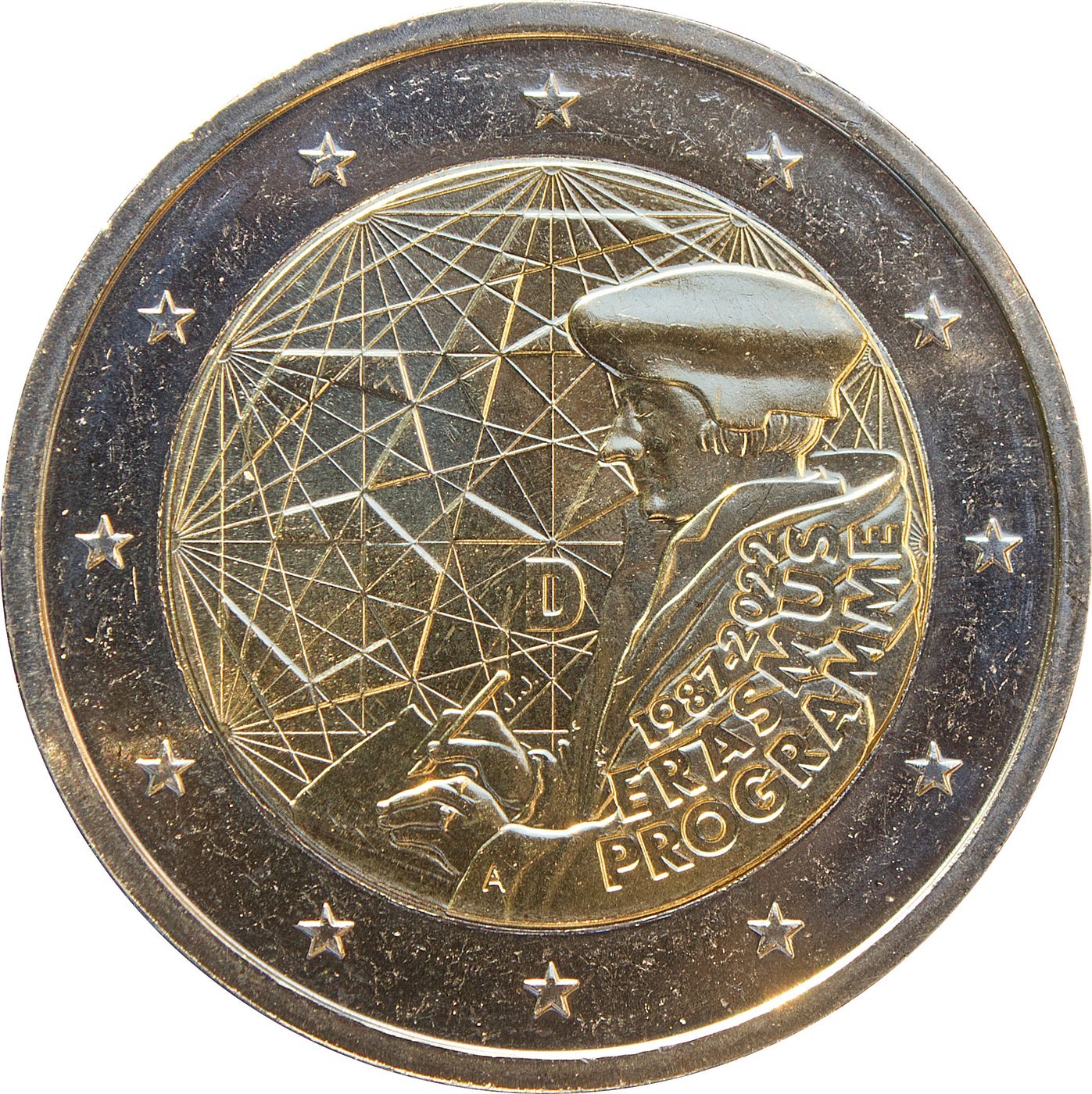
Start with the commemorative obverse. The defining feature is the Erasmus Programme design showing a student figure together with a globe, a motif representing study and mobility across Europe. Look for inscriptions naming Erasmus and for the country code D for Germany, which distinguishes the German issue from other countries' versions of the same shared 2022 design.
Confirm the common reverse. The other face is the standard 2 Euro common side: a large numeral 2, the word EURO, a map of Europe and the ring of twelve stars. Because this side is identical on every eurozone 2 Euro coin, it confirms the denomination but not the specific issue — always attribute the coin from the Erasmus obverse.
Check size, metal and edge. The coin is bi-metallic, with a lighter (cupronickel-coloured) outer ring around a golden-coloured centre disc, about 25.75 mm across and roughly 8.5 g. The edge is finely reeded with lettering. These specifications match all 2 Euro coins, so a piece that is single-metal, magnetic throughout, or the wrong size is not a genuine 2 Euro.
Find the mint mark and date. German 2 Euro coins carry a single-letter mint mark — A (Berlin), D (Munich), F (Stuttgart), G (Karlsruhe) or J (Hamburg) — near the design, along with the year 2022. All five mints struck versions, so the mint letter identifies where a given coin was made rather than a different coin type.
Watch look-alikes and authentication. Many countries issued the same Erasmus design in 2022, so a similar student-and-globe obverse without the German markings belongs to another country. As a low-value modern coin it is rarely faked; be cautious mainly of coloured, gold-plated or privately altered novelty versions, which are not the original circulating issue and hold no extra official value.
Frequently asked questions
How do I know it is the German version and not another country's?
All 2022 Erasmus coins share the same obverse design, so look for the German country code D and one of the German mint marks (A, D, F, G or J). Those markings identify Germany as the issuer.
Where is the mint mark on the coin?
German 2 Euro coins show a single-letter mint mark near the commemorative design: A for Berlin, D for Munich, F for Stuttgart, G for Karlsruhe or J for Hamburg. All five struck the 2022 Erasmus coin.
How can I tell a genuine coin from a novelty version?
A genuine coin is bi-metallic, about 25.75 mm and 8.5 g, with the plain common reverse. Coloured, gold-plated or otherwise altered examples are privately modified novelties, not the official circulating issue.
Is the reverse unique to this coin?
No. The reverse is the standard 2 Euro common face shared by every eurozone country, so it only confirms the denomination. Identify the specific coin from the Erasmus student-and-globe obverse.