
How to Identify the Germany 2 Euro Elbphilharmonie Commemorative
Spot the 2017 Hamburg 2 euro by its Elbphilharmonie national side, common star-ringed European reverse, bi-metallic build and German edge lettering.
Read the full Germany 2 Euro Elbphilharmonie Commemorative encyclopedia entry →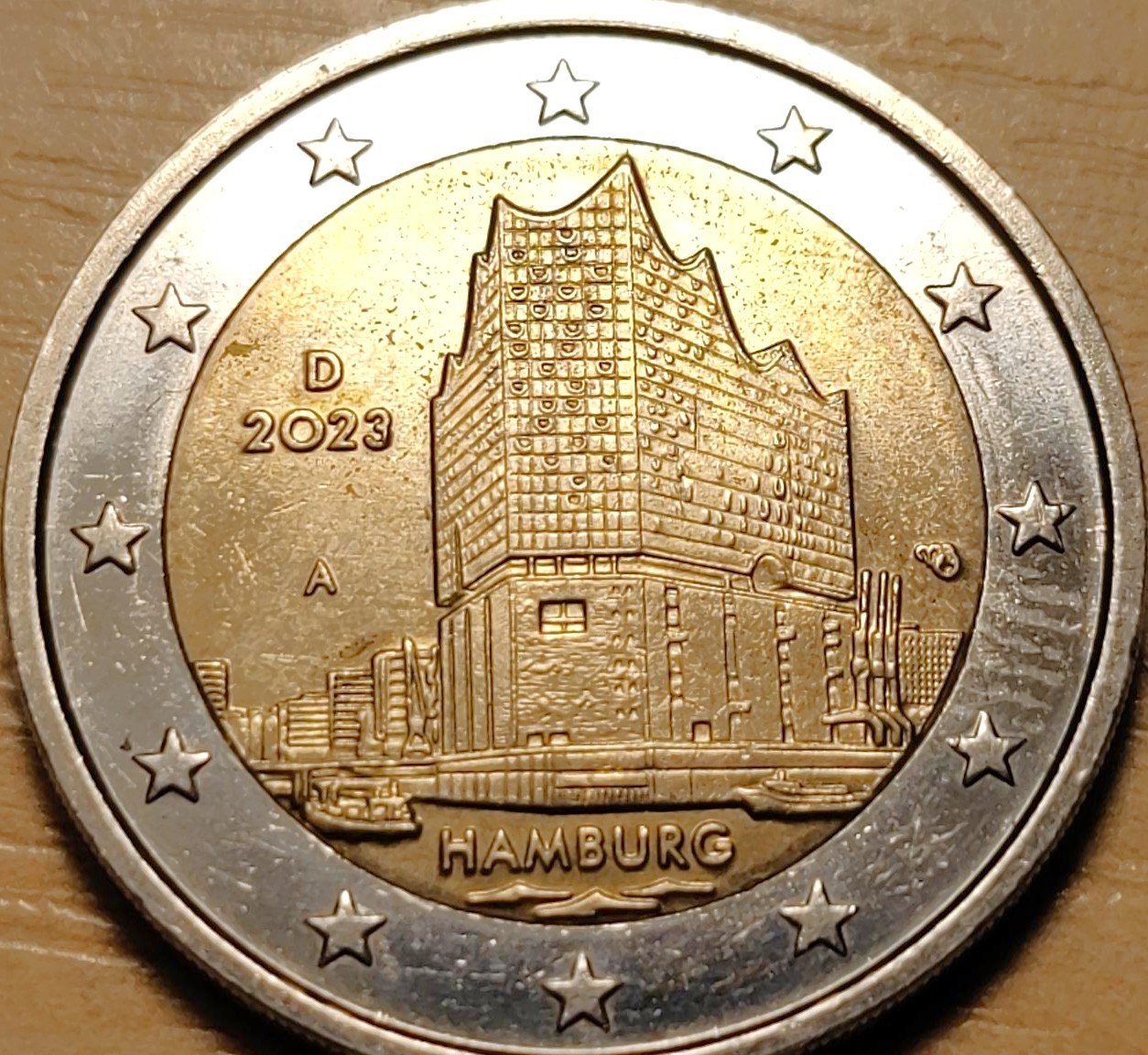
Start with the national side. The defining feature is the Elbphilharmonie, shown as an architectural design with a wave-like glass roof above a solid base. Look for the country code D, the year 2017, and an inscription referring to Hamburg. This landmark motif is what separates the coin from every other 2 euro commemorative.
Confirm the common reverse. The other side shows the numeral 2, the word EURO, and a map of Europe surrounded by the twelve EU stars. Because this side appears on all 2 euro coins, use it to confirm the denomination but never to identify the specific type; the Elbphilharmonie side does that.
Check size, weight and metal. Genuine pieces are bi-metallic, about 25.75 mm across and roughly 8.5 g, with a silvery-white center inside a pale gold-colored ring. A coin that is a single color throughout, strongly magnetic, or noticeably off in size or weight should be treated with suspicion.
Read the edge and find the mint mark. The edge should carry the lettering EINIGKEIT UND RECHT UND FREIHEIT with oak sprigs. On the national side, look for a single letter mint mark: A (Berlin), D (Munich), F (Stuttgart), G (Karlsruhe) or J (Hamburg). Collectors often assemble all five.
Watch for look-alikes and fakes. Other years of the federal-states series share the same size and reverse but show different buildings, so match the landmark and date carefully. Counterfeit 2 euro coins exist; verify the bi-metallic step, sharp lettering, correct edge inscription and proper weight, and for anything sold at a premium, prefer coins in original mint packaging or with a specialist's opinion.
Frequently asked questions
How do I know it's the Hamburg coin and not another year in the series?
Every year of the German states series uses the same size and common reverse but a different landmark. The Elbphilharmonie concert hall and the 2017 date identify this as the Hamburg issue.
Where is the mint mark and why does it matter?
A single letter (A, D, F, G or J) on the national side shows which of Germany's five mints struck the coin. All are common, but collectors often want one of each letter to complete a set.
What quick checks help spot a fake?
Confirm the coin is genuinely bi-metallic, weighs about 8.5 g and measures about 25.75 mm, has crisp lettering, and carries the correct German edge inscription; soft detail or wrong specs are warning signs.