
How to Identify the German 10 Deutsche Mark Commemorative
Spot a German silver 10 DM commemorative by its Federal Eagle reverse, 10 Deutsche Mark denomination, portrait obverse, mint mark, and ~32.5 mm silver form.
Read the full German 10 Deutsche Mark Commemorative encyclopedia entry →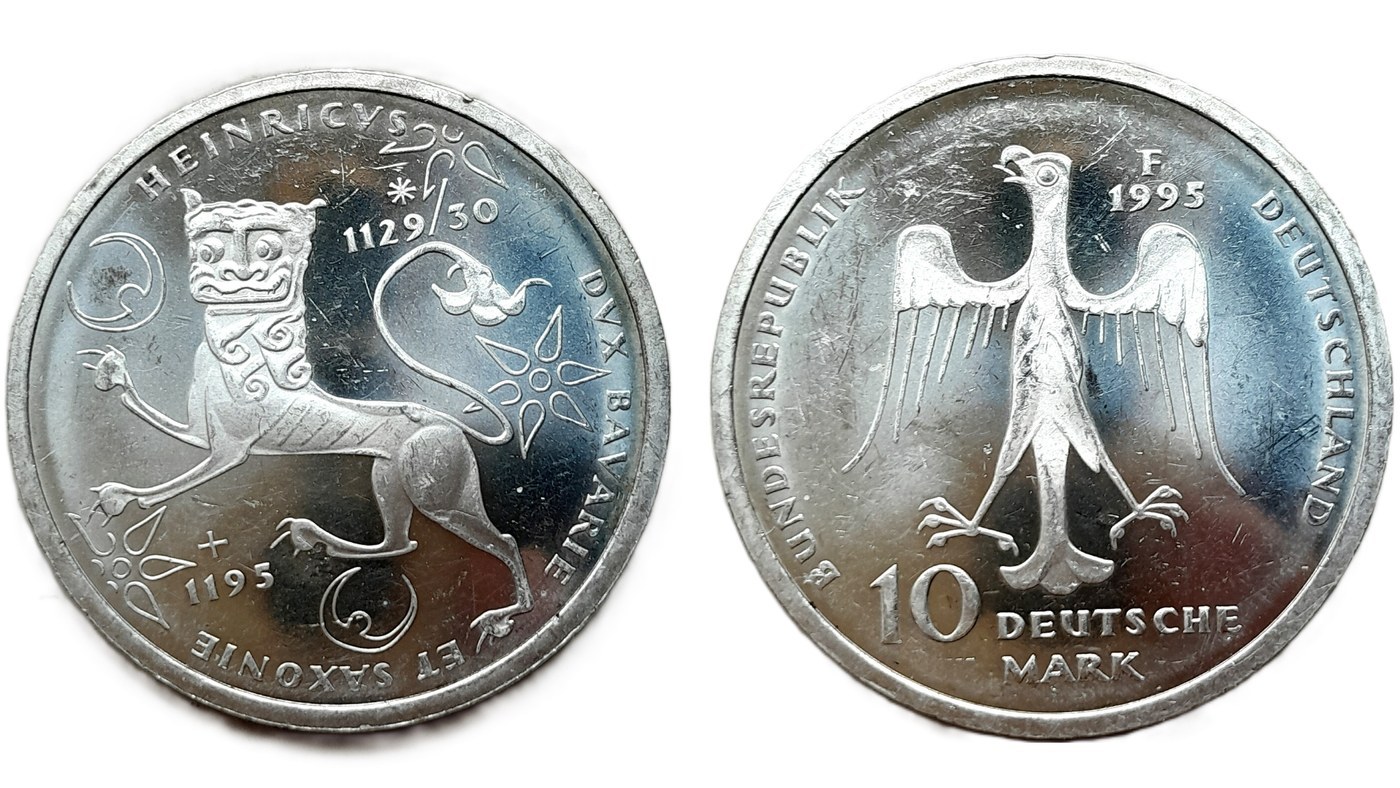
Read the reverse first. Every coin in this series shows the German Federal Eagle (Bundesadler) together with BUNDESREPUBLIK DEUTSCHLAND, the value 10 DEUTSCHE MARK, and a year. Confirming that denomination and the eagle immediately places the coin in the German silver commemorative family, regardless of which subject appears on the front.
Then read the obverse theme. On this 1995 issue the obverse carries a profile portrait of Heinrich der Loewe (Henry the Lion) inside ornate heraldic ornament, usually with a legend naming him and the occasion. Because each date in the series commemorates something different, the obverse design and inscription are what distinguish one issue from another.
Check size, weight, and edge. These coins are roughly 32.5 mm across and about 15-16 g in silver, with a reeded or lettered edge. A silver coin will feel dense and ring brightly; verify the fineness and weight if you intend to value it by metal content. The edge often carries an inscribed motto, which is normal for the series.
Find the mint mark. A single letter on the reverse identifies the striking mint (for German coins of this era: A Berlin, D Munich, F Stuttgart, G Karlsruhe, J Hamburg). The same design was often struck at several mints, so the letter helps pin down the exact variant and match it to catalog listings.
Watch for look-alikes and condition traps. Do not confuse this with the circulating cupro-nickel or the base-metal 10-Pfennig and later coins, or with medals that lack a stated denomination. Also distinguish plain Brilliant Uncirculated strikes from mirror-finish Proof (Spiegelglanz) versions, which are worth more. Genuine silver is non-magnetic; be cautious of cleaned, polished, or plated pieces, and compare against catalog images when in doubt.
Frequently asked questions
How do I confirm it is a 10 Deutsche Mark and not another denomination?
Check the reverse for the wording 10 DEUTSCHE MARK next to the Federal Eagle. Lower German denominations are marked in Pfennig or as 1, 2, or 5 Mark and are usually base metal, not silver.
Where is the mint mark and why does it matter?
It is a single letter (A, D, F, G, or J) on the reverse. It tells you which German mint struck the coin; the same design was often made at more than one mint, so the letter identifies the exact variant.
How can I tell a Proof from a normal strike?
Proof (Spiegelglanz) coins have mirror-like fields and frosted devices and typically come in sealed mint packaging. Standard Brilliant Uncirculated pieces have a satin, non-mirrored surface and are more common.
Is it real silver, and how do I check?
Yes, these commemoratives are silver. Confirm by weight and diameter (about 15-16 g and 32.5 mm), a bright ring when tapped, and a non-magnetic response. Have questionable pieces tested before valuing them.