
How to Identify the Fugio Cent
A collector's checklist for confirming an 1787 Fugio Cent: reading the sundial obverse, the linked-ring reverse, and watching for restrikes and copies.
Read the full Fugio Cent encyclopedia entry →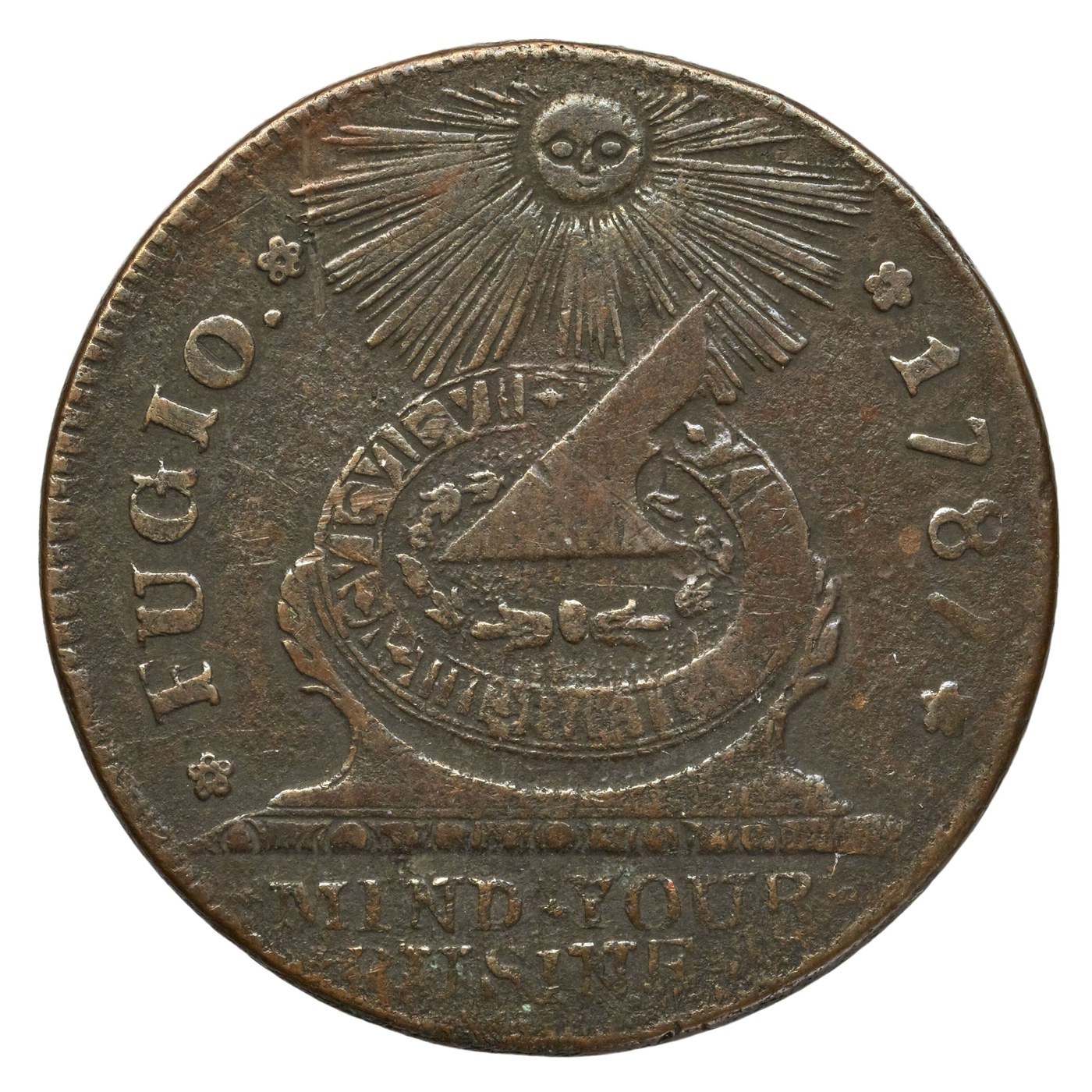
Start with the obverse, which is the most diagnostic feature. A genuine Fugio Cent shows a sun with rays beaming onto a sundial, the word "FUGIO" to the left of the dial, the date 1787 to the right, and the motto "MIND YOUR BUSINESS" curving along the bottom. If your coin shows this sun-and-sundial scene with "FUGIO," you are looking at the correct type.
Confirm the reverse next. It should display thirteen small interlinked rings arranged in a circle, with the words "UNITED STATES" or "STATES UNITED" around the outer edge and "WE ARE ONE" inside a central band. The chain of linked rings is the hallmark device and is the same ring motif visible on this coin. The exact wording and ring arrangement vary between die varieties, which specialists use to attribute individual pieces.
Check the physical basics. The coin is solid copper, has a plain (non-reeded) edge, and measures roughly 28-29 mm in diameter, about the size of an early large cent. There is no mint mark to look for, because the coin was struck under contract rather than at a national mint. A brown, aged copper surface is normal for a period piece.
Be cautious about authentication. Later restrikes, souvenir copies, and modern reproductions of the Fugio design exist, and some are cast or made from copied dies; telltale signs include soft or mushy detail, casting seams, incorrect weight, or unnaturally uniform surfaces. Because genuine 1787 examples can be valuable and vary greatly by variety and condition, have any promising coin verified and graded by a reputable third-party service before assuming its value.
Frequently asked questions
How do I tell a Fugio Cent from a regular large cent?
Look at the designs. The Fugio Cent shows a sun and sundial with "FUGIO" and "MIND YOUR BUSINESS" on the obverse and thirteen linked rings on the reverse. A U.S. large cent instead shows a Liberty head and a wreath reverse reading "ONE CENT."
What size and metal should a genuine one be?
It should be copper, plain-edged, and about 28-29 mm across, comparable to an early large cent. It has no precious-metal content and no mint mark.
Are all Fugio Cents dated 1787?
Yes. All genuine circulating Fugio Cents carry the 1787 date. A different date, or a very crisp modern-looking strike, points toward a restrike, reproduction, or novelty piece rather than an original.
What are the biggest authentication risks?
Cast copies, later restrikes, and altered or tooled surfaces. Because varieties differ in value and fakes exist, examples worth real money should be confirmed and graded by a reputable grading service.