
How to Identify the French Cérès 5 Francs
A collector's guide to recognizing the Cérès 5 francs by the wheat-wreathed goddess, the republican motto, its silver size and its mint marks.
Read the full French Cérès 5 Francs encyclopedia entry →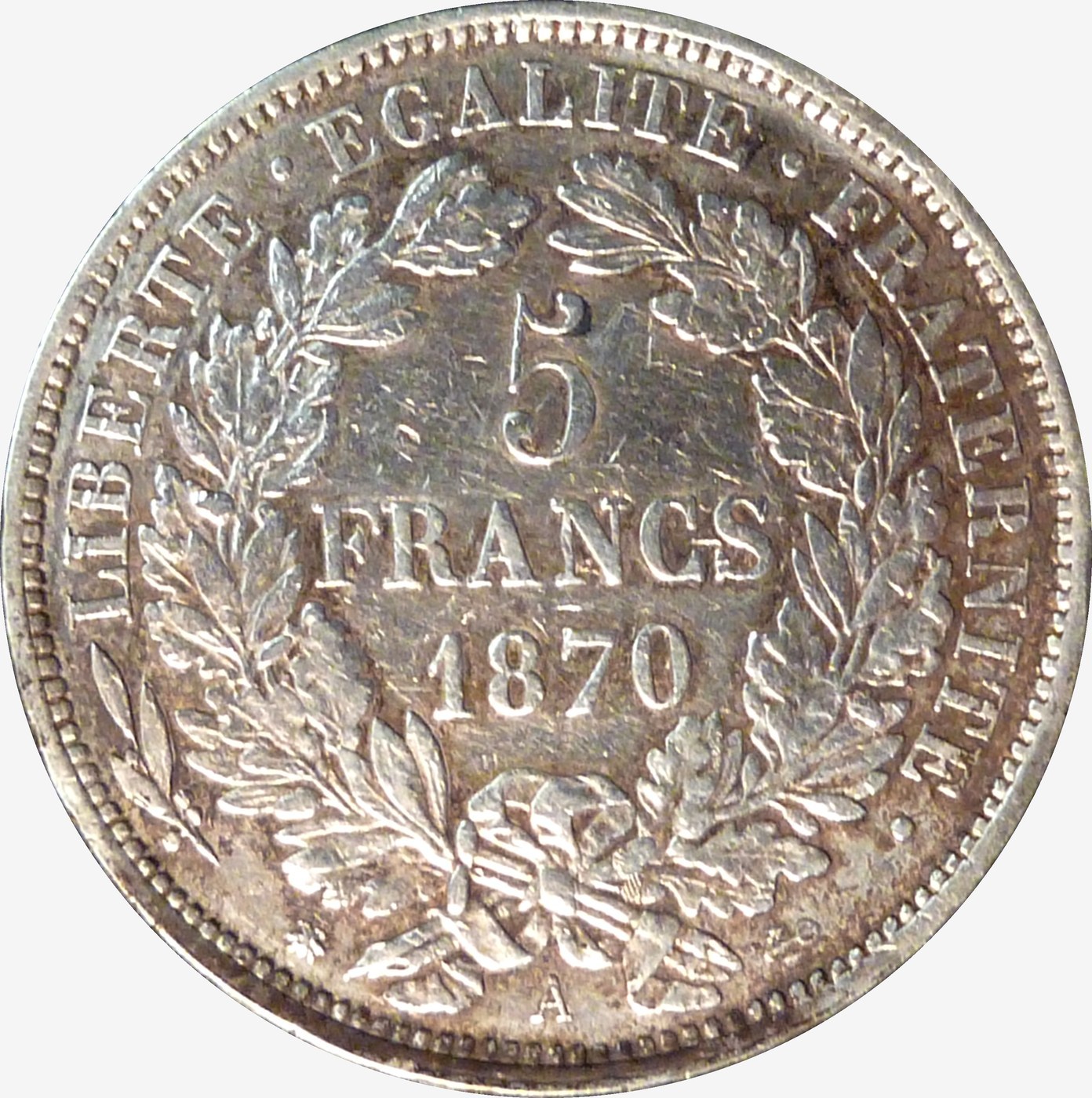
Begin with the head on the obverse. A genuine Cérès 5 francs shows a female head — Cérès, the harvest goddess — facing left, wearing a soft liberty cap and crowned with a wreath of wheat ears. Around her runs the motto LIBERTÉ ÉGALITÉ FRATERNITÉ. That combination of wheat wreath, liberty cap and republican motto is the fastest confirmation of the type and separates it from empire-era portraits of Napoleon III, which show a bare or laureate male head instead.
Turn the coin to read the reverse, which is the side not shown in this image. On the Cérès 5 francs you should find the value 5 FRANCS inside a wreath, with RÉPUBLIQUE FRANÇAISE, the date, and a small mint mark with privy symbols in the legend or near the wreath. The mint letter — most often A for Paris or K for Bordeaux — together with the date pins the coin to a specific issue, which matters for both authentication and value.
Confirm size and metal together. This is a heavy, crown-sized silver coin, close to 37 mm across and near 25 grams, struck in .900 fine silver with a milled edge. It should feel substantial and ring rather than clunk. A coin of the right design but noticeably light, undersized or non-silver in colour is either a smaller Cérès denomination (the 50 centimes, 1 franc and 2 francs use a similar head) or a replica.
Watch for look-alikes and confusions. The Cérès head also appears on the smaller silver francs, so always check the value and diameter — only the crown-sized piece is the 5 francs. The later, much more common Hercules 5 francs shows three standing figures, not a single head, so it should not be mistaken for the Cérès type. Do not confuse the Cérès 5 francs with the empire's Napoleon III 5 francs of the 1850s–1860s either.
Finally, be cautious about authenticity on any large silver crown. Because of the silver content, 5-franc pieces have been faked and altered; check that the weight, diameter and edge match the standard, look for cast seams, soft mushy detail or wrong-colour metal, and be wary of tooled dates or added mint marks. For a scarce date or mint, compare against reference images of a confirmed Cérès 5 francs of the same year and mint, and consider third-party grading before paying a significant premium.
Frequently asked questions
What is the quickest way to confirm a Cérès 5 francs?
Look for the left-facing female head in a liberty cap wreathed with wheat, ringed by LIBERTÉ ÉGALITÉ FRATERNITÉ, on a large silver coin — with 5 FRANCS in a wreath on the reverse.
How do I tell it from the smaller Cérès francs?
By size and value. The same Cérès head is used on the 50 centimes, 1 and 2 francs, so check the reverse value and the diameter — only the crown-sized, roughly 37 mm, ~25 g coin is the 5 francs.
Where is the mint mark and why does it matter?
The mint mark and privy symbols sit in the reverse legend, near the wreath — commonly A for Paris or K for Bordeaux. With the date, they identify the exact issue, affecting scarcity and value.
How can I spot a fake?
Check that weight, diameter and edge match the .900 silver standard. Cast seams, soft detail, wrong colour or metal, and tooled dates or mint marks are warning signs; grade scarce pieces before paying a premium.