
How to Identify the France 2 Euro D-Day Anniversary Commemorative
Confirm the 2014 French D-Day 2 euro by its Débarquement legend, 1944-2014 dates, RF mark, bi-metallic build, and 12 EU stars.
Read the full France 2 Euro D-Day Anniversary Commemorative encyclopedia entry →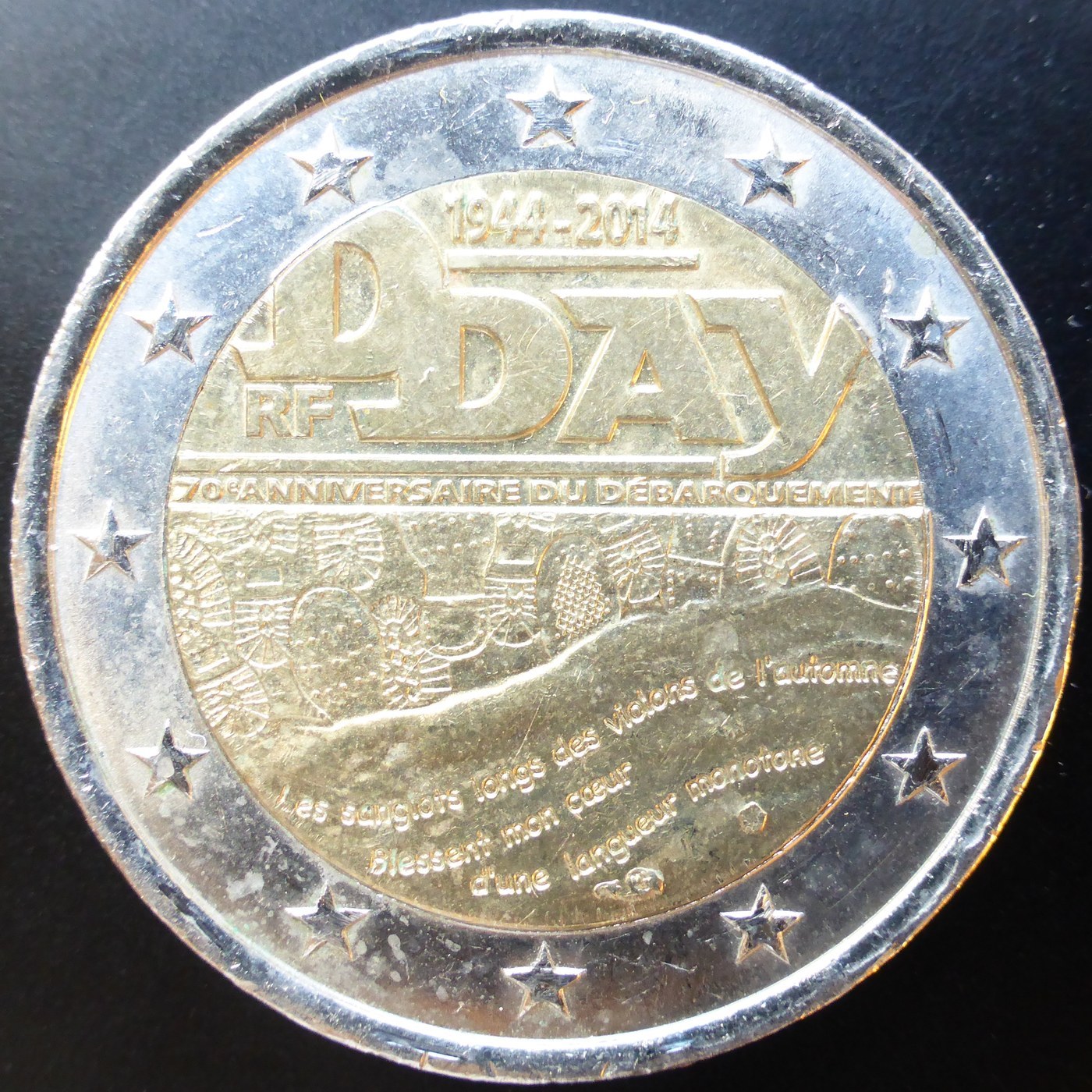
Start with the format. This is a standard 2 euro coin: bi-metallic, about 25.75 mm in diameter and roughly 8.5 g, with a pale cupronickel-coloured outer ring around a golden-toned centre and a lettered edge. If the piece is the wrong size, single-metal, or magnetic throughout, it is not a genuine 2 euro coin.
Read the national side. The defining features are the inscription “70e ANNIVERSAIRE DU DÉBARQUEMENT”, the paired dates 1944-2014, and the D-Day commemorative imagery. Also look for the RF monogram (République Française) and the small mint marks — these identify the coin as the French 2014 issue rather than a commemorative from another eurozone country.
Check the common side and the stars. The reverse is the ordinary “2” and map-of-Europe design shared by all 2 euro coins, ringed by twelve EU stars; the national side is likewise bordered by stars. Because the common side is identical across the eurozone, always identify from the D-Day legend and dates, not the map side.
Rule out look-alikes. Many countries issue 2 euro commemoratives each year with the same shape, size, and star border, so the coin can be confused with other national themes at a glance. The French D-Day legend, the 1944-2014 dates, and the RF mark together separate this issue from all other 2 euro types. Distinguish ordinary circulation strikes from mint-packaged coincard, BU, or proof versions, which affect value.
Authenticate with care. Verify diameter, weight, and the two-tone bi-metallic construction, and inspect the edge lettering and the crispness of the inscription. Counterfeit 2 euro coins exist because of the denomination's value; sharp, well-defined lettering and correct physical specs are reassuring, and anything offered at a large premium in special packaging is worth checking against reference images or a specialist opinion.
Frequently asked questions
How do I tell this from another country's 2 euro commemorative?
All 2 euro commemoratives share the size, bi-metallic build, and star border, so read the national side: this one carries “70e ANNIVERSAIRE DU DÉBARQUEMENT,” the 1944-2014 dates, and the French RF mark.
What are the quickest authenticity checks?
Confirm the roughly 25.75 mm diameter and about 8.5 g weight, the two-tone bi-metallic construction with a lettered edge, and sharp, evenly formed lettering; wrong specs or a single metal indicate a fake or a non-euro token.
Does the finish change how I identify it?
Yes. The same design exists as circulation strikes and as mint-issued coincard, BU, and proof versions; proofs have mirror fields and frosted devices, which affects grade and value and should be noted when identifying a piece.