
How to Identify the Five Guineas of Anne
A collector's guide to recognizing Queen Anne's gold Five Guineas by its left-facing portrait, the VIGO mark, crowned shields, large size, and edge inscription.
Read the full Five Guineas of Anne encyclopedia entry →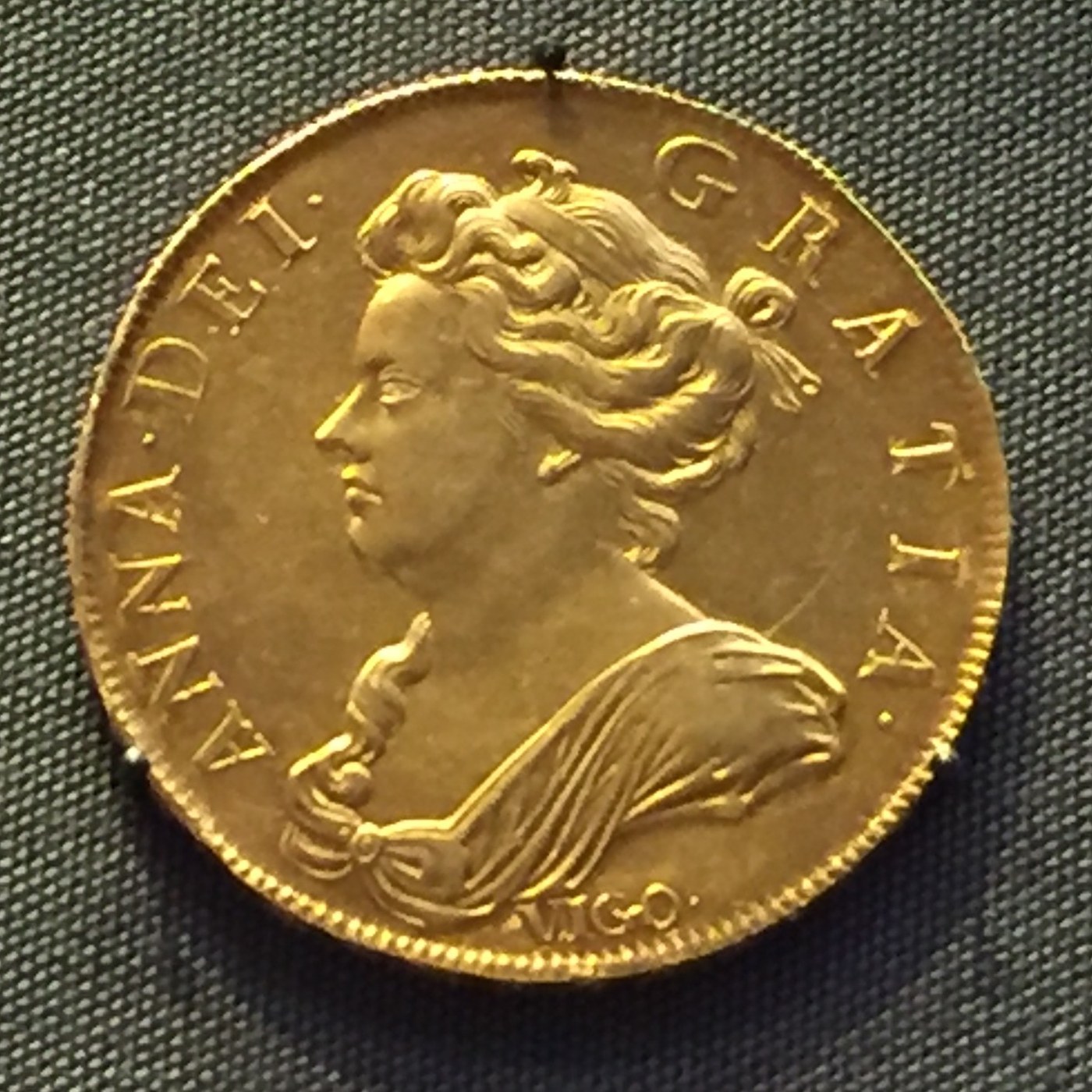
Start with the portrait and the VIGO mark. The obverse shows Queen Anne facing left, draped, within a Latin legend naming her queen, and on this issue the word VIGO sits directly below the truncation of the bust. That VIGO inscription is the first thing to confirm, since it identifies gold captured at Vigo Bay and separates this celebrated coin from ordinary non-VIGO five-guinea pieces of the reign.
Read the reverse carefully. Look for crowned shields bearing the royal coats of arms set in a cross (cruciform) pattern with scepters in the angles, all within a Latin legend. On the 1703 pre-Union coinage the shields show the separate arms of England, Scotland, Ireland, and France; a post-Union arrangement of the impaled English and Scottish arms indicates a later date and therefore not the VIGO issue.
Assess size, metal, and edge. The Five Guineas is a large, heavy gold coin, the biggest gold denomination of the reign, so weigh and measure the piece and compare it against published specifications to separate it from the smaller guinea, half-guinea, and two-guinea pieces. As a milled coin it should have a regular round flan and, typically, an inscribed edge rather than a plain or merely grained one; the edge lettering is an important authentication feature.
Watch for look-alikes. Plain five-guinea pieces of Anne without VIGO, and five guineas of other monarchs such as Charles II, William III, or George I, share the large module and cruciform-shield reverse. The combination of Anne's left-facing bust, the VIGO inscription, and the 1703 date is what pins the coin to this specific and much rarer issue.
Authenticate with care. Because the VIGO Five Guineas is famous and enormously valuable, cast copies, electrotypes, and modern replicas are common. Watch for casting seams, bubbles, soft or mushy detail, incorrect weight or diameter, a wrong or missing edge inscription, and VIGO lettering that lacks the crispness of machine-struck work. For any coin of this stature, seek an opinion from a specialist in English milled gold or a reputable grading service before purchase.
Frequently asked questions
Which side is the obverse?
The side with the left-facing draped portrait of Queen Anne, the Latin royal legend, and the VIGO inscription below the bust is the obverse. The crowned shields of arms arranged in a cross with scepters between them is the reverse.
How do I know it is the VIGO issue and not a plain Anne Five Guineas?
Look for the word VIGO below the truncation of the bust and confirm the 1703 date in the design. Five-guinea pieces of Anne without that mark are the ordinary issues and are far less rare and valuable than the VIGO coin.
How do I tell the Five Guineas from a single guinea?
By size and weight. The Five Guineas is much larger and heavier than the guinea, half-guinea, and two-guinea pieces. Weigh and measure the coin against published specifications, since the designs are related but the modules differ.
Why does the edge matter for authentication?
As a milled coin, the Five Guineas normally carries an inscribed edge. A plain, wrong, or poorly formed edge, together with off specifications for weight and diameter or weak VIGO lettering, is a warning sign that a piece may be a copy.