
How to Identify the Connecticut Tercentennial Half Dollar
A collector's checklist for confirming a 1935 Connecticut Tercentennial half dollar — the Charter Oak, standing eagle, silver specs, and authentication cautions.
Read the full Connecticut Tercentennial Half Dollar encyclopedia entry →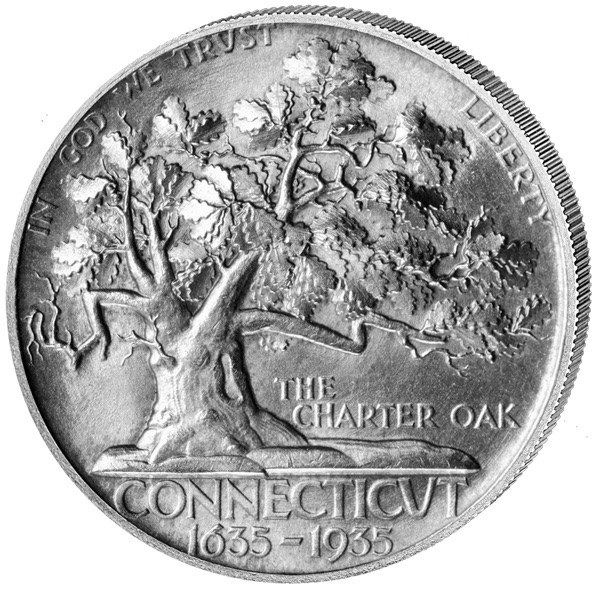
Start with the reverse, which is the fastest identifier. A genuine Connecticut Tercentennial Half Dollar shows a large, spreading oak tree — the Charter Oak — with the anniversary dates 1635 and 1935 and lettering naming the Connecticut tercentennial. No circulating half dollar of the 1930s carries a tree design, so this alone separates it from the Walking Liberty half dollars of the same period.
Check the obverse next. It depicts a standing American eagle in profile with folded wings, executed in the restrained, shallow relief typical of 1930s medallic sculpture. Together the standing eagle and the Charter Oak confirm the type; if either side shows a Liberty figure or Liberty head, you are looking at a different coin.
Verify the physical specifications. The coin is a standard half dollar: roughly 30.6 mm in diameter, about 12.5 grams, struck in 90% silver with a reeded edge. A calibrated scale and calipers are the best tools here — a piece that is off in weight, diameter, or edge reeding for a silver half dollar is a warning sign. The metal should show the color and luster of 90% silver, not a plated or off-color surface.
Expect no mint mark. Every genuine example was struck at Philadelphia in 1935, so the absence of a mint mark is normal. Any Connecticut Tercentennial half dollar bearing a mint mark or a date other than 1935 should be treated as suspect.
Be cautious with authentication, since desirable commemoratives are targets for counterfeits and for cleaning or artificial toning that inflates apparent grade. Watch for mushy or doubled lettering, weak detail in the oak's branches, incorrect weight, or a color that does not match 90% silver. For any higher-value purchase, rely on reputable dealers and third-party grading (PCGS, NGC) rather than eye appeal alone.
Frequently asked questions
What is the quickest way to identify this coin?
Look at the reverse for the Charter Oak tree with the dates 1635–1935. That tree design does not appear on any circulating half dollar of the era and is the surest single identifier.
Should there be a mint mark?
No. The coins were struck only at the Philadelphia Mint in 1935, so a genuine example has no mint mark. A mint mark or a different date is a red flag.
How can I tell it apart from a 1935 Walking Liberty half dollar?
The Walking Liberty shows a full striding Liberty figure on the obverse and a perched eagle on the reverse. The Connecticut commemorative instead has a standing eagle on the obverse and the Charter Oak tree on the reverse.
How do I confirm it is genuine silver?
Check the specs: about 30.6 mm, roughly 12.5 grams, 90% silver, reeded edge. Off weight, wrong diameter, missing edge reeding, or an unnatural color are warning signs; use third-party grading for valuable pieces.