
How to Identify the Colombian 8 Escudos Gold (Popayán)
A visual guide to Colombia's large gold 8 Escudos struck at the Popayán mint, identified by its Liberty-cap or bust obverse, condor/mountain reverse, and 'P' mintmark.
Read the full Colombian 8 Escudos Gold (Popayán) encyclopedia entry →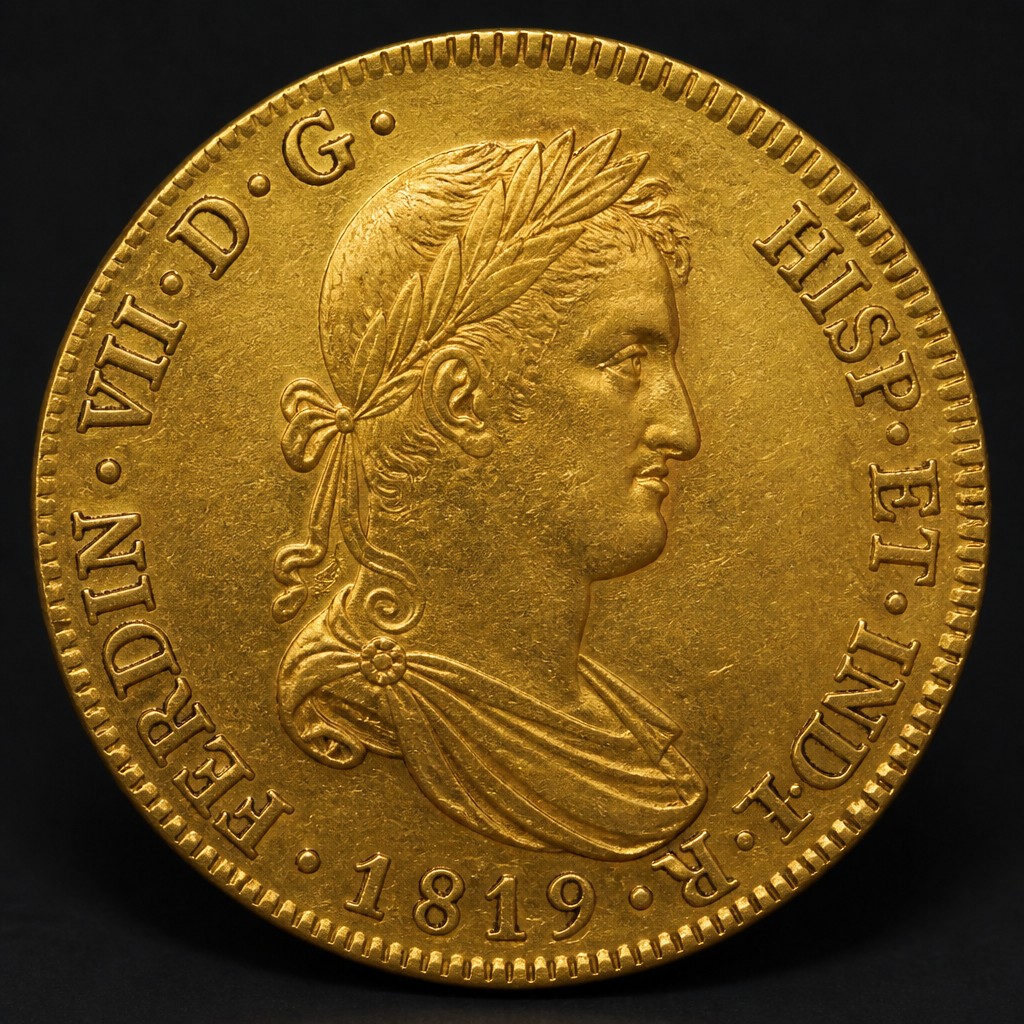
What It Is
The 8 Escudos was the largest gold denomination struck in colonial and early-republic Colombia (then New Granada). Coins from the Popayán mint, in southwestern Colombia, are especially prized because that mint operated continuously from the Spanish colonial period into the early Republic, producing both royal bust types and later republican "cap and rays" designs. These are heavy, hand-struck gold pieces meant for major commerce and reserves, not everyday change.
Obverse Design
Colonial-era pieces show a right-facing bust of the reigning Spanish king (Charles III, Charles IV, or Ferdinand VII) with a Latin legend naming the monarch and the date. Republican pieces, struck after independence, instead show a radiant Liberty cap on a pole (the Phrygian cap of liberty) within a wreath, with a legend such as "LIBERTAD" and the date below.
Reverse Design
Colonial reverses carry the crowned Spanish arms flanked by the Pillars of Hercules with a "PLUS ULTRA" banner. Republican reverses typically show a mountain landscape with a soaring condor, or a shield design, encircled by the country name (such as "REPUBLICA DE LA NUEVA GRANADA" or later "ESTADOS UNIDOS DE COLOMBIA") and the denomination "8 ESCUDOS."
Size, Weight, and Metal
These are large gold coins, roughly 36-37 mm in diameter and about 27 grams, struck in high-fineness gold (commonly around .875-.900 fine depending on era). The edge is typically plain or lightly engrailed on hand-struck examples.
Mint Marks and Assayer Initials
Look near the base of the design, usually below the bust or arms, for a small "P" (for Popayán) paired with one or two assayer initial letters. These small letters are essential for confirming the mint and are often the first detail worn away on a circulated coin, so examine that area under magnification.
Telling It Apart From Similar Coins
Popayán 8 Escudos can be confused with 8 Escudos from other South American mints such as Bogotá (mintmark "NR") or Peruvian and Chilean gold onzas of similar size and weight. The design style, legend wording, and mintmark letters are the key differentiators—compare the exact lettering and mint abbreviation rather than relying on overall appearance alone.
Judging Condition
Because these coins were hand-struck on irregular planchets, weak striking in the centers is common even on lightly worn examples and is not automatically a sign of heavy circulation. Focus instead on the high points—the cap, the bust's cheek and hair, or the condor's breast—for actual wear, and check that the legend and date remain fully legible.
Authenticity Red Flags
Because of their gold content and rarity, these coins are frequently targeted for fakes. Warning signs include incorrect diameter or weight, a suspiciously bright or overly yellow color inconsistent with period gold alloys, soft or mushy design details from cast reproductions, and mintmark letters that look added, re-cut, or oddly spaced compared to reference examples. A coin that is noticeably lighter or heavier than the expected weight for its stated denomination should be examined closely before assuming it is genuine.
Frequently asked questions
How do I know a gold 8 Escudos is from Popayán and not another mint?
Look for a small "P" mintmark near the base of the design, alongside one or two assayer initials; other mints used different letters such as "NR" for Bogotá.
What's the difference between colonial and republican 8 Escudos?
Colonial coins show a Spanish king's bust and crowned arms with pillars; republican coins show a Liberty cap or a condor-and-mountain design with republic-era legends.
How heavy is a genuine 8 Escudos?
It should weigh about 27 grams and measure roughly 36-37 mm across; significant deviation from this suggests a copy.
Why is the strike often weak in the center?
These coins were hand-struck on irregular planchets with screw presses, so a soft central strike is normal and not necessarily a sign of wear or a fake.