
How to Identify the Central American Republic 8 Reales
A collector's checklist for the silver Central American Republic 8 reales: the sun-and-mountains and tree designs, size, legends, mints, and authentication cautions.
Read the full Central American Republic 8 Reales encyclopedia entry →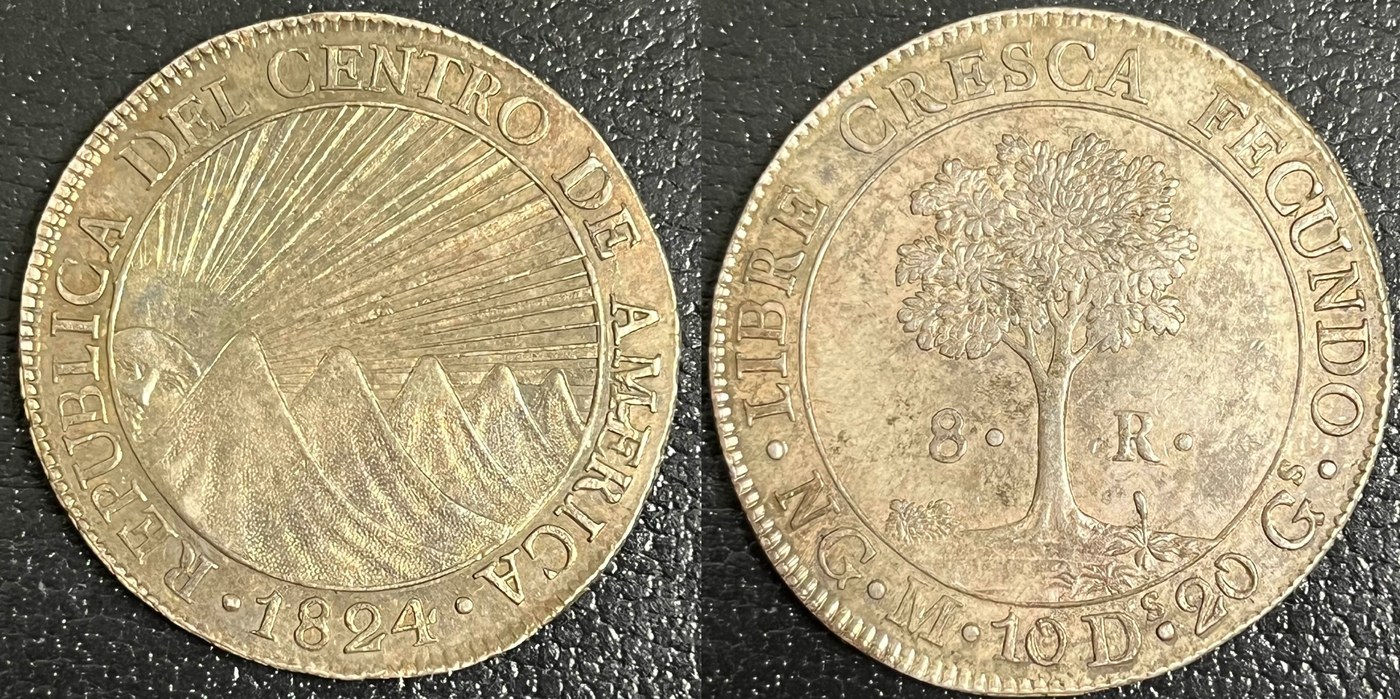
Begin with the two central designs, because together they identify the type at a glance. One side shows a rising sun with spreading rays over a range of mountains, encircled by the legend REPUBLICA DEL CENTRO DE AMERICA. The other side shows a tree, accompanied by the denomination and the date. If a large silver coin carries both the sun-over-mountains motif and the tree with that legend, you are almost certainly looking at a Central American Republic 8 reales.
Read the legends and the date carefully. The REPUBLICA DEL CENTRO DE AMERICA inscription confirms the issuing federation and separates the coin from later national issues of individual Central American countries that reused similar imagery. Locate the year, here 1824, and the 8 reales value, which together pin the coin to a specific issue within the federation series.
Check the physical characteristics. This is a silver, crown-sized coin on the standard 8 reales module inherited from Spanish colonial coinage, so it should feel substantial and measure noticeably larger than minor reales fractions. Weigh and measure it and compare against published figures for the type; a piece markedly off in diameter, weight, or the ring of genuine silver deserves closer scrutiny. Early coins were hand-struck, so expect some irregularity of strike and centering rather than machine-perfect uniformity.
Look for mint marks and assayer initials in the fields or legends. Federation 8 reales were struck at more than one mint across the 1820s to 1840s, and the mint, date, and assayer combination is central to attribution and value. Small differences in the mountains, the sun's rays, the tree, and the lettering distinguish issues, so match these against a specialist reference rather than assuming all similar coins are identical.
Be cautious about authenticity. Because this is a desirable silver type, it attracts counterfeits and alterations. Watch for cast copies with seam lines, grainy or bubbled surfaces, and soft, mushy lettering; for coins whose weight or diameter is wrong; and for added or re-cut mint marks or dates meant to imitate a scarcer issue. When value or surfaces raise any doubt, seek an opinion from a specialist in Latin American coinage or submit the coin for third-party authentication.
Frequently asked questions
What is the fastest way to confirm this is a Central American Republic 8 reales?
Check both sides: a rising sun with rays over mountains and the legend REPUBLICA DEL CENTRO DE AMERICA on one, and a tree with the 8 reales denomination and date on the other. On a large silver coin, that combination identifies the type. Then read the date and mint marks.
How do I tell it apart from later national coins with similar imagery?
Individual Central American countries later reused sun, mountain, and tree motifs, so the imagery alone is not enough. Rely on the REPUBLICA DEL CENTRO DE AMERICA legend and the 8 reales denomination to confirm it is a federation issue rather than a later single-nation coin.
Does the mint and date matter for identification?
Yes. Federation 8 reales were struck at more than one mint across roughly the 1820s to 1840s, and the mint, date, and assayer combination determines the exact issue and affects scarcity. Match the marks and design details to a specialist reference.
How can I spot a fake or altered coin?
Look for casting seams, grainy or bubbled surfaces, soft lettering, and a weight or diameter that does not match published figures for the silver crown. Watch for added or re-cut mint marks and dates. If in doubt, have the coin authenticated by a specialist or grading service.