
How to Identify the Capped Bust Quarter
A collector's checklist for the Capped Bust Quarter: reading the cap-and-eagle design, confirming size and silver, and spotting look-alikes and fakes.
Read the full Capped Bust Quarter encyclopedia entry →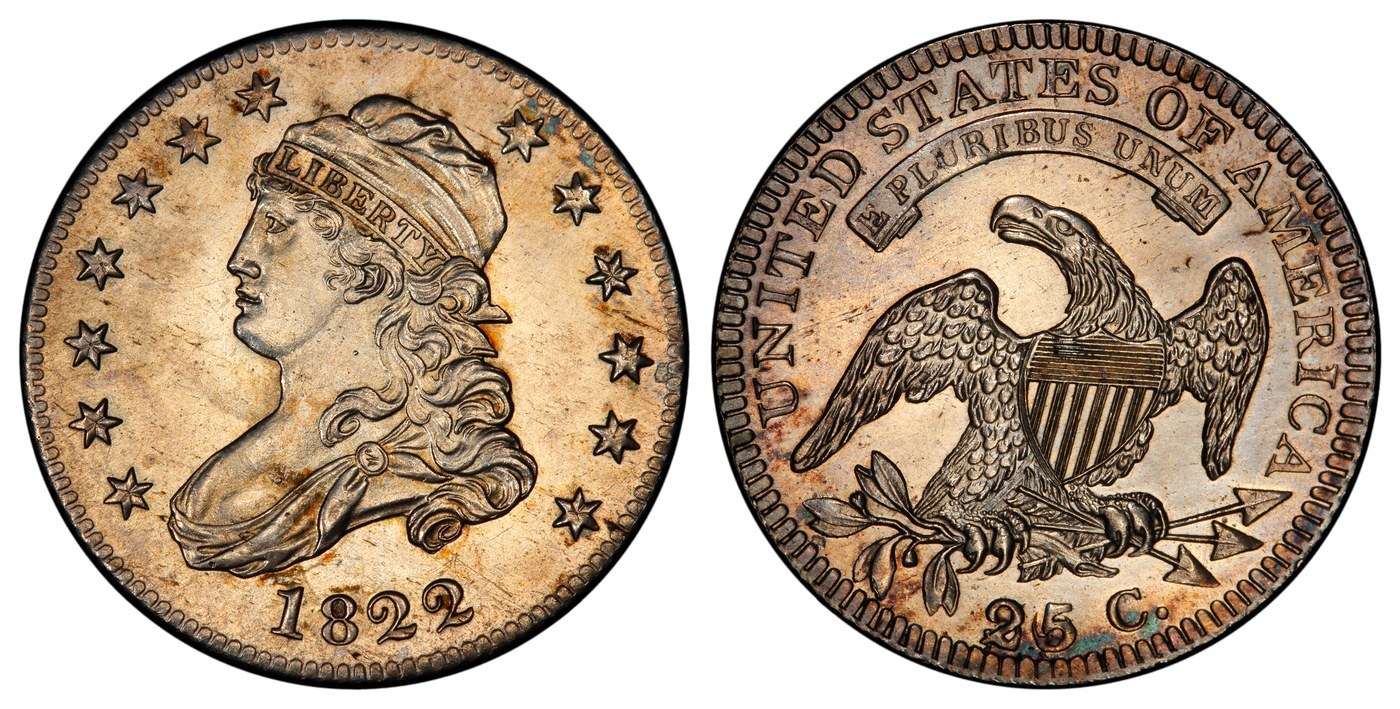
Begin with the defining design. The obverse must show Liberty facing left in a soft cloth cap, the cap band lettered LIBERTY, with loose curls falling to the shoulder and stars around the border above a four-digit date. The reverse must show a bald eagle with a striped shield across its breast, clutching an olive branch and arrows, with UNITED STATES OF AMERICA and the denomination shown as '25 C.' The pictured coin is dated 1822 and, as a large-size piece, carries a scroll reading E PLURIBUS UNUM above the eagle.
Next check the physical coin. It is silver, not copper or nickel, with a reeded edge. Large-size quarters (1815–1828), including this 1822, measure about 27 mm and weigh near 6.7 grams; small-size quarters (1831–1838) are smaller at roughly 24.3 mm and drop the E PLURIBUS UNUM motto. Genuine surfaces show soft gray toning. If a supposed Capped Bust quarter is bright white, unnaturally sharp, or has a seam around the rim, treat it with caution.
Use size and denomination to rule out neighbors. The same capped-bust obverse and shield-eagle reverse also appear on the half dime, dime, and half dollar, so confirm the '25 C.' legend and the roughly 27 mm (large) or 24 mm (small) diameter to be sure you have the quarter rather than the smaller dime or the larger half dollar. On the following series, the Seated Liberty quarter (from 1838) shows a full seated Liberty, not a capped bust, which quickly separates the two types.
Do not hunt for a mint mark. All Capped Bust quarters came from Philadelphia and carry none, so an absent mint mark is expected. Identification instead rests on the date, the star arrangement, the '25 C.' denomination, and—for specialists—the specific die marriage. The 1822 in particular is known for a dramatic 25/50 C. denomination error, where the die was first cut with the wrong value, so examine the denomination closely on that date.
Finally, weigh authentication risk. Early silver quarters are counterfeited, cast, and sometimes altered from other dates, and cleaning is common. Because die varieties and condition can swing the value dramatically, have any coin you believe to be scarce or high-grade authenticated and graded by a reputable third-party service before buying or selling.
Frequently asked questions
What size and weight should a Capped Bust Quarter be?
Large-size coins (1815–1828) are about 27 mm across and weigh roughly 6.7 grams in about 89 percent silver, with a reeded edge. Small-size coins (1831–1838) are smaller, near 24.3 mm.
Where is the mint mark on a Capped Bust Quarter?
There is none. Every Capped Bust quarter was struck at the Philadelphia Mint, which used no mint mark, so you should not expect to find one.
How do I tell the quarter from the similar dime or half dollar?
They share the capped-bust obverse and shield-eagle reverse, so use size and the denomination. The quarter reads '25 C.' and measures about 27 mm (large size), larger than the dime and smaller than the half dollar.
What are the main authentication concerns?
Cast or struck counterfeits, altered dates, and harsh cleaning are all common on early silver. Because varieties and grade heavily affect value, valuable examples should be certified by a recognized grading service.