
How to Identify the Canadian Colored Maple Leaf
The Canadian Colored Maple Leaf is a Royal Canadian Mint silver or gold bullion coin featuring the classic maple leaf design enhanced with applied color printing on select thematic issues.
Read the full Canadian Colored Maple Leaf encyclopedia entry →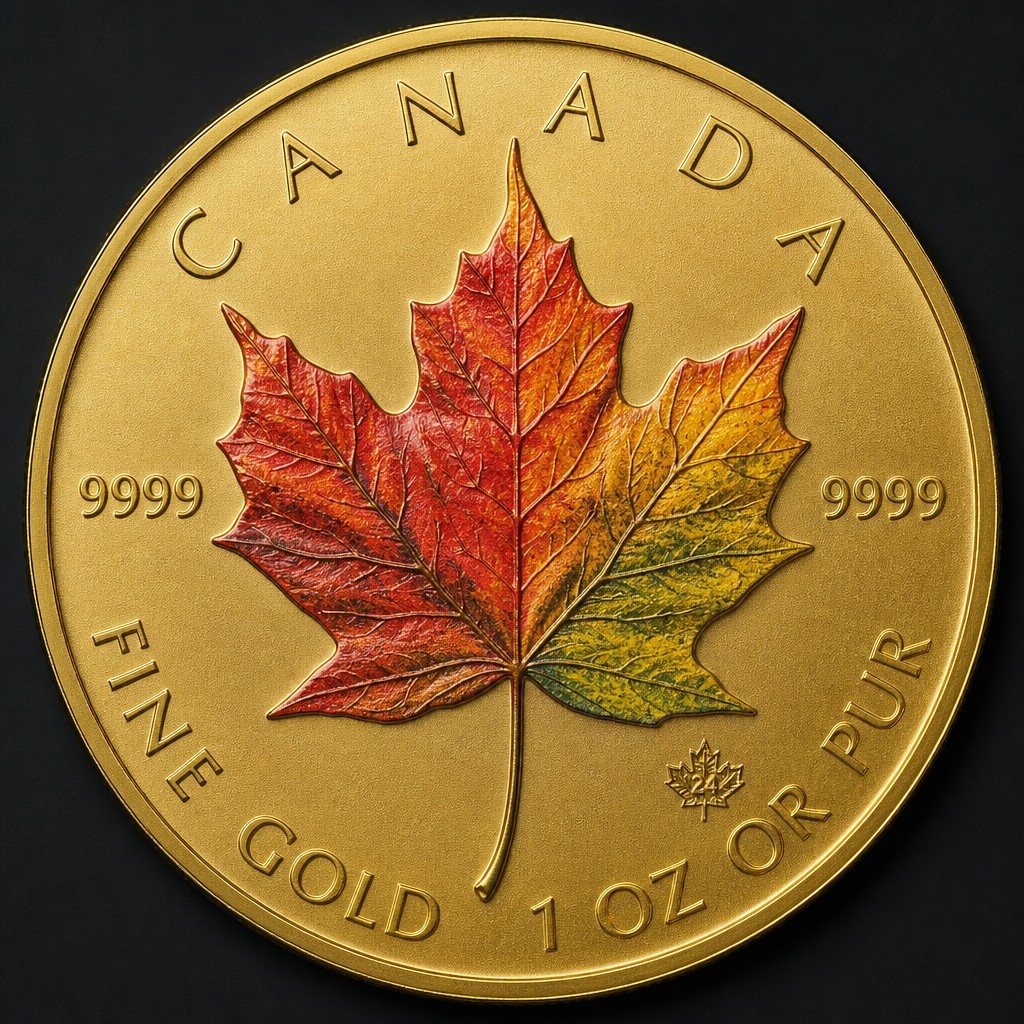
What It Is
The Canadian Colored Maple Leaf refers to special editions of the Royal Canadian Mint's Maple Leaf bullion coin series in which part of the design is enhanced with applied color, typically to highlight wildlife, holiday themes, or other decorative motifs layered onto the traditional maple leaf reverse. The standard uncolored Maple Leaf debuted in 1979 in gold and 1988 in silver, and colorized versions have since become a popular way for the mint to offer variety within the long-running series.
Obverse Design & Inscriptions
The obverse carries the official Canadian coinage portrait of the monarch, historically Queen Elizabeth II and more recently King Charles III, along with the coin's face value and the word "CANADA." This side is generally left in its standard silver or gold finish without added color.
Reverse Design & Inscriptions
The reverse shows the iconic single maple leaf design that anchors the entire Maple Leaf series, but on colored editions, additional printed artwork, such as an animal, flower, or holiday image, is added around or incorporated into the leaf. The purity ("9999" for silver, "999.9" for gold) and coin weight are inscribed near the design.
Size, Weight, Metal, and Edge
Most colored Maple Leaf coins follow standard bullion specifications, such as the one-ounce silver coin at 38.1mm diameter, struck in .9999 fine silver, or comparable gold weights in .9999 fine gold. Edges are typically reeded, matching the standard uncolored Maple Leaf coins in the same weight category.
Mint Marks and Where to Find Them
As Royal Canadian Mint products, these coins may carry a small maple leaf privy mark or micro-engraved security mark (introduced on modern Maple Leafs) near the date, which helps confirm authenticity and mint of origin.
Telling It Apart From Similar Coins
Colored Maple Leaf coins are distinguished from standard silver or gold Maple Leafs simply by the visible applied color, but they should not be confused with other countries' colorized bullion coins (like Cook Islands or Niue issues) which use different base designs. The core giveaway is the presence of the maple leaf and Canadian obverse portrait alongside the color artwork, along with the "CANADA" country name that other nations' colorized coins do not carry.
Judging Condition at a Glance
Because color is applied as a separate printing or enamel-like process after striking, condition assessment includes checking that the color remains vivid, evenly applied, and free of scratches, chips, or fading, in addition to the usual bullion-grade checks for bag marks and luster on the uncolored metal areas.
Authenticity Red Flags
Genuine colored Maple Leafs come from official Royal Canadian Mint releases with matching security features found on standard bullion Maple Leafs, including the radial line pattern and micro-laser mark. Be cautious of coins with sloppy or smudged color application, missing security features, incorrect weight, or sellers unable to confirm the coin as an official Mint release rather than an aftermarket colorized coin produced by a third party without Mint authorization.
Frequently asked questions
Is the color on a Colored Maple Leaf coin part of the original strike?
No, the color is typically applied as a separate printing or enameling step after the coin is struck, layered onto the standard maple leaf design.
What metal purity do Colored Maple Leaf coins use?
They generally follow standard Maple Leaf bullion specifications: .9999 fine silver or .9999 fine gold depending on the version.
How do I know a Colored Maple Leaf is genuine and not aftermarket colored?
Official releases are sold directly by or licensed through the Royal Canadian Mint and typically carry the same security features as standard Maple Leaf coins, such as micro-engraved marks.
Does the obverse portrait also have color added?
No, color enhancement is applied to the reverse design; the obverse portrait is left in the coin's natural metal finish.