
How to Identify the Bhutan 500 Ngultrum Commemorative
A collector's guide to Bhutan's 500 ngultrum silver commemorative: the royal portrait, dragon reverse, silver flan, the 2008 date, and authentication tips.
Read the full Bhutan 500 Ngultrum Commemorative encyclopedia entry →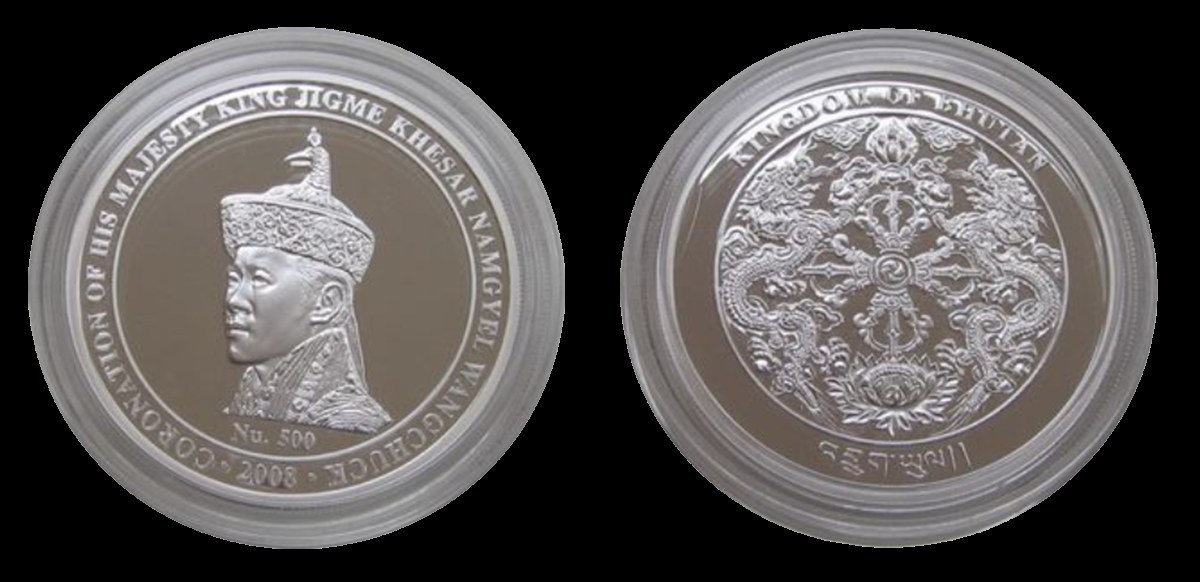
Begin with what the coin is: a modern silver commemorative of the Kingdom of Bhutan denominated 500 ngultrum. Unlike a worn historic coin, a genuine example has the crisp, clean surfaces of a recent strike and is frequently a proof, with mirror-like fields and frosted, raised devices. Many are still housed in a capsule or mint case, so consider any packaging and certificate as part of the identification.
Read the obverse first. It carries a portrait of King Jigme Khesar Namgyel Wangchuck, the fifth King of Bhutan, normally with lettering naming the ruler and the kingdom and the date 2008. Confirming the king's name and the 2008 date in the legend is the surest way to place the piece, because it ties the coin to the coronation-era issues of the fifth Dragon King rather than to earlier Bhutanese coinage.
The reverse is the standout feature. Look for an ornate design combining a dragon with a mythical creature, set among stylised clouds and traditional Bhutanese ornament. The dragon is Bhutan's national emblem — the country is Druk Yul, "Land of the Thunder Dragon" — and this dense, decorative dragon motif, together with the 500 ngultrum denomination, distinguishes the coin from the issues of neighbouring India, Nepal, Tibet or China that a newcomer might confuse it with.
Check the physical coin against what a silver commemorative should be. The piece should be non-magnetic silver of the correct diameter and weight for the issue; a coin that is magnetic, off-colour, or noticeably light or heavy for its size warrants caution. Compare the portrait, the dragon reverse and the legends against reference images of the type, since modern commemoratives are precisely made and genuine strikes show sharp, even detail throughout with no soft or blurry passages.
Finally, weigh the authentication risks. Because these are collector coins sold on the world market, be alert to mishandled or cleaned examples, to pieces removed from their original packaging, and to any that do not match the published weight, diameter and design. Handle proofs by the edge to avoid fingerprints, distrust surfaces with casting bubbles or seams, and for a higher-value example rely on the correct specifications and, where possible, third-party certification rather than the face value stamped on the coin.
Frequently asked questions
What is the quickest way to recognise this coin?
Look for a silver piece denominated 500 ngultrum with a portrait of King Jigme Khesar Namgyel Wangchuck and a 2008 date on one side, and an ornate dragon-and-mythical-creature design on the other. That combination identifies the Bhutanese commemorative.
How do I tell it apart from other Himalayan coins?
The named portrait of Bhutan's fifth King, the ngultrum denomination and the distinctive Bhutanese dragon motif set it apart from Indian, Nepali, Tibetan or Chinese coins. Reading the legend for the king's name and "ngultrum" is the clearest check.
Is it normally a proof coin?
Many examples are proofs, with mirror fields and frosted devices, and are often kept in a capsule or mint case. A clean, sharply struck surface is normal for this modern commemorative, so heavy wear would be unusual and worth questioning.
How can I check that it is genuine?
Confirm it is non-magnetic silver of the correct weight and diameter for the issue, with sharp, even detail matching reference images of the type. Be wary of off-weight, magnetic or off-colour pieces and of casting seams or bubbles; for valuable examples seek certification.