
How to Identify the Armenian Silver Noah's Ark
A guide to identifying the Armenian Silver Noah's Ark coin by its Mount Ararat and Ark reverse, Armenian coat-of-arms obverse, and .999 silver purity, with a design that stays largely consistent year to year.
Read the full Armenian Silver Noah's Ark encyclopedia entry →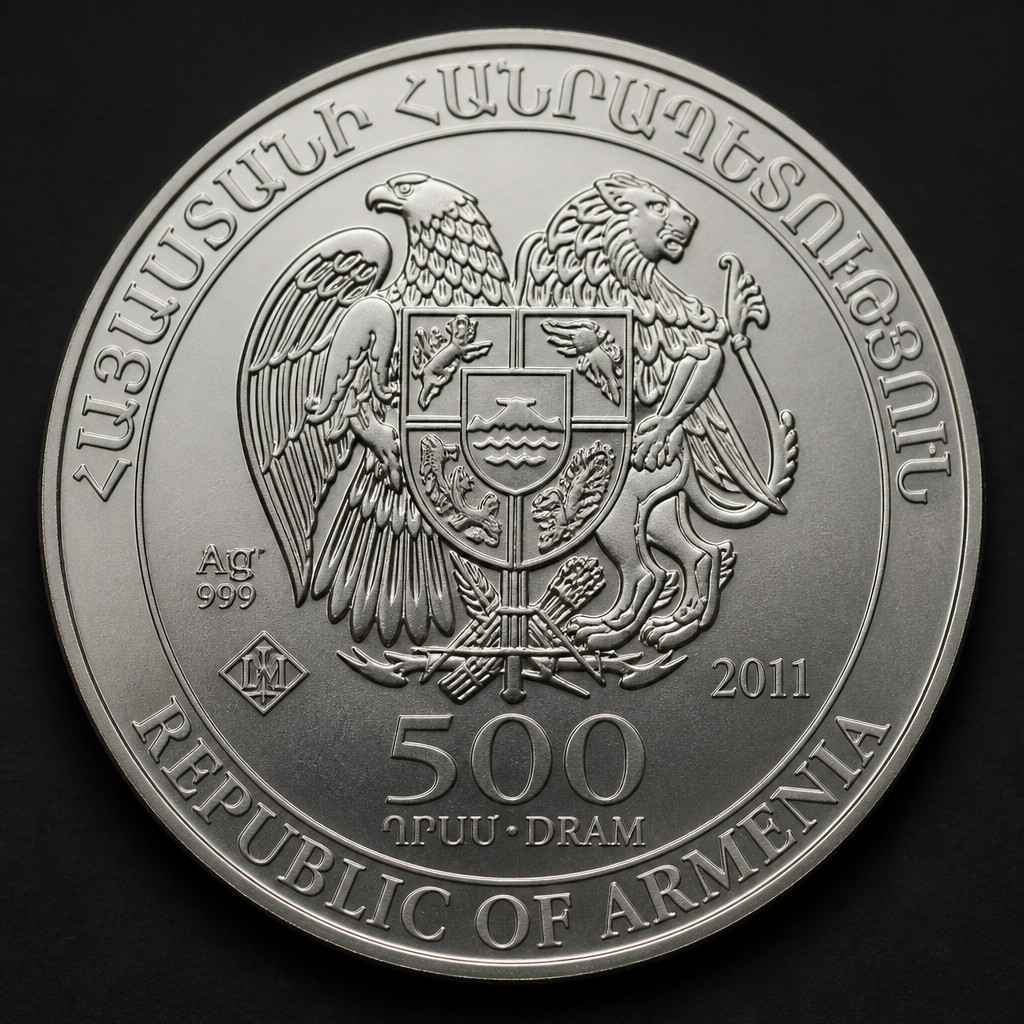
What It Is
The Noah's Ark coin is issued as legal tender of the Republic of Armenia and has been struck since 2011 by the Swiss precious-metals firm Geiger Edelmetalle rather than by a mint located in Armenia itself. Unlike many bullion series that change their artwork every year, the Noah's Ark design has stayed largely consistent from year to year.
Obverse Design
The obverse shows the Armenian coat of arms, an eagle and lion supporting a central shield, along with "REPUBLIC OF ARMENIA" and the coin's face value in Armenian dram.
Reverse Design
The reverse depicts Noah's Ark resting on the twin peaks of Mount Ararat, typically shown with sun rays and a dove, referencing the biblical account associated with the mountain.
Size, Weight, and Metal
The coin is struck in .999 fine silver, issued in a range of sizes from a small 1 oz coin up to larger multi-ounce and kilo formats, with face values scaling accordingly, such as 100 dram for the 1 oz version.
Mint Marks and Where to Find Them
The coin does not carry a mint mark, since it is produced by a single private mint under agreement with Armenia's central bank. Identification instead relies on the consistent Ark and Ararat design, the inscribed year, and matching weight and diameter.
Telling It Apart From Similar Coins
Because the artwork changes little from year to year, dating a Noah's Ark coin depends more on reading the inscribed year than on spotting design variations, which sets it apart from series like the Panda or Kookaburra that rely on yearly artwork changes. Larger official issues are often accompanied by an assay card or certificate from the minting company, which can help confirm the piece's origin.
Judging Condition at a Glance
Look for even satin luster and sharp detail in the mountain peaks, ark outline, and lettering. Silver develops natural toning over time, and handling marks reduce eye appeal without necessarily indicating an authenticity problem. Coins that remain sealed in their original capsule or assay packaging tend to keep a bright, undisturbed surface, while loose coins often pick up light rim dings and fine scratches across the open field around the mountain.
Authenticity Red Flags
Check that weight and diameter match official specifications for the stated size, confirm the coin is not magnetic, and be cautious of a blurred or indistinct strike. For larger bars or coins normally sold with an assay card, a missing or inconsistent card is worth noting, though its absence alone does not prove a coin is fake.
Frequently asked questions
Who strikes the Armenian Noah's Ark coin?
It is produced by the Swiss precious-metals company Geiger Edelmetalle under agreement with Armenia, rather than by a mint inside Armenia.
Does the Noah's Ark design change every year?
No, the design has stayed largely consistent since the series began in 2011, unlike bullion coins that change artwork yearly.
What is shown on the reverse?
Noah's Ark resting on the twin peaks of Mount Ararat, typically with sun rays and a dove.
What purity is the coin struck in?
.999 fine silver.