
How to Identify the American Silver Eagle
A practical guide to identifying the American Silver Eagle bullion coin by its Walking Liberty obverse, heraldic eagle reverse, weight, and counterfeit warning signs.
Read the full American Silver Eagle encyclopedia entry →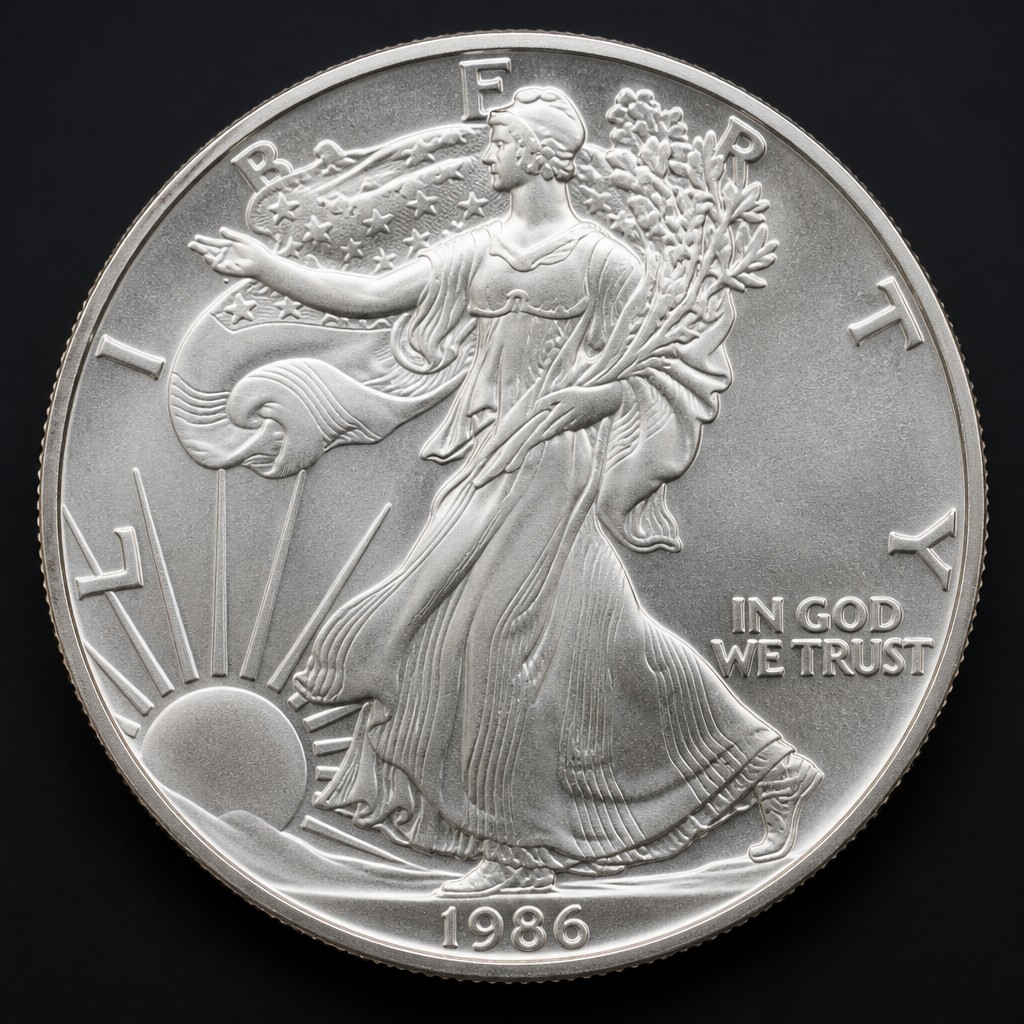
What It Is
The American Silver Eagle is the official silver bullion coin of the United States, first issued in 1986 and produced continuously since, with a face value of one dollar though it trades based on its silver content and collector demand. It is issued in both a standard bullion finish for investors and a proof or specially finished version for collectors, sold directly through authorized Mint channels rather than for general circulation.
Obverse (Front)
The obverse reuses Adolph A. Weinman's Walking Liberty design from the earlier half dollar: a full-length figure of Liberty striding toward the sun with the American flag draped around her, carrying olive branches and oak branches in her arms. "LIBERTY" arcs above, "IN GOD WE TRUST" is to the right, and the date is at the bottom.
Reverse (Back)
From 1986 to 2021, the reverse showed a heraldic eagle with a shield, holding an olive branch and arrows, with thirteen stars above and "UNITED STATES OF AMERICA," "1 OZ. FINE SILVER ONE DOLLAR," and "E PLURIBUS UNUM" around the design. Starting in 2021, a new reverse depicts a close-up eagle's head and neck with a talon grasping an olive branch.
Size, Weight, Metal, and Edge
The coin measures 40.6 mm in diameter, weighs 31.101 grams, and is struck in .999 fine silver. The edge is reeded.
Mint Marks
Most bullion-strike Silver Eagles carry no mint mark, since they are produced without regard to a specific facility being marked; proof and special collector issues do carry a mint mark ("S," "W," or "P" depending on the year and mint) typically found on the obverse, just above the date.
Telling It Apart From Similar Coins
The pre-2021 heraldic eagle reverse and post-2021 eagle head-and-neck reverse are the clearest way to date a coin at a glance without reading the numerals. The Walking Liberty obverse design is shared with the historic 1916-1947 Walking Liberty Half Dollar, but the Silver Eagle is larger, thicker, and marked "ONE DOLLAR" rather than "HALF DOLLAR."
Grading at a Glance
Bullion Silver Eagles are generally valued for their silver content rather than fine condition grading, but look for sharp lines in Liberty's flag drapery and skirt, and crisp feather detail on the eagle, to distinguish a well-struck, lightly handled coin from one with contact marks or wear.
Authenticity Red Flags
Counterfeits are common given the coin's popularity, so check for correct weight and diameter, a proper reeded edge count, and a strong magnetic test result (genuine .999 silver is not magnetic, though a rare-earth magnet should show a distinct slow-drag effect when the coin is tilted on an angled silver surface, unlike a plated fake). A dull, gray, or overly shiny surface, blurry lettering, or design elements that look slightly "off" compared to a known genuine example are common red flags for counterfeit or plated coins. Because the coin is thicker than most historic silver dollars, an example that feels unusually thin or light for its diameter should also be checked carefully.
Frequently asked questions
What changed on the American Silver Eagle in 2021?
The reverse design changed from a heraldic eagle with a shield to a close-up of an eagle's head, neck, and talon holding an olive branch.
Where is the mint mark on a Silver Eagle?
Regular bullion strikes have no mint mark; proof and special collector versions carry a mint mark on the obverse above the date.
How much silver is in an American Silver Eagle?
It contains exactly one troy ounce (31.101 grams) of .999 fine silver.
How can I spot a counterfeit Silver Eagle?
Check the weight, diameter, and edge reeding against genuine specifications, confirm it is not magnetic, and look closely for blurry lettering or design details that differ from an authentic coin.