
How to Identify the American Palladium Eagle
Spot a genuine $25 U.S. Palladium Eagle by its Weinman winged Liberty, olive-branch eagle, and the telltale 'PD .9995' metal marking.
Read the full American Palladium Eagle encyclopedia entry →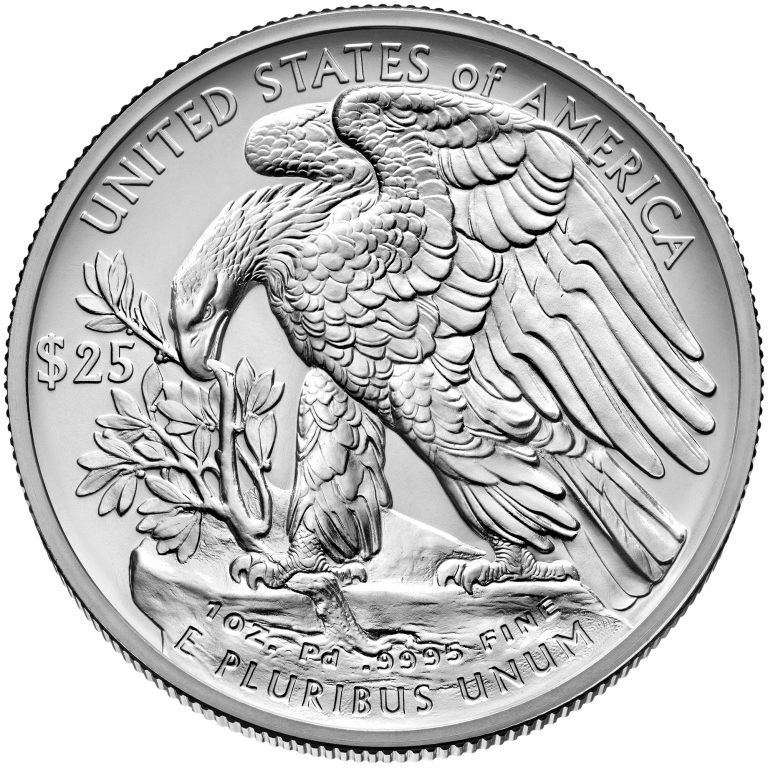
Start with the metal statement. Turn to the reverse and read the legend beneath the eagle: a genuine coin is stamped "1 OZ. PD. .9995 FINE PALLADIUM." The "PD" abbreviation and ".9995" fineness are your single best diagnostic — they immediately separate this coin from the visually similar platinum, silver, or gold Eagles.
Check the two designs together. The obverse shows a left-facing Liberty in a winged cap (Weinman's "Mercury" head) with "LIBERTY," "IN GOD WE TRUST," and the date; the photographed example is dated 2017, the first year of issue. The reverse shows a high-relief eagle with wings spread clutching an olive branch, surrounded by "UNITED STATES OF AMERICA," "E PLURIBUS UNUM," and the "$25" face value. Both motifs are Weinman's, so a coin pairing a heraldic shield-eagle or a Saint-Gaudens Liberty with a palladium claim is not this series.
Confirm the physical specs. The coin is one troy ounce, about 32.7 mm across, with a reeded (grooved) edge. Palladium is a bright silvery-white metal that resembles platinum, but because palladium is much less dense, a genuine one-ounce coin feels distinctly light for its diameter compared with a platinum or gold piece of similar size. A coin that is the right diameter but clearly too heavy, or magnetic, warrants suspicion.
Mint marks and finishes: bullion strikes carry no mint mark, while numbered proof and reverse-proof collector versions from West Point bear a "W." Knowing which finish you have helps set expectations for premium and packaging — proofs normally come in Mint boxes with a certificate.
Authentication cautions: palladium's value makes counterfeits and plated base-metal fakes worth watching for. Weigh the coin (it should be very close to 31.1 g gross for one ounce fine), measure the diameter, and inspect strike sharpness on Liberty's wing feathers. For any high-value or proof piece, third-party grading and authentication (for example by a recognized grading service) is the safest confirmation.
Frequently asked questions
What's the fastest way to tell a Palladium Eagle from a Platinum Eagle?
Read the reverse metal statement: the palladium coin says 'PD .9995,' while the platinum Eagle says 'PT .9995.' The two also use entirely different obverse and reverse designs.
Does the coin have a mint mark?
Plain bullion strikes have no mint mark. Collector proof and reverse-proof issues struck at West Point carry a 'W' mint mark.
Is it magnetic, and does that help authenticate it?
Genuine palladium is not attracted to a magnet. A coin that sticks to a magnet is not solid palladium, though a non-magnetic result alone does not prove authenticity — check weight and diameter too.