
How to Identify the American Gold Buffalo
A guide to identifying the American Gold Buffalo by its Native American obverse, bison reverse borrowed from the 1913 Buffalo nickel, and 24-karat gold purity.
Read the full American Gold Buffalo encyclopedia entry →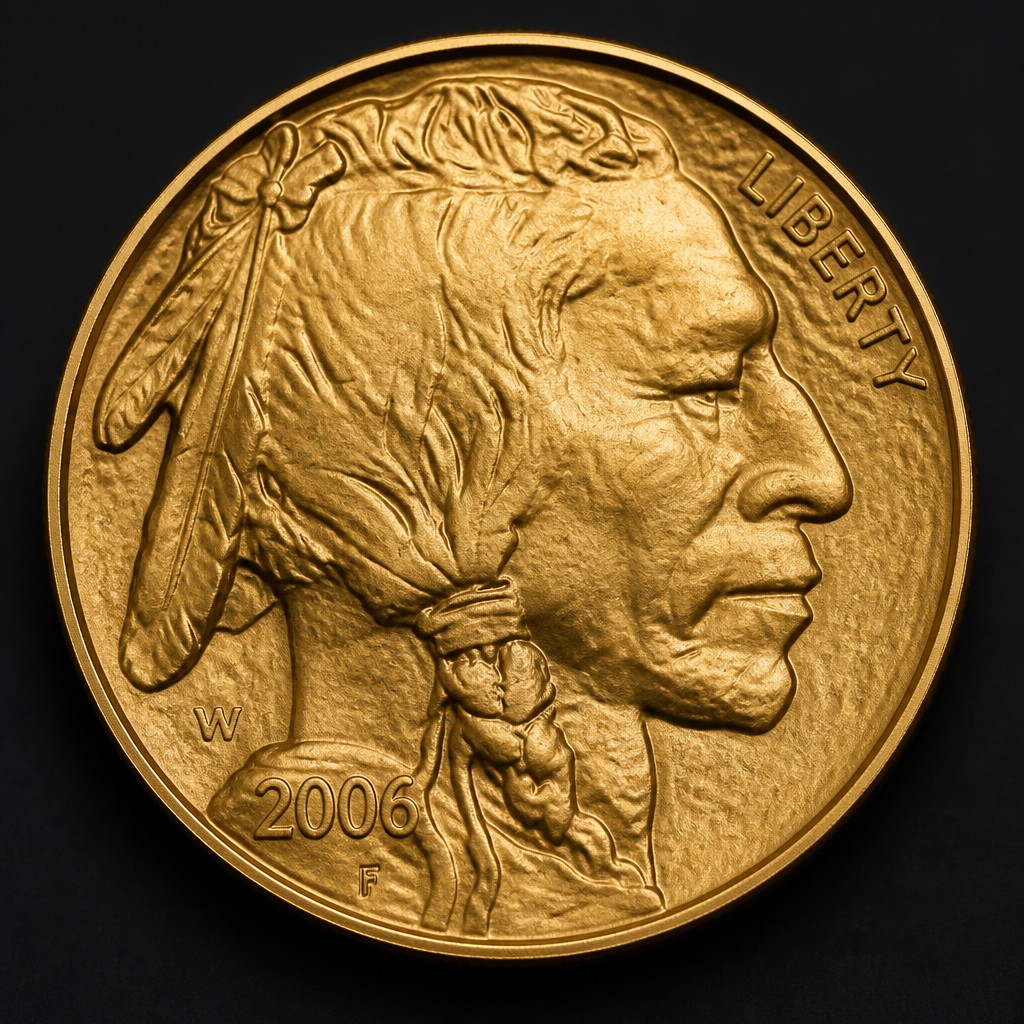
What It Is
The American Gold Buffalo, first issued in 2006, was the United States Mint's first 24-karat gold bullion coin. Its designs are adapted directly from James Earle Fraser's iconic 1913 "Buffalo nickel."
Obverse Design
The obverse shows a right-facing profile of a Native American man, a composite portrait that Fraser said drew on the features of more than one real individual. "LIBERTY" and the date appear alongside the portrait.
Reverse Design
The reverse depicts an American bison (commonly called a buffalo) standing on a mound of earth. "UNITED STATES OF AMERICA," "E PLURIBUS UNUM," the weight and fineness, and the denomination appear around the design.
Size, Weight, and Metal
Gold Buffalos are struck in .9999 fine (24-karat) gold. The standard size is 1 oz with a $50 face value; fractional sizes ($5 for 1/10 oz, $10 for 1/4 oz, and $25 for 1/2 oz) were struck only in 2008 and 2009.
Mint Marks and Where to Find Them
Standard bullion-strike Gold Buffalos carry no mint mark. A "W" mint mark, indicating the West Point Mint, appears only on the special proof and uncirculated collector versions sold directly to collectors, not on the ordinary bullion coins.
Telling It Apart From Similar Coins
The Gold Buffalo shares its designs with the much smaller, thinner five-cent Buffalo nickel, but the two are easily told apart by size, weight, and color. Compared with the American Gold Eagle, which shows a walking Lady Liberty design and is struck in a 22-karat gold alloy, the Gold Buffalo is pure 24-karat gold with a distinct Native American and bison design.
Judging Condition at a Glance
Gold does not tone, so condition is judged by strike sharpness and surface marks. Look at the fine hair detail on the portrait and the texture of the bison's fur and horn for wear or bag marks, keeping in mind that bullion strikes have a duller finish than proof coins. A coin fresh from its original packaging typically shows uniform, undisturbed luster across the field around the bison's mound, while a coin that has circulated through several owners often shows small rim dings and light scuffing on the highest points of the portrait.
Authenticity Red Flags
Confirm the coin's weight and diameter match the stated denomination, check that it is not magnetic, and be cautious of a "W" mint mark appearing on what is claimed to be an ordinary bullion coin, since that mark should only appear on numbered collector issues.
Frequently asked questions
What designs are used on the Gold Buffalo?
Both the obverse Native American portrait and the reverse bison are adapted from James Earle Fraser's 1913 Buffalo nickel design.
What purity is the American Gold Buffalo?
.9999 fine, or 24-karat, gold - the first coin of that purity from the U.S. Mint.
Were fractional-size Gold Buffalos made?
Yes, but only in 2008 and 2009; other years were struck only in the standard 1 oz size.
Why does my Gold Buffalo not have a mint mark?
Ordinary bullion-strike coins carry no mint mark; the 'W' mark for West Point appears only on special proof and uncirculated collector versions.