How to Identify the 500 Yen Japanese Immigration Commemorative
A collector's checklist for the 2008 Japan-Brazil immigration 500 yen: reading the ship and two-figure designs, the Heisei 20 date, and telling it from ordinary 500 yen coins.
Read the full 500 Yen Japanese Immigration Commemorative encyclopedia entry →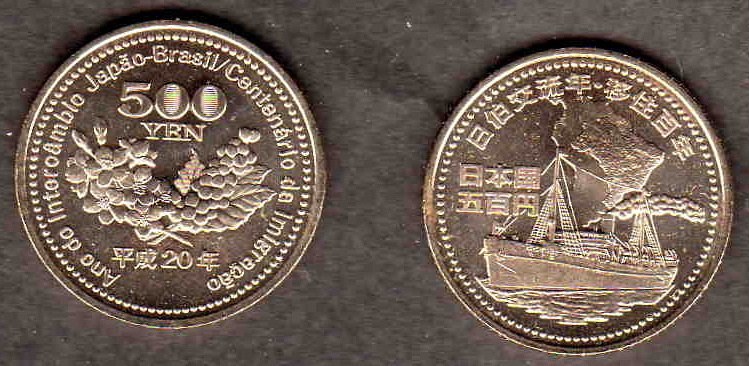
Begin with the pictorial designs, which are the coin's strongest identifier. One face carries two female figures, one pointing or reaching upward; the other carries a ship under sail. Both are surrounded by Japanese inscriptions naming the 100th anniversary of immigration. Together these commemorative scenes distinguish the coin immediately from an ordinary circulating 500 yen piece, which instead shows a paulownia plant and a large numeral.
Read the denomination and era date. The coin is a 500 yen issue dated Heisei 20, corresponding to 2008. Japanese commemoratives use the reign-era dating system, so look for the Heisei year mark rather than a Western date. Confirming both the 500 yen value and the Heisei 20 date pins the coin to this single-year immigration centennial issue.
Check the metal and format. The coin is cupro-nickel, giving it a uniform silvery, non-magnetic base-metal look, and it is close in size and thickness to Japan's standard 500 yen coinage. There is no precious metal involved, so the coin should not be mistaken for a silver or gold commemorative; its interest is in the design, not the alloy.
Watch for look-alikes and mismatches. Do not confuse this with a plain circulating 500 yen coin (no ship, no figures), nor with other Japanese 500 yen commemoratives that use different anniversary scenes. If a piece shows Portuguese text, a Brazilian denomination such as reais, or a Brazilian coat of arms, it is a Brazilian commemorative of the same centennial, not this Japanese coin -- both countries marked the anniversary separately.
Apply basic authentication sense. This is an inexpensive base-metal commemorative, so elaborate forgery is uncommon, but still verify that the weight, diameter, and design details match published specifications for the 2008 issue and that the inscriptions and the ship and figure scenes match verified catalog images. Original mint packaging, where present, supports both identification and condition.
Frequently asked questions
How do I tell this from a regular 500 yen coin?
A standard circulating 500 yen coin shows a paulownia plant and a large 500 numeral. This commemorative instead shows two figures on one face and a ship on the other, with anniversary inscriptions, which is the clearest way to tell them apart.
What year is this coin, and how is the date written?
It is dated Heisei 20, which corresponds to 2008. Japanese coins use the reign-era system, so look for the Heisei year mark rather than a Western-style date to confirm it.
Could this be a Brazilian coin instead of a Japanese one?
Both Japan and Brazil issued coins for the immigration centennial. If the piece shows Portuguese text, a Brazilian denomination like reais, or Brazilian national emblems, it is the Brazilian issue; the Japanese coin reads 500 yen with Japanese inscriptions.
Is it worth having this coin authenticated?
For most examples of this affordable base-metal commemorative, formal authentication is not essential. Verifying the weight, size, and design against published specs and catalog images is usually enough, though grading can help for especially high-grade or packaged pieces.
500 Yen Japanese Immigration Commemorative identified by the community
Recent 500 Yen Japanese Immigration Commemorative coins identified with Coin Identifier.