
How to Identify the 20 Kroner
A collector's guide to confirming Denmark's 1990 Margrethe II 20 Kroner by its crown-over-daisy design, 1940/1990 dates, aluminum-bronze tone, and segmented edge.
Read the full 20 Kroner encyclopedia entry →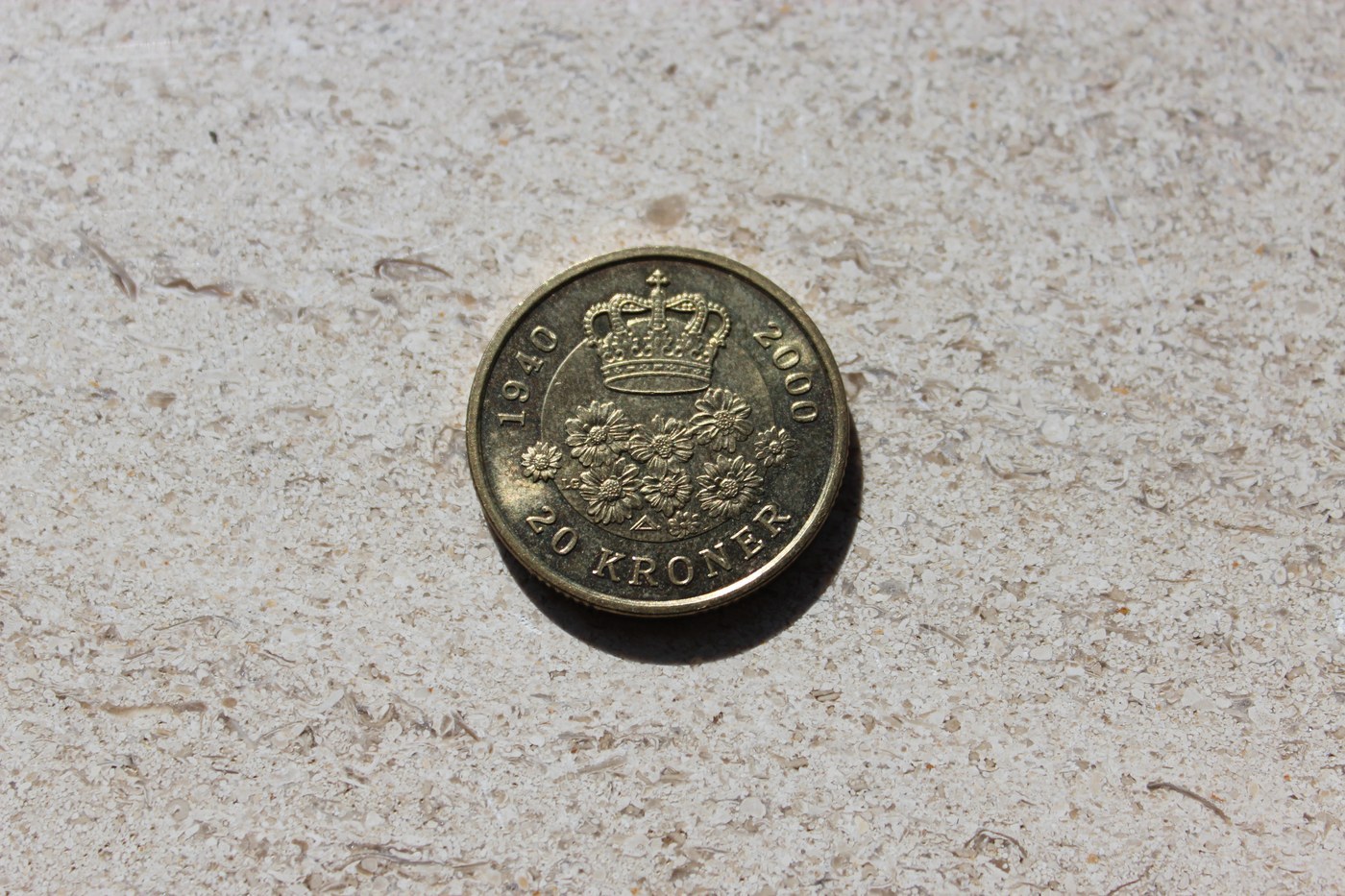
Start With the Design and Dates
The quickest confirmation is a crown set above a marguerite daisy flower, with the paired dates 1940 and 1990 flanking the design and 20 KRONER below. That daisy-and-crown motif with twin dates identifies the 50th-birthday commemorative specifically, as opposed to a standard circulation 20 Kroner carrying a single year and a plain crowned design.
Read Both Faces
One face shows the portrait of Queen Margrethe II with an inscription naming her as Queen of Denmark; the other carries the crown, daisy, dates, and value. If the coin bears the Queen's portrait but shows no daisy and no 1940/1990 date pair, you are likely looking at the ordinary 20 Kroner circulation type rather than this birthday issue.
Confirm Metal, Size, and Edge
The coin is aluminum-bronze, so it has a warm golden-brass tone, not the white color or heft of silver. Expect a mid-size circulating coin roughly 27 mm in diameter and near 9 grams. A useful diagnostic is the edge: this type has a pattern of alternating smooth and reeded segments rather than a fully reeded or fully plain edge, which helps distinguish it at a glance.
Rule Out Look-Alikes
Denmark's standard 20 Kroner circulation coins share the same denomination, metal, and Margrethe II portrait, so do not rely on the portrait or the value alone. Confirm the daisy-over-crown reverse and the 1940/1990 dates before concluding it is the birthday commemorative. Also separate it from Denmark's other base-metal denominations, which differ in size and design.
Authentication Notes
As an inexpensive modern base-metal coin, it is not a common target for high-value counterfeiting, but condition still governs value. Judge the sharpness of the crown, daisy, and portrait, and look for even, original surfaces. Avoid cleaning: polished or wiped coins lose collector value, and undisturbed aluminum-bronze with a natural tone is the most reliable sign of an unaltered piece.
Frequently asked questions
How do I tell this from a standard Danish 20 Kroner?
Look for the crown above a marguerite daisy and the dates 1940 and 1990. The ordinary circulation type shares the Queen's portrait and value but lacks the daisy and the twin birthday dates.
What color and size should the coin be?
It is aluminum-bronze, so it looks golden-brass rather than silver, and it is a mid-size coin about 27 mm across and near 9 grams.
Is the edge a useful clue?
Yes. This type has an edge of alternating smooth and reeded segments, which helps distinguish it from coins with a fully reeded or fully plain edge.
Should I clean the coin before identifying it?
No. Cleaning reduces collector value and can obscure original surfaces. Assess the coin as found, judging design sharpness and the evenness of the natural tone.