
How to Identify the 1999 Delaware State Quarter
The first release in the 50 State Quarters program, honoring Delaware as the first state to ratify the Constitution with a design of Caesar Rodney riding on horseback.
Read the full 1999 Delaware State Quarter encyclopedia entry →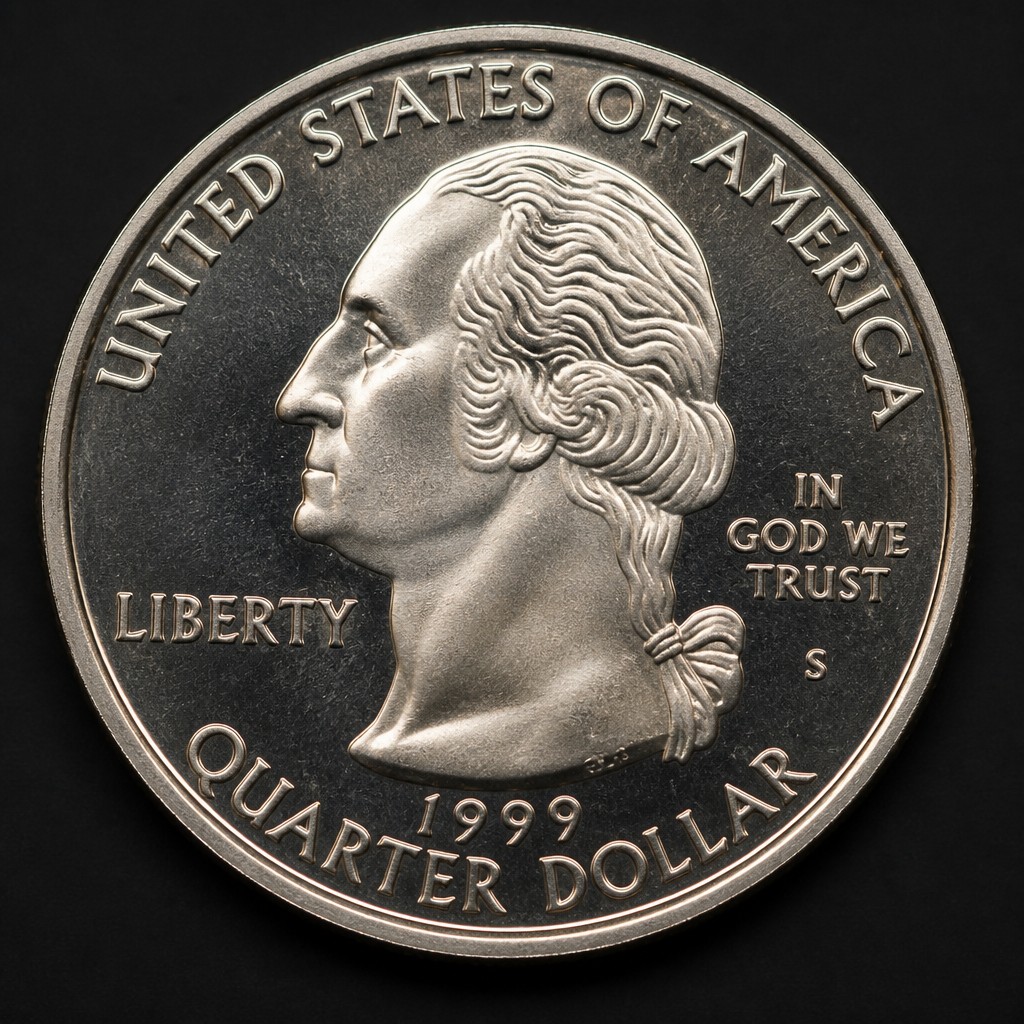
What the Coin Is
The 1999 Delaware quarter launched the United States Mint's 50 State Quarters program, which paired a standard Washington obverse with a new reverse design for each state, issued in the order each state joined the Union. Delaware, the first state to ratify the U.S. Constitution, was fittingly the first design released, kicking off a program that would run for a full decade.
Obverse Design & Inscriptions
The obverse keeps the familiar Washington quarter portrait facing left, updated slightly for the new program, with "UNITED STATES OF AMERICA," "LIBERTY," "IN GOD WE TRUST," and the date "1999" surrounding the portrait, following the same general layout used across every entry in the State Quarters series.
Reverse Design & Inscriptions
The reverse depicts Caesar Rodney riding on horseback, commemorating his famous overnight ride to Philadelphia to cast Delaware's deciding vote for independence in 1776. The design includes "CAESAR RODNEY," "DELAWARE," the phrase "THE FIRST STATE," and "1787," the year Delaware ratified the Constitution, along with "QUARTER DOLLAR" and "E PLURIBUS UNUM," giving the reverse a busy, narrative-driven look compared to earlier quarter designs.
Size, Weight, Metal, Edge
Circulating examples are struck in a copper-nickel clad composition, weigh 5.67 grams, measure 24.3 mm in diameter, and have a reeded edge. Special silver proof versions exist for collectors, struck in 90% silver, and these carry a noticeably heavier weight and different tone than the standard clad issue.
Mint Marks
Look just above the date on the obverse for the mintmark. A "P" indicates Philadelphia, a "D" indicates Denver, and an "S" denotes a San Francisco proof coin not intended for circulation, with each mint producing large quantities for this popular first release.
Telling It Apart From Similar Coins
The Delaware quarter is easily identified by its unique horseback rider reverse and the inscriptions "CAESAR RODNEY" and "THE FIRST STATE," features not shared with any other state design. Confirm the date reads "1999," since the reverse design was used only that year despite the coin depicting an earlier historical date, "1787," within the design itself, a detail that sometimes confuses newer collectors.
Judging Condition at a Glance
As a modern clad coin, wear is usually minimal unless the coin circulated for years; check the horse's legs and rider's details, along with Washington's hairline, for the first signs of wear. Most examples encountered today, especially from mint or bank rolls, remain in high grade, making well-worn specimens somewhat unusual for such a recent issue.
Authenticity Red Flags
Because this is a common modern coin, outright counterfeits are uncommon, but watch for coins with the wrong composition (a silver-colored coin that should be clad, or vice versa) or a mismatched weight, which could indicate a novelty or altered piece rather than genuine Mint production, particularly with items marketed as unusual color or metal variations.
Frequently asked questions
Why was Delaware the first state quarter released?
The program issued designs in the order states ratified the Constitution, and Delaware was the first state to do so.
What is depicted on the reverse?
Caesar Rodney riding on horseback, commemorating his ride to cast Delaware's vote for independence, along with the phrase 'THE FIRST STATE.'
Where is the mintmark located?
Just above the date on the obverse, showing a P for Philadelphia, D for Denver, or S for a San Francisco proof coin.
Is this quarter always made of clad metal?
Circulating versions are copper-nickel clad, though the Mint also issued 90% silver proof versions for collectors.
1999 Delaware State Quarter identified by the community
Recent 1999 Delaware State Quarter coins identified with Coin Identifier.
