
How to Identify the 1975 No S Proof Roosevelt Dime
A guide to identifying the 1975 No S proof Roosevelt dime, an extremely rare die error missing its expected San Francisco mint mark, covering its proof characteristics and how it differs from ordinary dimes.
Read the full 1975 No S Proof Roosevelt Dime encyclopedia entry →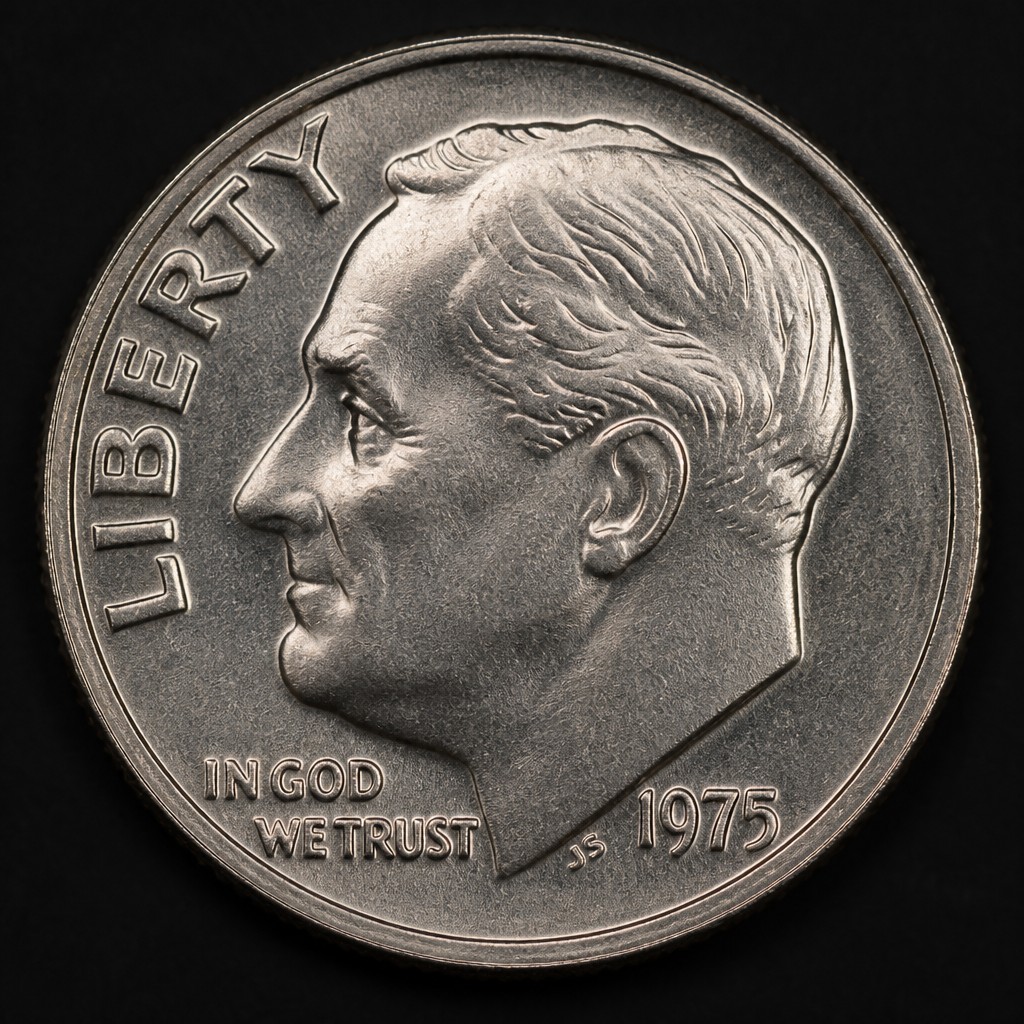
What It Is
Proof dimes from 1975 were meant to be struck at San Francisco and carry an "S" mint mark. A small number of proof dies that year were mistakenly punched without the mint mark, producing the 1975 No S proof dime, one of the most famous rarities of modern United States coinage. It is known only from original 1975 proof sets, which were sold directly to collectors rather than released into circulation.
Obverse Design
The design is the standard Roosevelt profile facing left, with "LIBERTY" above, "IN GOD WE TRUST" to the left, and the date "1975" at the lower right. On this variety, the space where the "S" mint mark should appear, just above the date, is blank rather than showing the expected letter.
Reverse Design
The reverse shows the usual torch flanked by olive and oak branches, with "UNITED STATES OF AMERICA" above and "ONE DIME" below. There is no design difference on the reverse; the missing mint mark issue is only relevant to the obverse, where the mark would normally sit.
Size, Weight, Metal & Edge
It is a standard clad proof dime: 17.9mm in diameter, 2.268 grams, copper-nickel clad over a copper core, with a reeded edge.
Why the Missing Mint Mark Matters
Ordinary Philadelphia and Denver dimes from this era also lack an "S," so a blank mint mark space by itself does not identify this rarity. What matters is that the coin also displays true proof characteristics: deeply mirrored fields, crisply squared rims, and fully struck design details, combined with a documented origin in a sealed 1975 proof set rather than loose circulation.
How to Recognize Genuine Proof Surfaces
Look for a mirror-like reflection in the flat fields around the devices, sharp, high-relief lettering, and complete, well-formed denticles around the rim. A business-strike dime, even one that happens to have no mint mark, will have a duller, satin-like surface and a softer rim compared to a genuine proof coin.
Judging Condition
Proof coins are graded differently from circulated coins, focusing on hairlines, contact marks, and how well the mirrored fields and any cameo frosting on the devices have been preserved, rather than on wear from handling or use.
Authenticity Red Flags
Because of its extreme rarity, any coin represented as a 1975 No S proof dime should be examined very carefully. Watch for a coin that lacks true proof surfaces, which would indicate it is simply an ordinary business strike and not the rarity, or for evidence that an "S" mint mark has been removed or polished away, which would leave telltale disturbance in the surface just above the date. Given the significance and value involved, verification by an established professional grading service is standard practice for any candidate example.
Frequently asked questions
What makes the 1975 No S dime different from a regular dime with no mint mark?
It must show genuine proof surfaces, mirror-like fields and a sharp strike, and originate from a sealed 1975 proof set, not just be missing a mint mark.
Do regular circulation dimes from 1975 also lack an S mint mark?
Yes, Philadelphia and Denver strikes never carry an S, so a missing mint mark alone does not identify this rarity.
How rare is the 1975 No S proof dime?
It is considered one of the rarest modern United States proof coins, known only in a handful of confirmed examples.
How can I verify a suspected example is genuine?
Given its rarity and value, any candidate coin should be examined by an established professional grading service before drawing conclusions.
Where would the S mint mark normally appear?
On the obverse, just above the date, which is the standard mint mark position for proof Roosevelt dimes of this era.