
How to Identify the 1973 RCMP Centennial Dollar
A Canadian commemorative dollar marking 100 years since the founding of the North-West Mounted Police, later the RCMP, featuring a mounted officer on the reverse.
Read the full 1973 RCMP Centennial Dollar encyclopedia entry →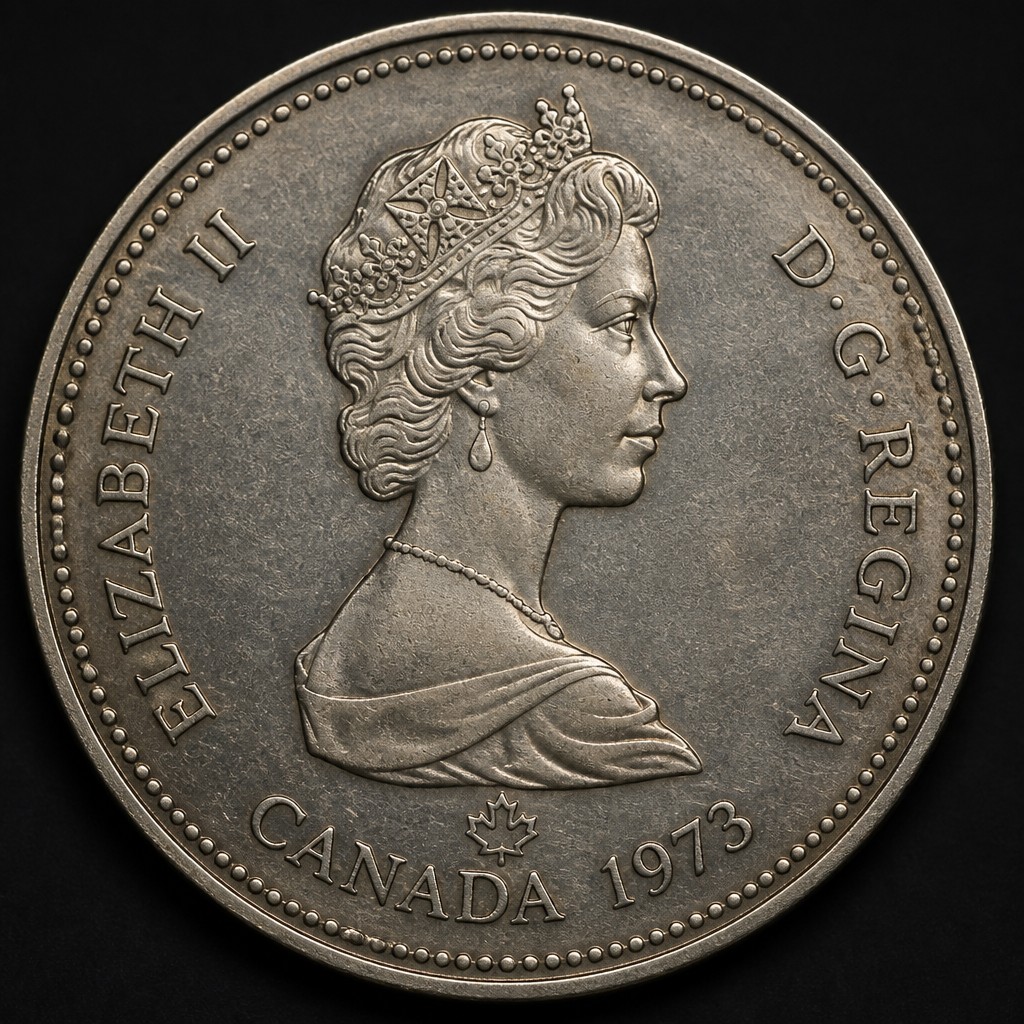
What Is This Coin?
This coin commemorates the 100th anniversary of the founding of the North-West Mounted Police in 1873, the forerunner of today's Royal Canadian Mounted Police (RCMP). It was issued as both a circulating nickel dollar and a collector silver version. The Mountie image is one of Canada's most internationally recognized national symbols, which helped make this a popular commemorative both domestically and among overseas collectors.
Obverse Design
The obverse shows Queen Elizabeth II's portrait from the design series in use during the early 1970s, with the legend "ELIZABETH II DEI GRATIA REGINA" surrounding the bust. This effigy matches other Canadian coins struck in the same short window of years, making it a useful cross-check against other coins from a mixed pocket-change collection.
Reverse Design
The reverse depicts a Mountie in dress uniform riding a horse, a pose closely associated with the RCMP's ceremonial Musical Ride tradition, with the flanking dates "1873" and "1973" and "CANADA" completing the inscription. The mounted figure gives this coin one of the most immediately recognizable designs among Canada's commemorative dollars.
Size, Weight & Metal
Regular circulation strikes are pure nickel, weighing about 15.62 grams with a diameter of roughly 32.13 mm and a reeded edge. As with other early-1970s commemorative dollars, a separate silver version (sold only in collector specimen or proof-like sets) was also produced, offering a brighter finish and different weight from the circulation coin.
Mint Marks & Where to Find Them
No mint mark appears on either version. Distinguishing the nickel and silver types relies on weight, color, and whether the coin is accompanied by original mint packaging rather than any stamped mark.
Telling It Apart From Similar Coins
The mounted officer design is unique to this issue and won't be confused with the maritime scene of the 1971 British Columbia dollar or the abstract floral design of the 1964 Charlottetown-Quebec dollar. The flanking 1873–1973 dates confirm the centennial theme at a glance. Like the 1971 British Columbia dollar, its nickel composition and smaller diameter distinguish it from the older, larger silver dollars minted before 1968.
Judging Condition at a Glance
Wear shows first on the horse's back and the rider's hat and shoulder, along with the queen's hair on the obverse. A coin with crisp, well-defined uniform and horse detail indicates better preservation, while worn coins show a smoothed, less distinct figure. As with other nickel commemorative dollars of the 1970s, look for retained satin-like mint luster in the fields as a sign of light or no circulation.
Authenticity Red Flags
Watch for coins with blurred or indistinct detail in the horse and rider (suggesting a cast counterfeit), incorrect weight, or poorly formed edge reeding. If a coin is offered as the collector silver version, confirm its weight and finish match expectations for that lower-mintage type rather than assuming based on appearance alone. As with other early-1970s commemorative dollars, original mint packaging and documentation add useful supporting evidence when evaluating a silver specimen example.
Frequently asked questions
What does this coin commemorate?
It marks the 100th anniversary of the founding of the North-West Mounted Police in 1873, which later became the Royal Canadian Mounted Police.
What does the reverse design show?
It depicts a Mountie in dress uniform riding a horse, evoking the RCMP's ceremonial Musical Ride tradition, flanked by the dates 1873 and 1973.
Is this coin made of silver?
Regular circulation strikes are nickel; a separate silver version was also issued but only in collector specimen or proof-like sets.
How can I tell the nickel and silver versions apart?
Compare weight and finish — the silver specimen version is typically brighter with a different weight than the duller gray nickel circulation coin.