
How to Identify the 1971-S Eisenhower Silver Dollar (Blue Ike)
The first-year San Francisco silver Eisenhower dollar sold uncirculated in a blue government envelope, nicknamed the 'Blue Ike' to distinguish it from the proof 'Brown Ike.'
Read the full 1971-S Eisenhower Silver Dollar (Blue Ike) encyclopedia entry →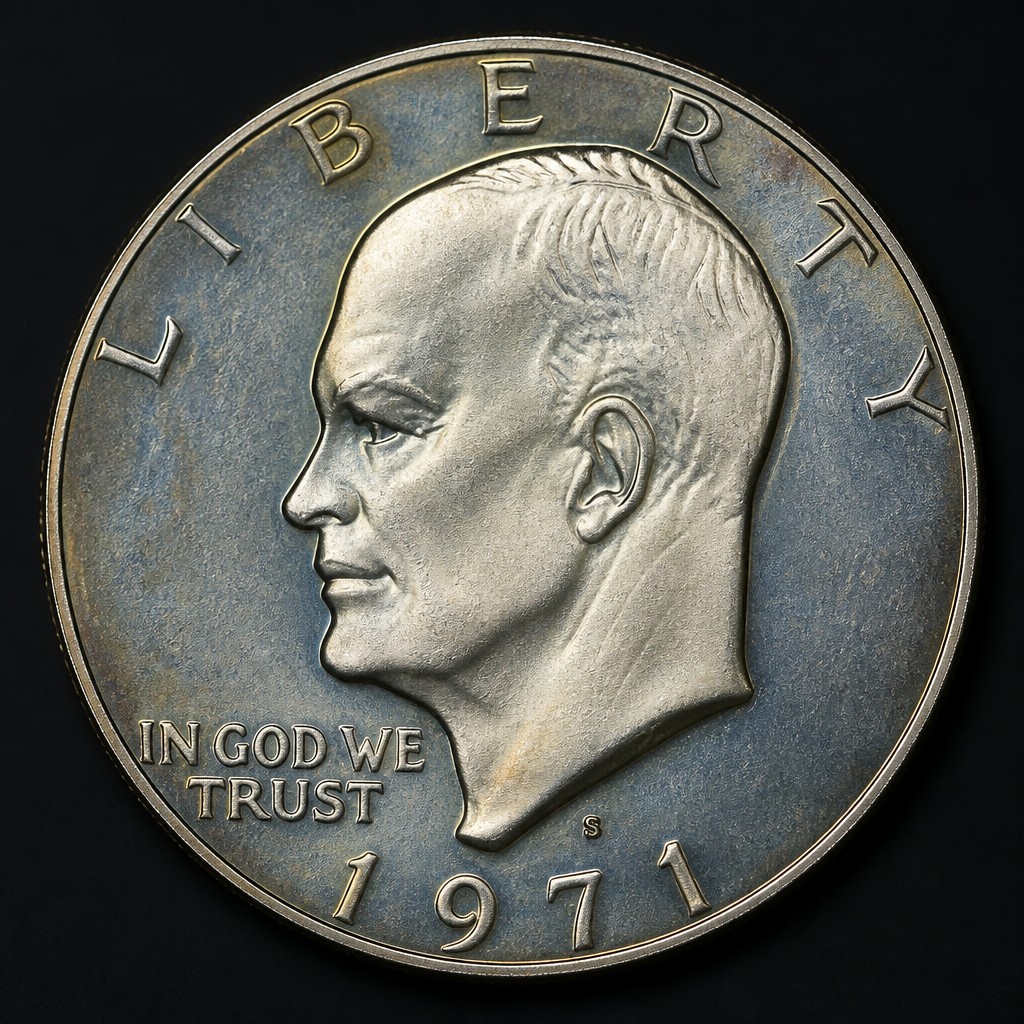
What It Is
The Eisenhower dollar debuted in 1971 as the first US dollar coin since the Peace dollar ended in 1935, honoring President Dwight D. Eisenhower and the Apollo 11 moon landing. While most circulating 1971 dollars were struck in copper-nickel clad, the Mint also struck special 40% silver versions at the San Francisco mint for collectors, sold directly to the public. The uncirculated version came in a blue package, earning it the nickname "Blue Ike," distinguishing it from the proof version sold in a brown box, nicknamed "Brown Ike."
Obverse Design
The obverse shows Frank Gasparro's left-facing bust of Eisenhower, with LIBERTY above, IN GOD WE TRUST to the left, and the date below.
Reverse Design
The reverse depicts an eagle clutching an olive branch and landing on the moon, with the Earth visible in the background, a design inspired by the Apollo 11 mission patch. UNITED STATES OF AMERICA and ONE DOLLAR surround the design.
Size, Weight, and Metal
The 40% silver "Blue Ike" and "Brown Ike" versions weigh 24.59 grams and measure 38.1 mm in diameter, noticeably heavier than the standard copper-nickel clad circulation dollar, which weighs 22.68 grams. Both have a reeded edge.
Mint Marks and Packaging
All silver 1971 Eisenhower dollars carry an "S" mint mark on the obverse above the date, since they were struck exclusively at San Francisco. The "Blue Ike" designation refers specifically to the uncirculated collector version originally packaged in a blue vinyl or cardboard envelope with a brown outer mailing box, while the proof version was packaged in a brown velvet-like case, hence "Brown Ike."
Telling It Apart From Similar Coins
The clearest visual cue between silver and clad Eisenhower dollars is the edge: silver coins show a visible thin line where the silver-copper outer layer meets the different inner core, and they weigh noticeably more. Compared to the proof "Brown Ike," the uncirculated "Blue Ike" has a satin-like finish rather than the deep mirrored fields and frosted design elements typical of a proof strike.
Judging Condition at a Glance
Look at Eisenhower's hair and cheek for smoothing, and the eagle's wing and leg feather detail on the reverse. Because "Blue Ike" coins were sold uncirculated but not sealed to proof standards, look for bag marks, light scuffs, or a slightly dull shine as normal characteristics rather than defects.
Authenticity Red Flags
Because the silver versions carry a premium over the common clad dollar, confirm authenticity by weighing the coin and checking for the layered silver edge. A coin sold as a "Blue Ike" without its original packaging cannot be visually confirmed as the silver variety by mint mark alone, since regular clad dollars also carry an "S" mint mark when struck as proofs or from San Francisco. Weight is the most dependable check.
Frequently asked questions
What does 'Blue Ike' mean?
It's a nickname for the 1971-S uncirculated 40% silver Eisenhower dollar, named for the blue envelope it was originally sold in by the Mint.
How is the Blue Ike different from the Brown Ike?
Both are 1971-S 40% silver Eisenhower dollars, but the Blue Ike is an uncirculated strike with a satin finish, while the Brown Ike is a proof strike with mirrored fields, sold in a brown case.
How do I know if my Eisenhower dollar is silver?
Weigh it. Silver versions weigh about 24.59 grams versus 22.68 grams for copper-nickel clad, and silver coins show a visible layered edge.
Does an 'S' mint mark always mean the coin is silver?
No. San Francisco also struck copper-nickel clad proof dollars with an 'S' mint mark, so mint mark alone doesn't confirm silver content; weight does.
Is the original packaging important for identifying a Blue Ike?
Yes, original packaging helps confirm the coin's history, but the coin itself can be identified as silver through its weight and edge appearance even without the packaging.