
How to Identify the 1970 No S Proof Roosevelt Dime
A guide to identifying the 1970 No S proof Roosevelt dime, a missing mint mark die error known from original proof sets, covering its design and how to distinguish genuine proof surfaces.
Read the full 1970 No S Proof Roosevelt Dime encyclopedia entry →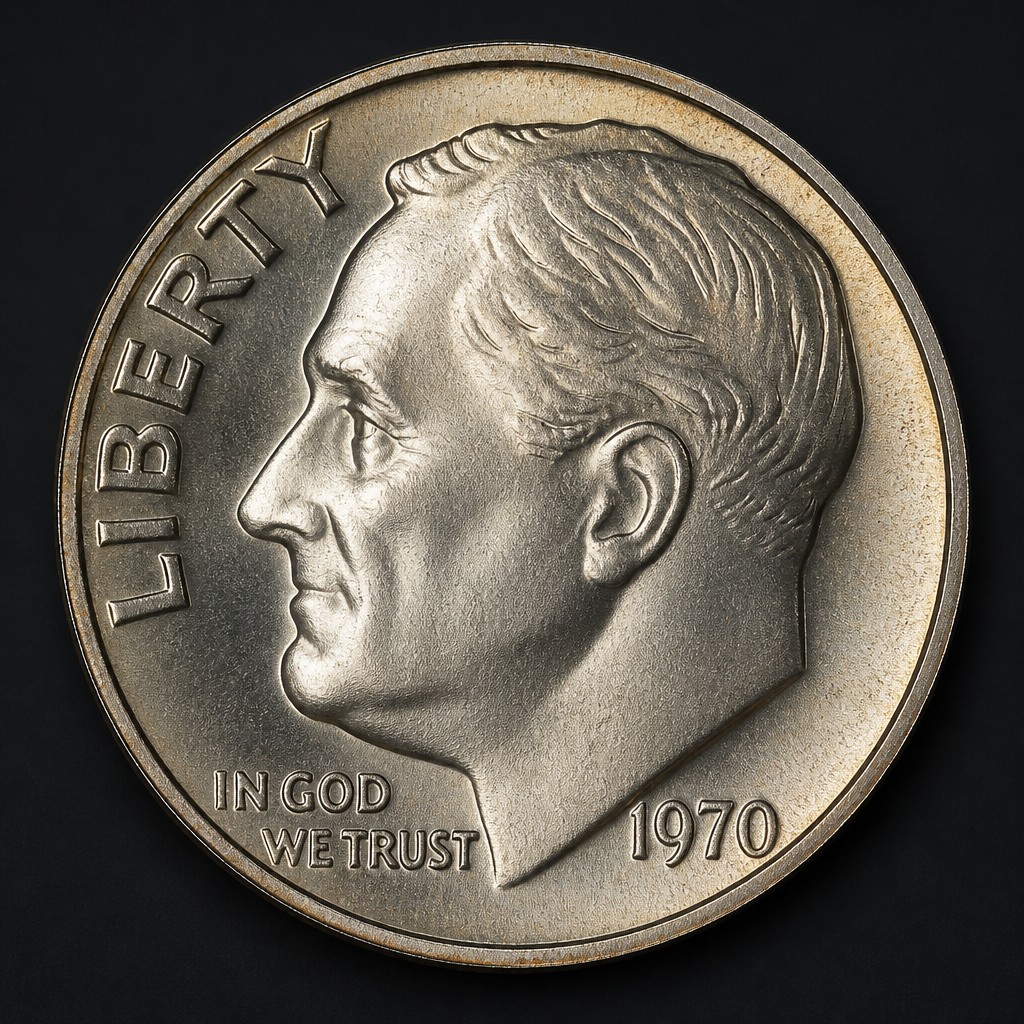
What It Is
The 1970 No S proof dime resulted from a die that was mistakenly finished without an "S" mint mark punch, a mistake that recurred more than once during this era of Roosevelt dime production. Genuine examples come only from sealed 1970 proof sets sold to collectors, not from circulating coinage.
Obverse Design
The obverse carries the familiar Roosevelt profile facing left, "LIBERTY" arcing above, "IN GOD WE TRUST" in the left field, and the date "1970" at the lower right. On this variety, the area just above the date where an "S" mint mark should sit is blank, lacking the expected letter.
Reverse Design
The reverse is identical to every other Roosevelt dime: a torch in the center, an olive branch to the left, an oak branch to the right, "UNITED STATES OF AMERICA" above, and "ONE DIME" below.
Size, Weight, Metal & Edge
It is a standard clad dime measuring 17.9mm across, weighing 2.268 grams, made of copper-nickel bonded over a copper core, with a reeded edge.
Why a Missing Mint Mark Alone Is Not Enough
Because regular Philadelphia and Denver dimes from 1970 also carry no mint mark, identifying this variety requires confirming true proof characteristics: deeply reflective, mirror-like fields, sharply squared rims, and crisp, fully formed design details throughout the coin.
Telling It Apart from Similar Coins
Compare the surface quality to a standard 1970-S proof dime, which shows the S mint mark clearly, and to a business-strike 1970 or 1970-D dime, which will look duller, with a satin rather than mirrored finish. Only a coin combining genuine proof surfaces with the missing mint mark, ideally still traceable to a 1970 proof set, fits this variety.
Judging Condition
Grading emphasizes the cleanliness of the mirrored fields and the presence of any hairlines, spots, or handling marks, since these coins were struck specifically for collectors and not intended to circulate through commerce.
Authenticity Red Flags
Examine the area above the date closely for any sign that a mint mark was removed from a genuine 1970-S proof dime, such as slightly disturbed or polished metal, a loss of mirror reflectivity in that specific spot, or an uneven surface texture. Consistent, undisturbed mirror surfaces across the whole coin support authenticity, while any localized dullness or texture change near the mint mark area warrants closer inspection or professional evaluation.
Frequently asked questions
What proof characteristics should I look for?
Deeply mirrored fields, sharp squared rims, and crisply struck design details rather than the duller finish of a business-strike coin.
Do all 1970 dimes without an S mint mark qualify as this rarity?
No, only coins that also show genuine proof surfaces and trace back to a 1970 proof set qualify; ordinary Philadelphia and Denver dimes also lack an S.
Where should the missing mint mark be located?
On the obverse, just above the date, in the same position used for the S mint mark on standard 1970 proof dimes.
How can I check for a removed mint mark?
Look closely for disturbed, polished, or slightly dished metal directly above the date, which can indicate a mint mark was removed rather than never struck.
Is the reverse design different for this variety?
No, the reverse matches every other Roosevelt dime; the identifying feature is limited to the obverse mint mark area.