
How to Identify the 1967 Centennial Gold $20 Coin
Struck to mark Canada's 100th birthday, the 1967 gold $20 coin pairs a Queen Elizabeth II obverse with the Canadian coat of arms on the reverse and was sold mainly to collectors rather than circulated.
Read the full 1967 Centennial Gold $20 Coin encyclopedia entry →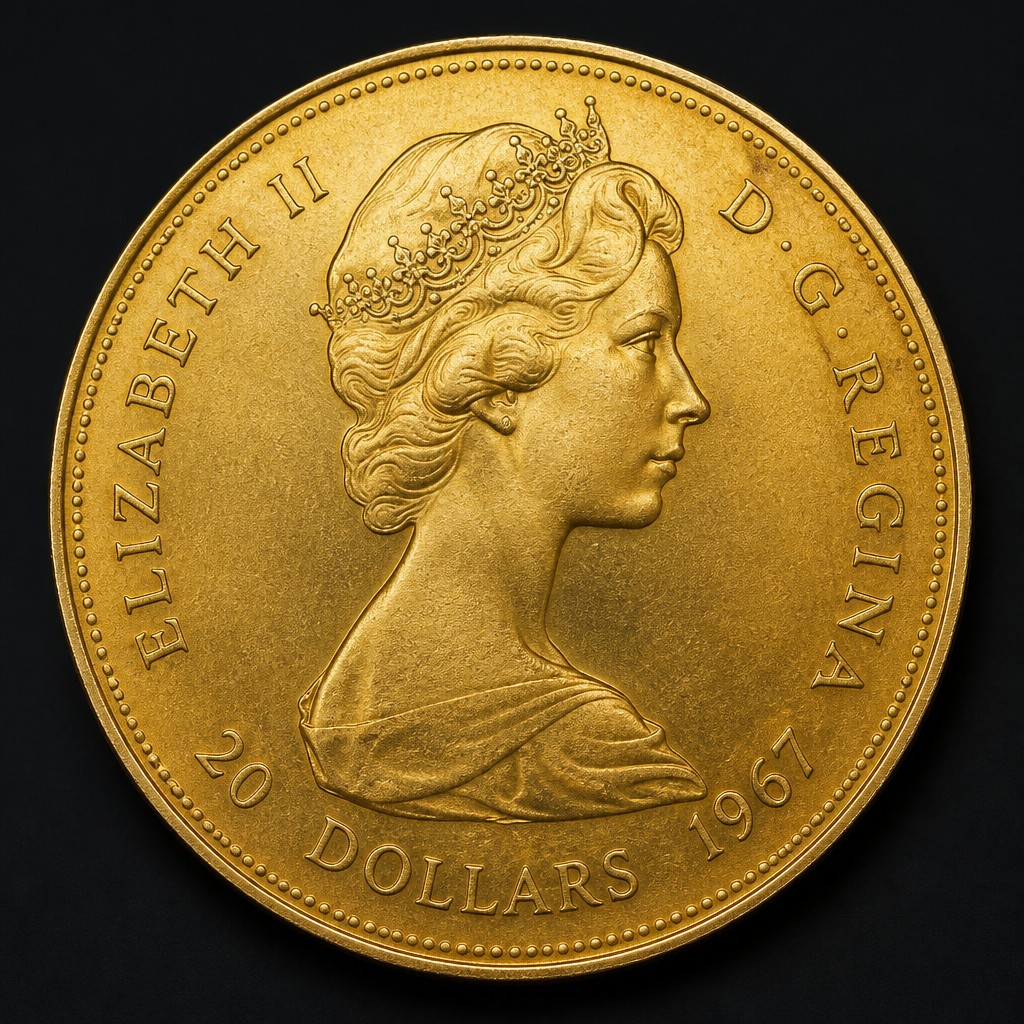
What It Is
The 1967 gold $20 piece was issued as part of Canada's Centennial celebrations, commemorating one hundred years since Confederation. Unlike the lower-denomination Centennial circulation coins that featured wildlife designs, this gold $20 was a special, higher-value collector issue sold in its own presentation case.
Obverse Design
The obverse features a portrait of Queen Elizabeth II, matching the style used on other Canadian coinage of the mid-1960s, with the legend "ELIZABETH II DEI GRATIA REGINA" and the date "1967" below the portrait.
Reverse Design
The reverse displays the Canadian coat of arms, a detailed rendering including the shield, supporting lion and unicorn, crown, and motto scroll, along with "CANADA" and the denomination "20 DOLLARS." The intricate coat of arms design distinguishes this coin from the simpler wildlife motifs used on the Centennial circulation set.
Size, Weight & Metal
The coin is struck in 90% gold, 10% silver, weighing approximately 18.27 grams (about 0.5288 troy ounces of pure gold) with a diameter of roughly 27 mm, following specifications similar to earlier Canadian $20 gold pieces from the early 1900s.
Mint Marks
The coin was produced exclusively at the Royal Canadian Mint in Ottawa and does not carry a separate mintmark; the date 1967 alongside the Centennial theming is sufficient to identify its origin and purpose.
Telling It Apart from Similar Coins
Because this coin shares its general size and gold content with earlier Canadian $20 gold pieces (such as those from 1912-1914), the key distinguishing features are the 1967 date and the coat of arms reverse design, which differs entirely from the maple leaf-and-shield reverse used on the earlier issues. Always check the date and reverse motif together before assuming which type of $20 gold piece you're examining.
How It Relates to the Centennial Set
The 1967 gold $20 was issued alongside, but separately from, the better-known Centennial circulation coin set, which ranged from the one-cent piece up to the silver dollar and used wildlife motifs such as the rock dove, mackerel, and Canada goose. The gold $20 stands apart from that set both in its higher face value and in its heraldic reverse, so it should not be confused with any of the smaller circulating Centennial designs.
Judging Condition at a Glance
Since most 1967 gold $20 coins were sold directly to collectors in cases rather than circulated, well-preserved specimens are common. Look for hairline scratches from handling or removal from capsules, and check the fine details of the coat of arms and the Queen's portrait for sharpness, which should remain crisp on a properly stored, lightly handled example.
Authenticity Red Flags
Given its gold content, verify weight and diameter closely, as counterfeit or gold-plated base-metal copies would typically be off on one or both measurements. Watch for a color that looks too yellow or too pale compared to genuine 90% gold, soft or indistinct details in the coat of arms engraving, and any magnetic response, since genuine gold coins are not magnetic.
Frequently asked questions
What event does this coin commemorate?
Canada's Centennial, marking 100 years since Confederation in 1967.
What is the coin's gold content?
It is struck in 90% gold and 10% silver, weighing about 18.27 grams total.
What is shown on the reverse?
The Canadian coat of arms, including the shield, supporting lion and unicorn, crown, and motto scroll.
Was this coin meant to circulate?
No, it was sold as a collector's item in a presentation case rather than released into general circulation.
How do I tell it apart from earlier Canadian $20 gold coins?
Check the date (1967) and the reverse design; earlier $20 gold pieces from the early 1900s use a different, simpler reverse motif.