
How to Identify the 1964 Kennedy Half Dollar (90% Silver)
The first-year Kennedy half dollar, struck in 90% silver and released within months of President Kennedy's assassination, identified by its bright silver color and heavier weight.
Read the full 1964 Kennedy Half Dollar (90% Silver) encyclopedia entry →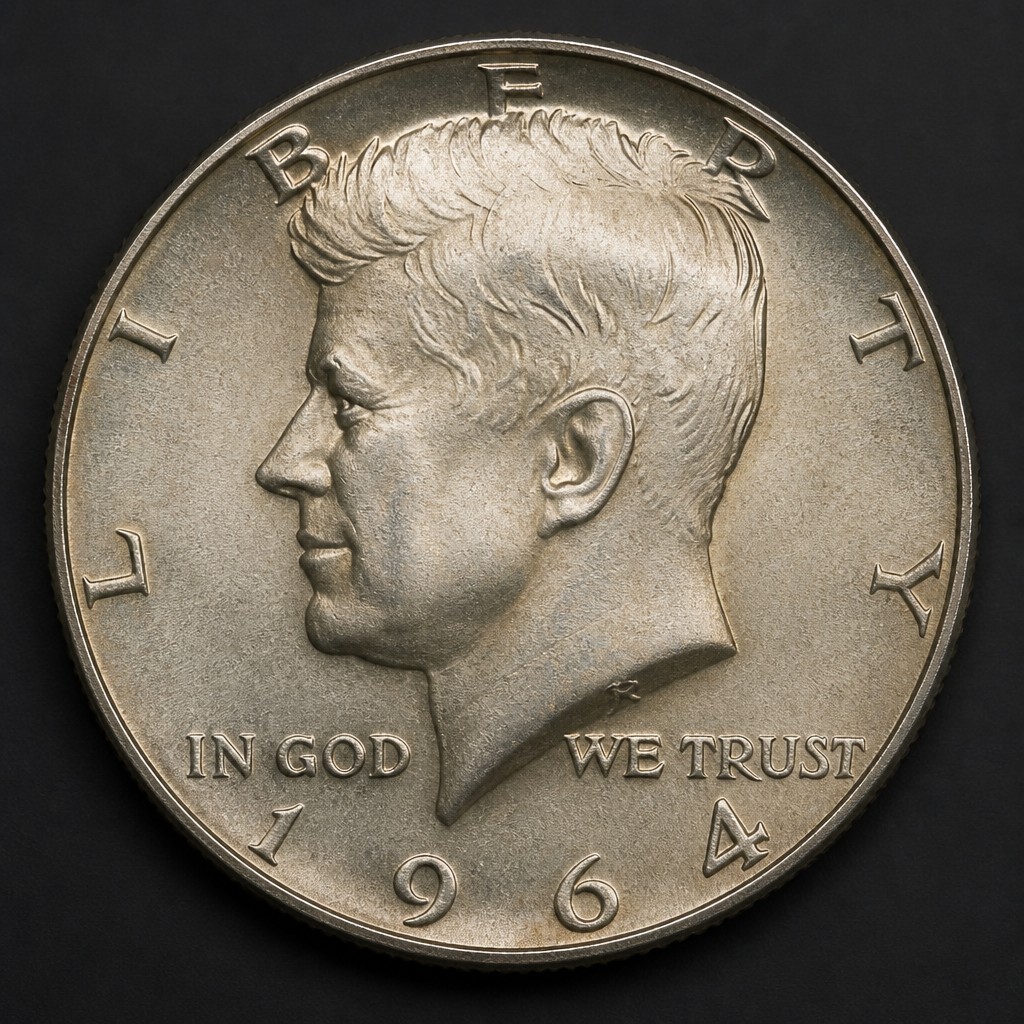
What It Is
The 1964 Kennedy Half Dollar was the first release in the Kennedy half dollar series, rushed into production after President John F. Kennedy's assassination in November 1963 as a way to quickly honor him on circulating coinage. It replaced the Benjamin Franklin half dollar and was struck only in this one year with a 90% silver composition before the Mint reduced the silver content in 1965.
Obverse Design
The obverse, designed by Gilroy Roberts, shows a left-facing bust of President Kennedy. LIBERTY arches above his head, IN GOD WE TRUST appears to the left of the bust, and the date sits at the bottom.
Reverse Design
The reverse, designed by Frank Gasparro, is adapted from the Presidential Seal and shows a heraldic eagle with wings spread, a shield on its chest, holding an olive branch and arrows, with a cluster of stars above and rays behind. UNITED STATES OF AMERICA wraps around the rim, HALF DOLLAR sits at the bottom, and a ribbon reading E PLURIBUS UNUM crosses beneath the eagle.
Size, Weight, and Metal
The 1964 half dollar weighs 12.50 grams, measures 30.6 mm in diameter, is struck in 90% silver and 10% copper, and has a reeded edge. This is noticeably heavier than the 40% silver halves that followed in 1965.
Mint Marks
1964 halves were struck at Philadelphia (no mintmark) and Denver ("D"). The mintmark, when present, is found on the reverse near the lower left, just above the branch and to the left of the eagle's tail feathers.
Telling It Apart From Later Kennedy Halves
The easiest visual cue is color and shine: 90% silver coins tend to have a brighter, more mirror-like white-silver appearance than the duller 40% silver clad halves of 1965-1970 or the copper-nickel clad halves from 1971 onward. Weighing the coin on an accurate scale is the most reliable test, since 12.50 grams confirms 90% silver, while lighter weights point to a later composition.
Judging Condition at a Glance
Check Kennedy's hair above the ear and the fine details of his cheek and jaw for wear, along with the eagle's breast feathers and the tips of the olive branch leaves on the reverse. Crisp, fully separated details indicate light wear, while flattened or merged features indicate a well-circulated coin.
Authenticity Red Flags
Because silver content drives much of this coin's appeal, watch for coins that feel unusually light, have a dull gray or brassy edge suggesting a clad core, or show a visible copper stripe on the edge, which would indicate a later clad composition rather than genuine 90% silver. Also inspect for re-engraved or altered dates, and compare the coin's diameter and edge reeding to a known genuine example if anything looks inconsistent.
Frequently asked questions
How can I tell a 1964 half dollar is 90% silver just by looking?
It has a brighter, whiter silver luster than later Kennedy halves, but the most reliable check is weighing it: 90% silver examples weigh 12.50 grams.
Where is the mint mark on a 1964 Kennedy half dollar?
On the reverse, near the lower left near the eagle's tail and branch. No mintmark means Philadelphia; a 'D' means Denver.
Why was the Kennedy half dollar created so quickly?
It was authorized and released within months of President Kennedy's assassination in November 1963 as a tribute that would circulate widely.
Does the edge of the coin help confirm it's silver?
Yes. A solid silver edge with no copper stripe visible supports a 90% silver composition, while a visible copper line in the edge points to a later clad coin.
Are 1964 Kennedy half dollars rare?
They were produced in large numbers and are not rare, but their 90% silver content makes them more valuable than later clad versions.