
How to Identify the 1958 British Columbia Totem Pole Dollar
A Canadian commemorative silver dollar marking the 100th anniversary of the Colony of British Columbia, featuring a detailed totem pole design on the reverse.
Read the full 1958 British Columbia Totem Pole Dollar encyclopedia entry →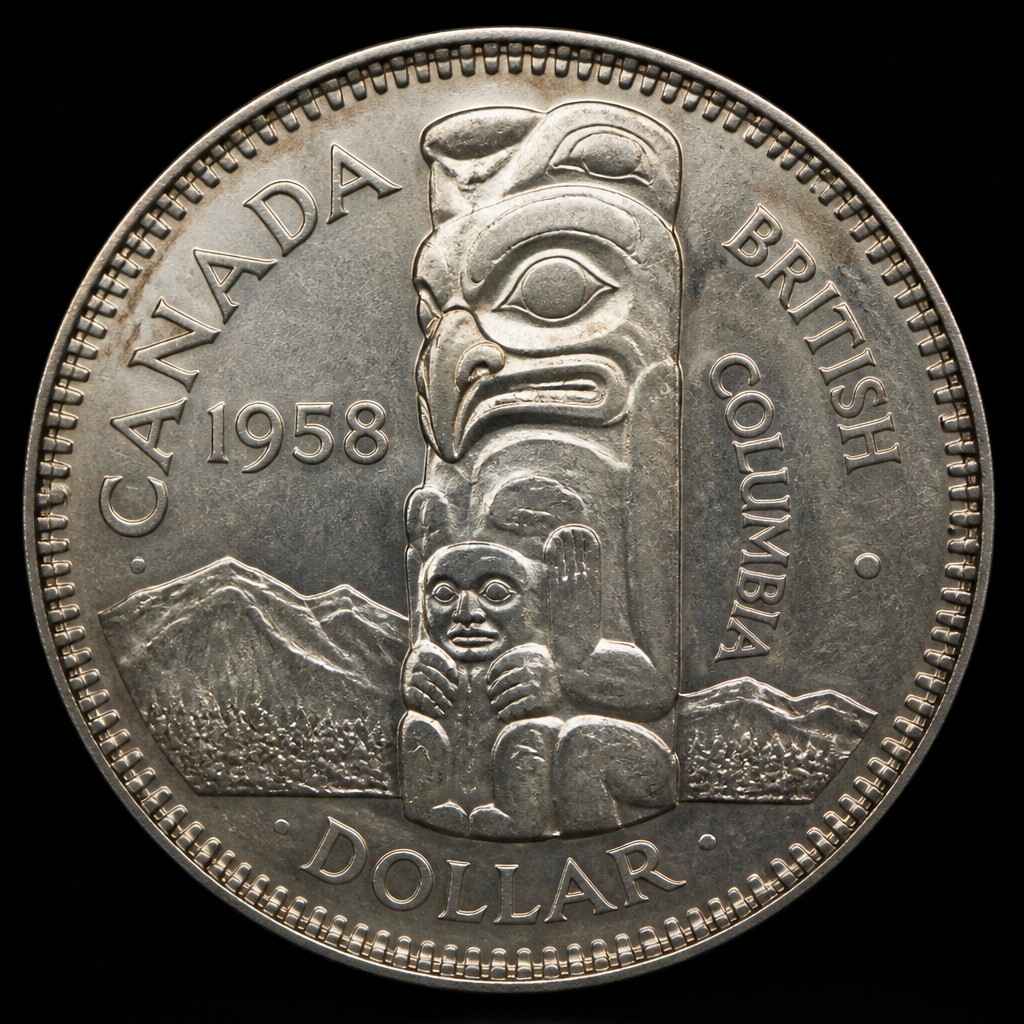
What Is This Coin?
This coin was issued to mark the centennial of the Colony of British Columbia, established in 1858. Its reverse design draws on Pacific Northwest Indigenous artistic traditions to represent the province's heritage. Among Canada's commemorative silver dollars, this issue is often singled out for the artistic ambition of its reverse, which is more sculptural and vertically composed than the horizontal scenes used on most other commemorative dollars.
Obverse Design
The obverse shows Queen Elizabeth II's portrait from the coinage series used in the 1950s and early 1960s, with the legend "ELIZABETH II DEI GRATIA REGINA" surrounding the bust. This earlier, youthful laureate portrait helps place the coin within the broader timeline of Elizabeth II Canadian coinage compared to later, updated effigies.
Reverse Design
The reverse, designed by Stephen Trenka, features a detailed totem pole flanked by the dates "1858" and "1958," with "CANADA" and "DOLLAR" (or the implied denomination through size) worked into the design. The vertically stacked carved figures give this reverse a distinctive, easily recognizable silhouette unlike any other Canadian commemorative dollar.
Size, Weight & Metal
The coin is struck in .800 fine silver, weighing about 23.33 grams with a diameter of 36 mm and a reeded edge, matching the standard specifications for Canadian silver dollars of the period. This large, heavy format was standard for all Canadian commemorative dollars of the era, so weight and diameter alone won't distinguish this issue from others — the reverse artwork does that job.
Mint Marks & Where to Find Them
No mint mark appears on this Ottawa-struck coin; identification relies entirely on the distinctive reverse design and the flanking dates. Because British Columbia's centennial issue had a healthy original mintage, well-circulated examples are not difficult to locate today.
Telling It Apart From Similar Coins
The totem pole motif is unmistakable and won't be confused with any other Canadian dollar design. The two flanking dates (1858 and 1958) immediately identify it as a centennial issue rather than a regular-date circulation dollar.
Judging Condition at a Glance
Wear appears first on the raised carved details of the totem pole figures and on the queen's hair on the obverse. A coin with sharp, well-defined carving lines and figures indicates higher preservation, while worn examples show a smoothed, less distinct pole. Look also at the fields surrounding the pole for retained mint frost, which disappears quickly once a coin has circulated even briefly.
Authenticity Red Flags
Watch for blurred, indistinct carving detail on the totem pole (suggesting a cast counterfeit), incorrect weight or diameter, or poorly defined edge reeding. Genuine strikes show crisp, well-defined relief throughout the carved figures and clean, legible lettering. Because the vertical totem design has many small carved sections, casting flaws often show up as rounded or mushy transitions between figures, which is a useful detail to examine closely.
Frequently asked questions
What does this coin commemorate?
It marks the 100th anniversary of the founding of the Colony of British Columbia in 1858.
Who designed the totem pole reverse?
The design was created by Stephen Trenka, drawing on Pacific Northwest Indigenous carving traditions.
How can I confirm this is the centennial issue and not a regular dollar?
Look for the two flanking dates, 1858 and 1958, on the reverse alongside the totem pole design, which together confirm the commemorative issue.
What metal is the coin made of?
It is struck in .800 fine silver, consistent with other Canadian commemorative dollars from this era.