
How to Identify the 1949-S Roosevelt Dime
A practical identification guide to the silver 1949-S Roosevelt dime, covering the obverse and reverse design, mint mark location, and how to distinguish it from later clad dimes.
Read the full 1949-S Roosevelt Dime encyclopedia entry →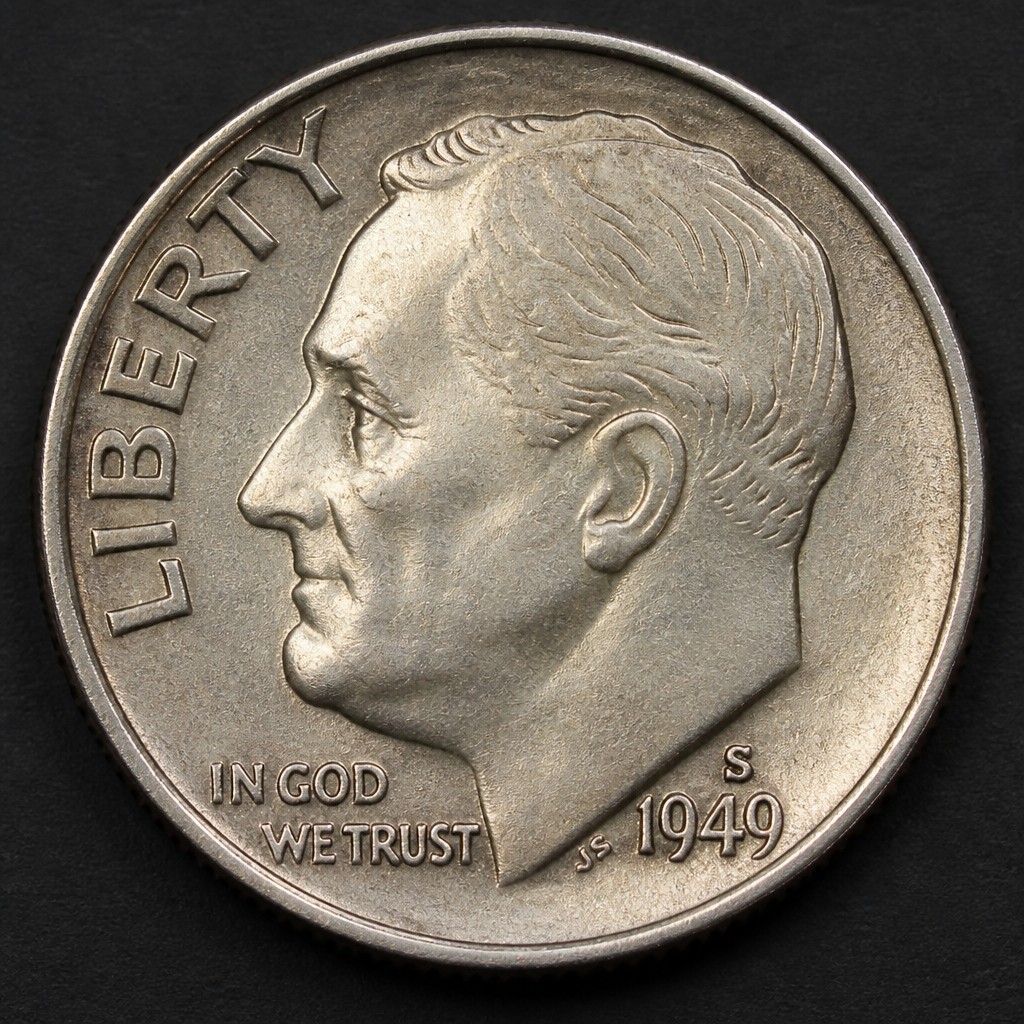
What It Is
The Roosevelt dime debuted in 1946, designed by John R. Sinnock and honoring President Franklin D. Roosevelt shortly after his death, in part because of his association with the March of Dimes campaign against polio. The 1949-S is a lower-mintage San Francisco issue from the early silver era of the series, struck at a time when San Francisco's dime output was relatively modest.
Obverse Design
Roosevelt's profile faces left. "LIBERTY" arcs along the upper left rim, "IN GOD WE TRUST" sits in the field to the left of the portrait, and the date is at the lower right. The designer's initials "JS" appear at the base of the neck truncation, a detail worth checking on any Roosevelt dime to confirm it matches the standard design.
Reverse Design
A lit torch stands in the center, flanked by an olive branch on the left, symbolizing peace, and an oak branch on the right, symbolizing strength and independence. "UNITED STATES OF AMERICA" arcs around the top, "E PLURIBUS UNUM" runs in small letters near the left rim, and "ONE DIME" sits at the bottom.
Size, Weight, Metal & Edge
Like all pre-1965 dimes, it measures 17.9mm across, weighs 2.5 grams, and is struck in 90% silver, 10% copper, with a reeded edge.
Mint Mark Location
The "S" mint mark appears on the reverse, to the left of the torch's base and just above the "ONE DIME" lettering. This is the same position used for mint marks on every Roosevelt dime through 1964.
Telling It Apart from Similar Coins
Compare it to the 1949 Philadelphia issue, which has no mint mark, simply by checking for the "S." To distinguish it from post-1964 clad Roosevelt dimes, examine the edge: a silver dime's edge is a uniform silver-gray color all the way through, while a clad dime shows a visible thin copper-colored stripe sandwiched between the outer nickel layers.
Judging Condition at a Glance
Look at the two horizontal bands crossing the torch on the reverse. Fully separated, sharp bands, sometimes described informally as "Full Bands," indicate a well-struck coin with less wear, while worn examples show the bands merging or fading, along with flattening in Roosevelt's hair curls and the ridges of his ear on the obverse.
Authenticity Red Flags
Because it is a semi-key, lower-mintage date compared to other dimes of the era, check for an added "S" mint mark on what would otherwise be a common 1949 Philadelphia dime. Look for irregular mint mark shape, uneven serifs, or surface disturbance around the letter, and confirm the coin has the expected silver-gray edge rather than a plated or clad appearance, which would indicate a later coin altered to look like the earlier silver issue.
Frequently asked questions
Is the 1949-S Roosevelt dime silver?
Yes, all Roosevelt dimes struck through 1964 are 90% silver, including the 1949-S.
Where is the mint mark on a 1949-S dime?
On the reverse, to the left of the torch base, directly above the words ONE DIME.
How do I tell a silver dime from a modern clad dime?
Check the edge: silver dimes show a solid silver-gray edge, while clad dimes show a visible copper stripe between the outer layers.
What does 'Full Bands' mean on this coin?
It refers to the two horizontal bands on the torch being fully separated and sharply struck, a sign of a strong strike rather than wear.
What do the branches on the reverse represent?
The olive branch on the left symbolizes peace, and the oak branch on the right symbolizes strength and independence.