
How to Identify the 1943 Washington Quarter Doubled Die Obverse
A visual guide to the 1943 Washington Quarter Doubled Die Obverse variety, explaining where to look for doubling in the date and motto and how to avoid mimics.
Read the full 1943 Washington Quarter Doubled Die Obverse encyclopedia entry →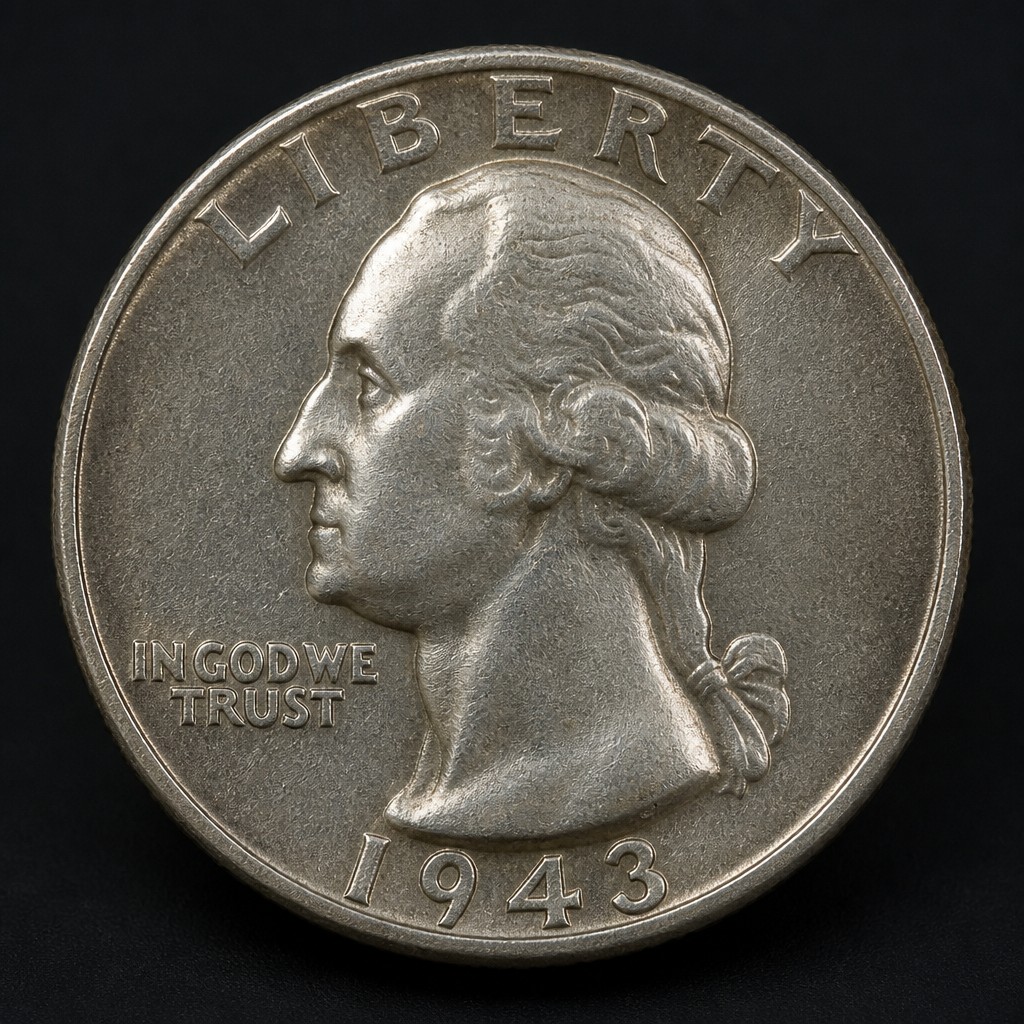
What This Coin Is
The 1943 Doubled Die Obverse is a die variety of the wartime silver Washington quarter, resulting from a working die that received two misaligned hub impressions, leaving visible doubling in select design elements.
Obverse Design
John Flanagan's portrait of George Washington faces left, based on a Jean-Antoine Houdon bust. "LIBERTY" arches above his head, "IN GOD WE TRUST" sits just behind his neck, and the date appears below the bust at the bottom rim.
Where the Doubling Appears
Collectors look for doubling in the date and in the lettering of the obverse motto, appearing as a secondary outline or noticeable thickening along the edges of the affected numerals and letters when examined closely under magnification.
Reverse Design
An eagle with wings spread perches on a bundle of arrows, with two olive branches curving beneath it. "UNITED STATES OF AMERICA" arches around the top, "QUARTER DOLLAR" runs along the bottom, and "E PLURIBUS UNUM" sits in a small ribbon just above the eagle.
Size, Weight, Metal, and Edge
Silver-era Washington quarters (1932-1964) are struck in 90% silver, 10% copper, weigh 6.25 grams, measure 24.3 mm in diameter, and have a reeded edge, the same specifications used throughout the Barber and Standing Liberty series before it.
Mint Mark Location
On coins from this era, the mint mark sits on the reverse, centered just below the wreath and above "QUARTER DOLLAR." No letter indicates Philadelphia; "D" indicates Denver and "S" indicates San Francisco. This variety is associated with the Philadelphia strike, so a genuine example typically shows no mint mark on the reverse.
Telling It Apart from Similar Coins
Regular 1943 quarters without doubling are common. Since 1943 coins can show general softness or die wear from wartime production pressures, it's important to distinguish genuine doubled-die doubling—clean and rounded—from ordinary strike weakness or die deterioration, which tends to look flat or mushy rather than split.
Judging Condition at a Glance
Wear first appears on Washington's hair curls just above and behind the ear, and on the eagle's breast and the tops of its leg feathers on the reverse. Sharp, separated hair strands and a fully feathered breast point to higher grades, while smoothed hair and a flat-looking eagle breast indicate more circulation.
Authenticity Notes
As with other doubled die varieties, verifying a suspected 1943 example means comparing its doubling pattern precisely against confirmed reference images, since general softness in the strike or a worn coin can superficially resemble doubling to the naked eye.
Frequently asked questions
What causes a doubled die variety?
A misaligned hubbing process during die production, leaving two slightly offset impressions of the design on the working die.
Where does the doubling show on the 1943 DDO?
Mainly in the date and the obverse motto lettering.
Can normal wear create a similar effect?
No, but strike weakness or die deterioration can create a blurry look that should not be confused with the clean, split appearance of true doubling.
Is this variety found on quarters from a specific mint?
It is associated with the Philadelphia issue, which carries no mint mark on the reverse.