
How to Identify the 1939-S Jefferson Nickel
Key identification points for the San Francisco-minted 1939-S Jefferson Nickel, a semi-key date in the early series.
Read the full 1939-S Jefferson Nickel encyclopedia entry →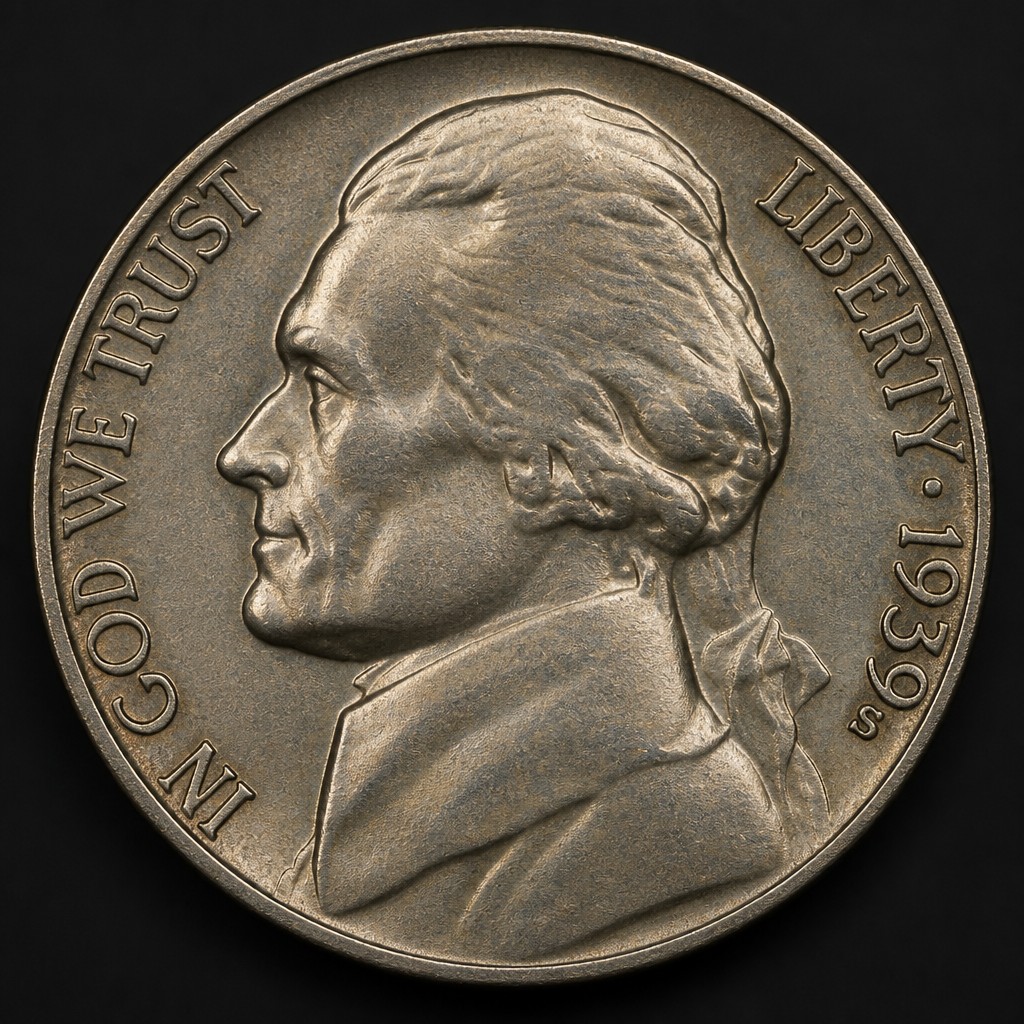
What It Is
The 1939-S Jefferson Nickel is a San Francisco-struck issue from the second year of the series. Its mintage was modest compared to other Jefferson Nickels of the era, making it a semi-key date that collectors look for when building a complete set by date and mint mark, even though it is not nearly as scarce as some of the true key dates in other denominations from the same period. It is frequently mentioned alongside the 1939-D as one of the two harder early dates to locate in top condition.
Obverse Design
The obverse features Thomas Jefferson's profile facing left, with LIBERTY along the left rim, IN GOD WE TRUST along the right rim, and the date placed at the lower right near the shoulder.
Reverse Design
The reverse shows Monticello with MONTICELLO and FIVE CENTS in the exergue, E PLURIBUS UNUM above the building, and UNITED STATES OF AMERICA around the upper rim.
Size, Weight, Metal, Edge
The coin is 21.2mm in diameter, weighs 5.00 grams, is composed of 75% copper and 25% nickel, and has a plain edge.
Mint Marks
Look on the reverse to the right of Monticello, near the base of the building, for a small "S." That mark identifies the coin as a San Francisco strike; the absence of a mint mark indicates Philadelphia, and a "D" indicates Denver, so all three mint marks should be checked against the visible letter before concluding which mint produced a given coin.
Telling It Apart from Similar Coins
Because 1939 nickels can carry either the earlier or later reverse hub style, with lower or taller steps below Monticello, collectors examining a 1939-S should check the step detail as well as the mint mark, since both details help confirm the coin's exact variety and strike quality. Some examples are also confused at a glance with 1939-D coins if the mint mark is worn or dirty, so cleaning the coin gently (without abrasives) or using magnification can help clarify a faint letter.
Grading at a Glance
Check Jefferson's cheek and hair for the first signs of wear on the obverse. On the reverse, look at how distinct and separated the steps of Monticello appear; a fully struck coin will show clean, unbroken step lines rather than a blended, flat area beneath the building, which is often the result of a weak strike rather than actual wear.
Authenticity Red Flags
Be cautious of a mint mark that appears added, oversized, or oddly positioned relative to genuine 1939-S coins, since a low mint mark can be counterfeited onto a more common Philadelphia coin to inflate its perceived scarcity. Also watch for unnatural shine or fine scratch patterns that suggest the coin has been cleaned to disguise circulation wear or to make a lower-grade coin appear closer to uncirculated.
Frequently asked questions
Where do I find the mint mark on a 1939-S nickel?
On the reverse, to the right of Monticello near the base of the building.
Is the 1939-S rare?
It is not extremely rare, but it had a smaller mintage than most other pre-war Jefferson Nickels, making it a desirable semi-key date.
How can I tell a 1939-S from a 1939-D or plain 1939?
The mint mark letter next to Monticello is the deciding factor: S for San Francisco, D for Denver, and no letter for Philadelphia.
What should I look for to judge strike quality?
Check whether the steps below Monticello are fully separated and sharp, which indicates a well-struck coin.