
How to Identify the 1939 Royal Visit Silver Dollar (Parliament)
A commemorative Canadian silver dollar marking the 1939 royal tour of King George VI and Queen Elizabeth, featuring the Parliament Buildings on its reverse.
Read the full 1939 Royal Visit Silver Dollar (Parliament) encyclopedia entry →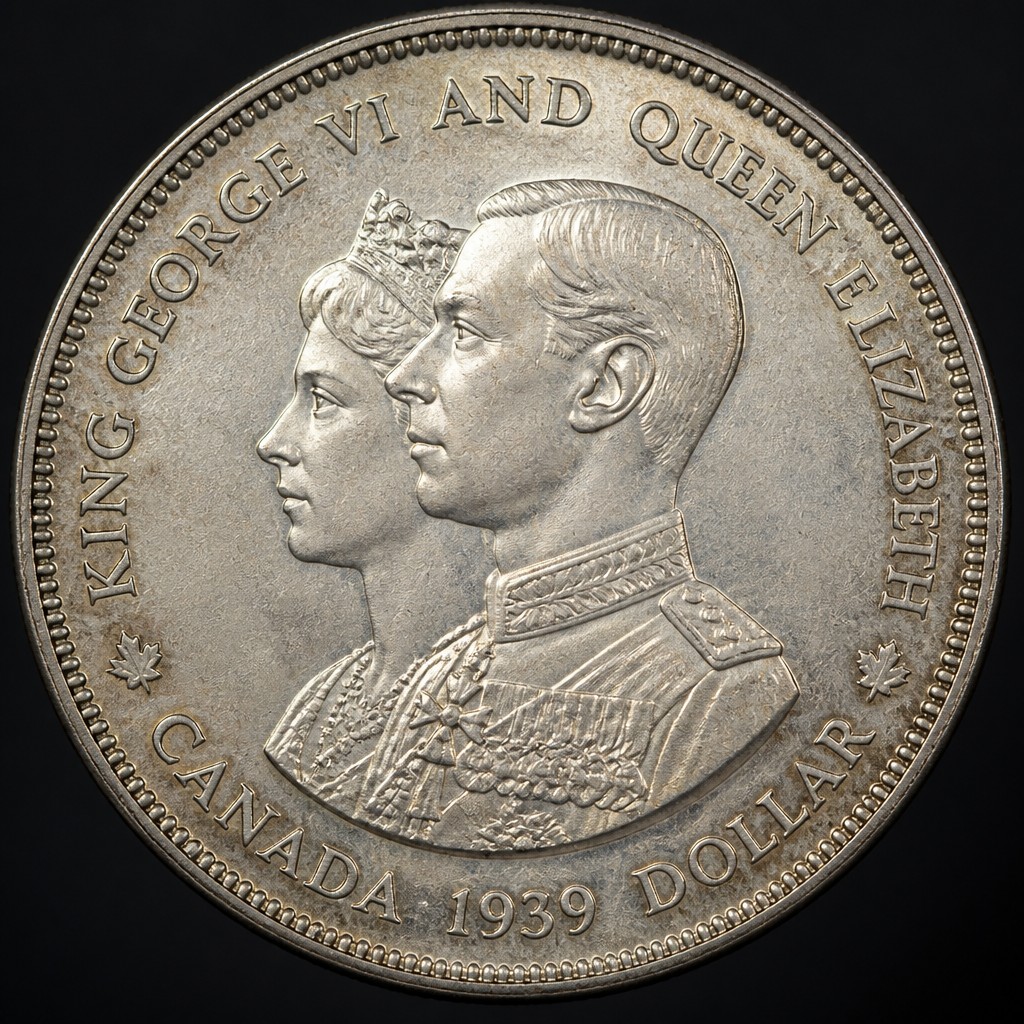
What Is This Coin?
This coin commemorates the 1939 tour of Canada by King George VI and Queen Elizabeth, the first visit to the country by a reigning monarch. It replaced the Voyageur reverse for one year with a scene of Canada's Parliament Buildings. The visit itself was a major public event at the time, and the coin was produced in quantities well above typical dollar mintages of the preceding years to meet public demand for a keepsake.
Obverse Design
The obverse shows a portrait of King George VI facing left, with the legend "GEORGIVS VI DEI GRATIA REX ET IND IMP" (reflecting his title as Emperor of India, still in place at this date) surrounding the bust.
Reverse Design
The reverse, designed by Emanuel Hahn, depicts the Centre Block of Canada's Parliament Buildings in Ottawa, including the Peace Tower, with "CANADA" and the date "1939" around the scene. This architectural view makes it instantly distinguishable from the Voyageur canoe design used in most other years.
Size, Weight & Metal
The coin is struck in .800 fine silver, weighing about 23.33 grams with a diameter of 36 mm and a reeded edge, matching the specifications of other Canadian silver dollars of the period.
Mint Marks & Where to Find Them
No mint mark appears on this Ottawa-struck coin. As with other Canadian dollars of the era, identification relies on the design and date rather than any mint designation, so a careful look at the reverse scene remains the most reliable approach.
Telling It Apart From Similar Coins
The Parliament Buildings reverse is unique to this one year, so it won't be confused with the Voyageur canoe design used in 1935, 1936, 1937, and 1938, or with later commemorative reverses like the 1949 Newfoundland ship design. This was also a comparatively higher-mintage commemorative, making well-preserved examples more attainable than some other pre-war Canadian dollars. Its single date (rather than a flanking pair like later Centennial issues) also sets it apart visually from the dual-dated commemoratives that came after it.
Judging Condition at a Glance
Wear appears first on the Peace Tower's upper details and the highest points of the king's portrait. A coin with sharply defined architectural lines and full detail in the building's facade indicates a higher grade, while circulated examples show softened, less distinct stonework. Because this issue is relatively plentiful, many collectors are able to be selective and hold out for pieces with strong original luster and minimal contact marks.
Authenticity Red Flags
Watch for coins with blurred or indistinct architectural detail (a sign of casting or a worn counterfeit die), incorrect weight or diameter, or poorly formed reeding on the edge. Because this date is relatively available compared to some rarer Canadian dollars, there is less incentive for elaborate counterfeiting, but basic physical checks remain worthwhile. Pay particular attention to any example advertised as a superb uncirculated specimen, since the premium for top condition can occasionally attract cleaned or artificially improved coins.
Frequently asked questions
What event does this coin commemorate?
It marks the 1939 royal tour of Canada by King George VI and Queen Elizabeth, notable as the first visit by a reigning monarch to the country.
Why does the reverse show a building instead of the usual canoe scene?
The Voyageur design was temporarily replaced for this one year with a special reverse depicting the Parliament Buildings to mark the royal visit.
Is the 1939 dollar rare compared to other Voyageur-era dollars?
It had a relatively higher mintage than some other pre-war Canadian dollars, so well-worn examples are generally more available than several other commemorative dates.
What metal is this coin made from?
It's struck in .800 fine silver, consistent with other Canadian silver dollars minted during this period.