
How to Identify the 1932-D Washington Quarter
A visual identification guide to the 1932-D Washington quarter, the key date of the series' first year, covering its design, mint mark placement, and how to spot added mint marks.
Read the full 1932-D Washington Quarter encyclopedia entry →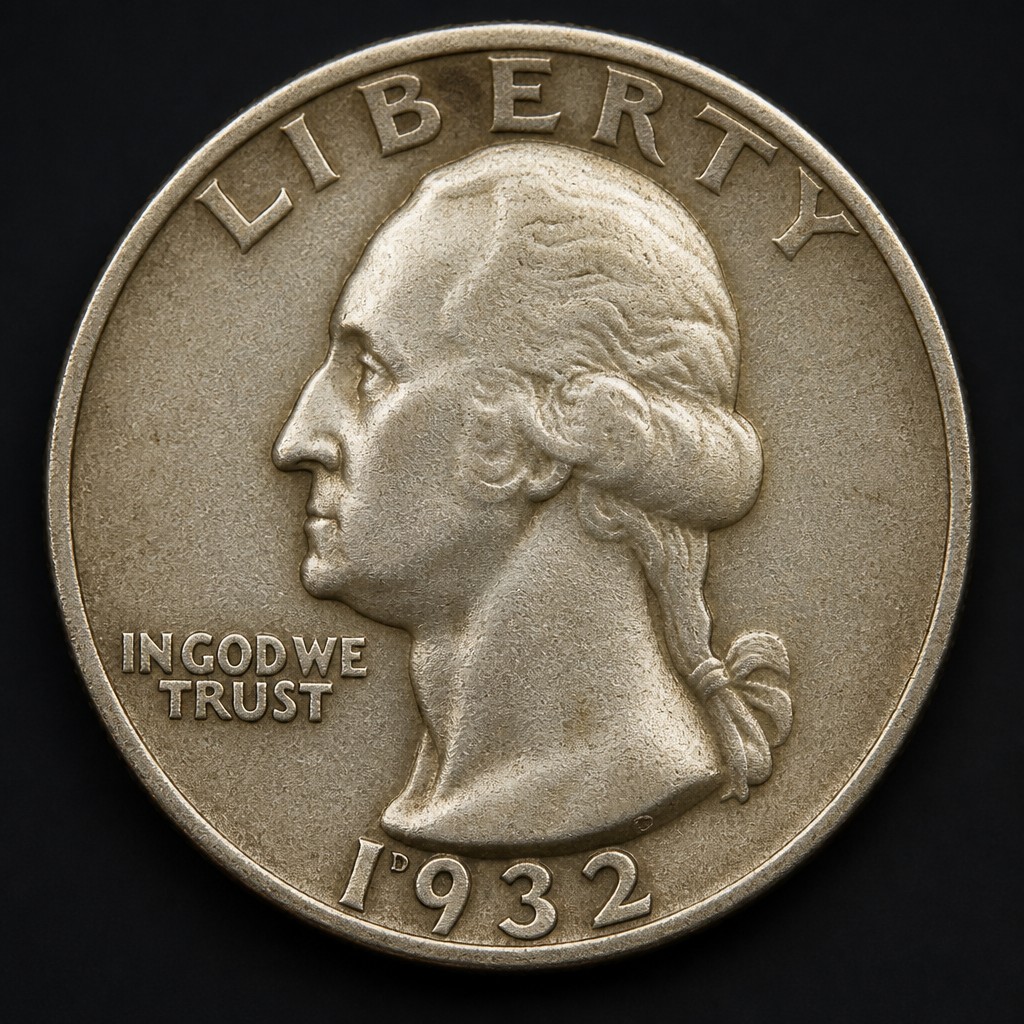
What It Is
The Washington quarter debuted in 1932 to mark the bicentennial of George Washington's birth, designed by sculptor John Flanagan, and went on to become one of the longest-running coin designs in US history. The 1932-D is the key date of the entire series thanks to its low original mintage during the depths of the Great Depression.
Obverse Design
Washington's bust faces left, with "LIBERTY" arcing above his head, "IN GOD WE TRUST" in the field to the left of the portrait, and the date at the bottom, framed by a small wreath-like border of leaves near the rim.
Reverse Design
An eagle with wings spread stands atop a bundle of arrows, flanked by two olive branches. "UNITED STATES OF AMERICA" arcs above, "QUARTER DOLLAR" is at the bottom, and "E PLURIBUS UNUM" appears in small letters just above the eagle's head.
Size, Weight, Metal & Edge
The coin measures 24.3mm in diameter, weighs 6.25 grams, is struck in 90% silver and 10% copper, and has a reeded edge.
Mint Mark Location
On pre-1965 Washington quarters, the mint mark sits on the reverse, centered below the wreath and just above the words "QUARTER DOLLAR." For the 1932-D, look for a small "D" in that spot; a coin with nothing there is a Philadelphia strike.
Telling It Apart from Similar Coins
The 1932-D and 1932-S are the two key dates of the series, both with mintages far below the common 1932 Philadelphia issue. Confirm which mint mark, if any, appears in the space below the wreath: no letter means Philadelphia, "D" means Denver, and "S" means San Francisco. Because the 1932-D generally commands a stronger premium, mint mark verification deserves extra care with this date in particular.
Judging Condition at a Glance
Check Washington's cheek and hairline on the obverse and the eagle's breast and leg feathers on the reverse; these are the first areas to show flattening from wear. On well-preserved examples, fine hair strands near the ear and individual feather tips on the eagle remain distinct.
Authenticity Red Flags
Because the 1932-D is far more valuable than the common 1932 Philadelphia issue, it is a frequent target for an added mint mark. Examine the "D" closely for correct size, shape, and font compared to verified genuine examples, and look for tooling marks, file lines, or an unnatural surface texture in the field surrounding the mint mark, all signs that it was added after the coin left the mint rather than struck as part of the original die.
Frequently asked questions
Where is the mint mark on a 1932-D quarter?
On the reverse, centered below the wreath and just above the words QUARTER DOLLAR.
Why is the 1932-D considered a key date?
The Denver mint struck a much smaller number of quarters in 1932 compared to Philadelphia, making surviving examples scarcer.
How can I tell if the D mint mark is genuine?
Compare its size, shape, and placement to verified genuine 1932-D quarters, and check under magnification for tooling marks or an added-metal appearance.
What metal is the 1932-D quarter made of?
It is 90% silver and 10% copper, weighing 6.25 grams with a reeded edge.
What does the reverse eagle design represent?
An eagle standing on a bundle of arrows flanked by olive branches, a common patriotic motif paired with the E PLURIBUS UNUM motto above it.