
How to Identify the 1913 Barber Quarter
A visual guide to the 1913 Barber quarter, a low-mintage Philadelphia issue in the Barber series, covering its Liberty head design and mint mark placement.
Read the full 1913 Barber Quarter encyclopedia entry →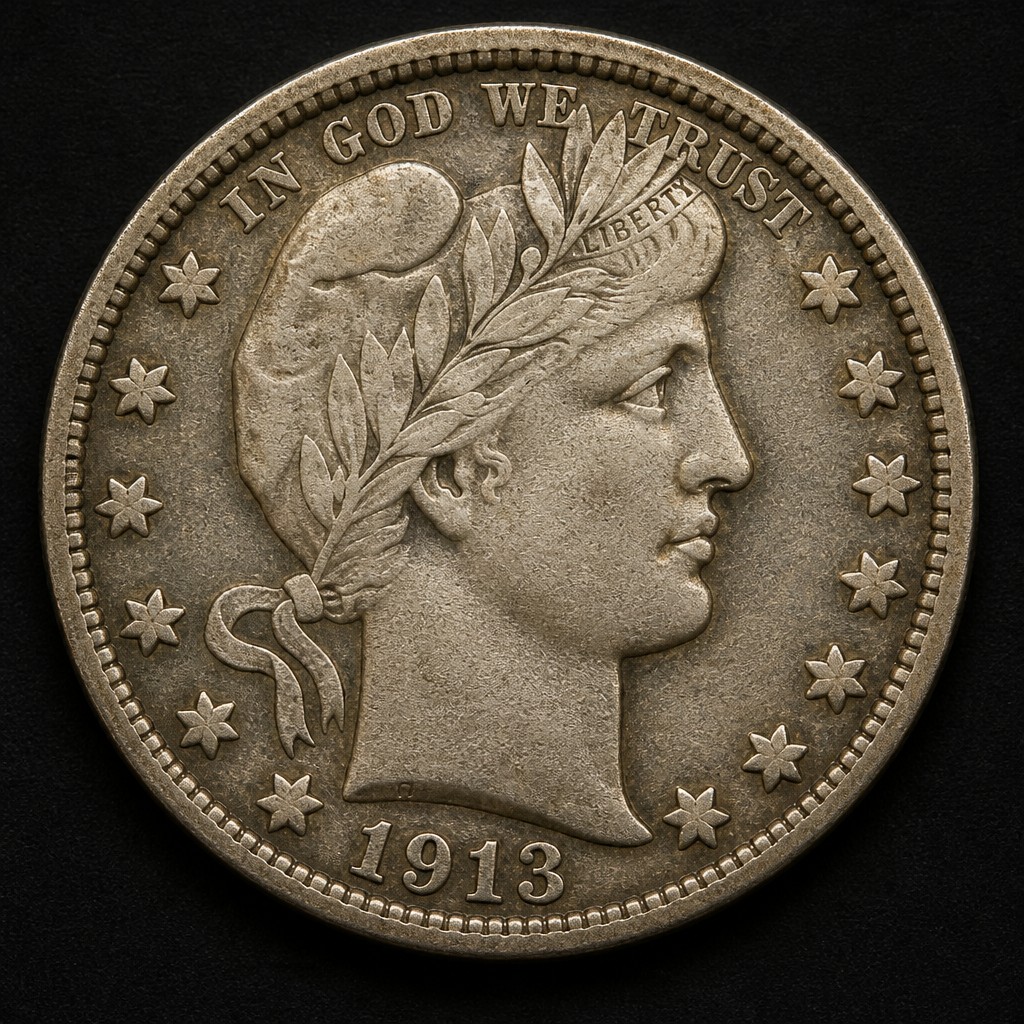
What It Is
The 1913 quarter belongs to the Barber series, designed by Chief Engraver Charles E. Barber and struck from 1892 to 1916. The 1913 Philadelphia issue is notable for one of the lowest mintages in the series, making it a scarcer date sought after by collectors building a complete Barber quarter set.
Obverse (Front)
The obverse depicts Liberty's head facing right, wearing a laurel wreath and cap with a headband inscribed "LIBERTY." Stars encircle the portrait near the rim, and the date "1913" appears below the bust.
Reverse (Back)
The reverse shows a heraldic eagle with wings spread, holding a bundle of arrows and an olive branch, with a shield across its breast. "UNITED STATES OF AMERICA" arcs above and "QUARTER DOLLAR" appears below, with "E PLURIBUS UNUM" on a ribbon above the eagle.
Size, Weight, Metal, and Edge
The coin measures approximately 24.3 mm in diameter and weighs about 6.25 grams, struck in 90% silver and 10% copper, with a reeded edge.
Mint Marks
The mint mark, when present, sits on the reverse below the eagle, between the bottom of the wreath and the "QUARTER DOLLAR" inscription. A 1913 quarter with no mint mark in this location is a Philadelphia strike; a "D" indicates Denver and an "S" indicates San Francisco.
Telling It Apart From Similar Coins
Within the Barber series, quarters are distinguished mainly by date and mint mark, since the design remained unchanged throughout the run from 1892 to 1916. Collectors should take care not to confuse a worn 1913 with other low-mintage years in the series, such as 1896-S or 1901-S, by carefully verifying the last digit of the date and checking the mint mark position on the reverse.
Grading at a Glance
Because the Barber design has relatively shallow relief, wear shows up quickly. Key check points are Liberty's cheek and the high point of her hair above the forehead on the obverse, and the eagle's head, wing tops, and the leg holding the arrows on the reverse. Heavily worn examples may show the date and lettering still legible while fine hair and feather details are nearly gone.
Authenticity Red Flags
Given the 1913 Philadelphia issue's lower mintage and collector demand, watch for coins with an added or re-engraved date, where a common later date has been altered to resemble 1913, or an added mint mark meant to simulate a different, scarcer variety. Under magnification, altered digits or letters often show tool marks, uneven spacing, or texture that differs from the surrounding, mint-made surface. Comparing weight, diameter, and overall design sharpness to known genuine examples, or seeking evaluation from a professional grading service, is the most reliable way to confirm authenticity.
Frequently asked questions
Where is the mint mark on a 1913 Barber quarter?
On the reverse, below the eagle and just above the "QUARTER DOLLAR" inscription; no letter there means it was struck in Philadelphia.
Is the 1913 Barber quarter rare?
The Philadelphia issue had a notably low mintage compared to most other years in the series, making it a scarcer date, though other issues like 1901-S and 1896-S are considered even harder to find.
What metal is a 1913 Barber quarter made of?
It is struck in 90% silver and 10% copper, weighing approximately 6.25 grams.
How do I know if the date has been altered on a Barber quarter?
Examine the date numerals under magnification for uneven spacing, tool marks, or texture that differs from the surrounding field; genuine dates are integral to the die strike and show consistent depth and style matching the rest of the design.
What's the easiest way to tell a Barber quarter from a Seated Liberty quarter?
The Barber design shows Liberty as a head-and-neck portrait facing right with a laurel wreath, while the earlier Seated Liberty design shows a full seated figure holding a shield and pole; the two are easy to distinguish at a glance.