
How to Identify the 1895 Morgan Dollar (King of Morgans)
Known as the 'King of Morgan Dollars' because no business strikes are known from Philadelphia that year, this famous rarity was issued only as a proof coin.
Read the full 1895 Morgan Dollar (King of Morgans) encyclopedia entry →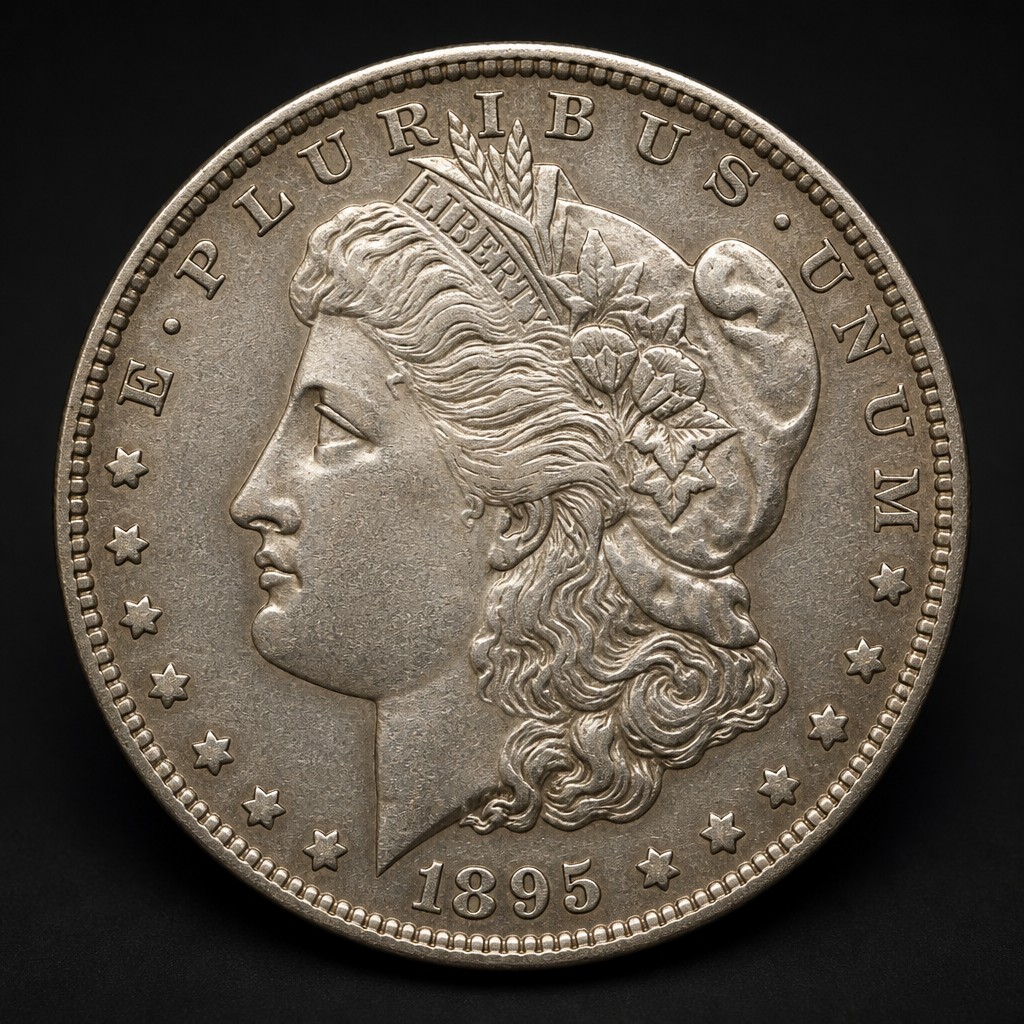
What It Is
The 1895 Morgan dollar carries an unusual story: Mint records show a mintage of business strikes, yet none are known to survive or have ever been authenticated in circulated form from Philadelphia. Every genuine 1895 Morgan dollar with no mint mark that exists today is a proof coin, struck in small numbers for collectors, earning it the nickname "King of Morgan Dollars."
Obverse Design
The obverse shows Liberty's head facing left, wearing a cap wreathed with wheat and cotton, with a band reading "LIBERTY" across her hair. Stars encircle the portrait and the date sits below, matching the standard Morgan dollar design used from 1878 to 1921.
Reverse Design & Inscriptions
The reverse depicts an eagle with wings outstretched, holding an olive branch and arrows, set within a wreath. "E PLURIBUS UNUM" arches above the eagle, "IN GOD WE TRUST" sits just above that near the rim, "UNITED STATES OF AMERICA" wraps the border, and "ONE DOLLAR" appears below the wreath.
Size, Weight, Metal, and Edge
Like all Morgan dollars, it weighs 26.73 grams, is struck in .900 fine silver, measures 38.1 mm in diameter, and has a reeded edge.
Mint Marks and Where to Find Them
Philadelphia-struck Morgan dollars carry no mint mark. Business strikes from that year exist only with an "O" (New Orleans) or "S" (San Francisco) mint mark below the wreath on the reverse. A coin dated 1895 with no mint mark should show the characteristics of a proof coin, not a worn circulation piece.
Telling a Genuine Proof From an Altered Coin
Genuine 1895 proofs display mirror-like, reflective fields, crisp and squared-off rims, and fully struck-up design details, since proof coins were struck multiple times on specially polished dies and planchets. A coin dated 1895 with no mint mark that instead shows the dull luster and softer strike typical of an ordinary business-strike Morgan dollar is not consistent with any known genuine example and warrants serious scrutiny.
Judging Condition at a Glance
On a genuine proof, look for retained mirror reflectivity in the fields even on lower-grade examples, along with wear beginning on Liberty's cheek and hair above the ear, and on the eagle's breast feathers.
Authenticity Red Flags
Because a business-strike 1895 Philadelphia dollar is not a legitimately known coin, any example presented as one should be treated with heavy skepticism — this includes coins that may have had a mint mark removed or altered to make an 1895-O or 1895-S appear as a plain 1895. Look closely at the mint mark area below the wreath for file marks, texture differences, or an irregular surface that would indicate tampering. Third-party grading and authentication are strongly advised before assigning any value to a coin claimed to be this date.
Frequently asked questions
Why is the 1895 Morgan dollar called the 'King of Morgans'?
Because no business-strike (circulated) examples from Philadelphia are known to exist — only proof coins from that year with no mint mark are recognized as genuine.
Are there other 1895 Morgan dollars besides the Philadelphia proof?
Yes, 1895-O and 1895-S business strikes were made in New Orleans and San Francisco and carry those mint marks below the wreath on the reverse.
How do I know if a proof coin is genuine?
Genuine proofs show mirror-like fields, sharp squared rims, and a fully struck design, unlike the softer look of an ordinary circulation strike.
What should make me suspicious of a plain 1895 Morgan dollar?
Dull surfaces typical of a business strike, or any sign that a mint mark was removed from the reverse below the wreath, are red flags since no genuine business strike from Philadelphia is known.