
How to Identify the 1892 Barber Quarter
A visual guide to the 1892 Barber Quarter, the first year of the design, explaining its obverse and reverse features, specifications, and how to check for tampering.
Read the full 1892 Barber Quarter encyclopedia entry →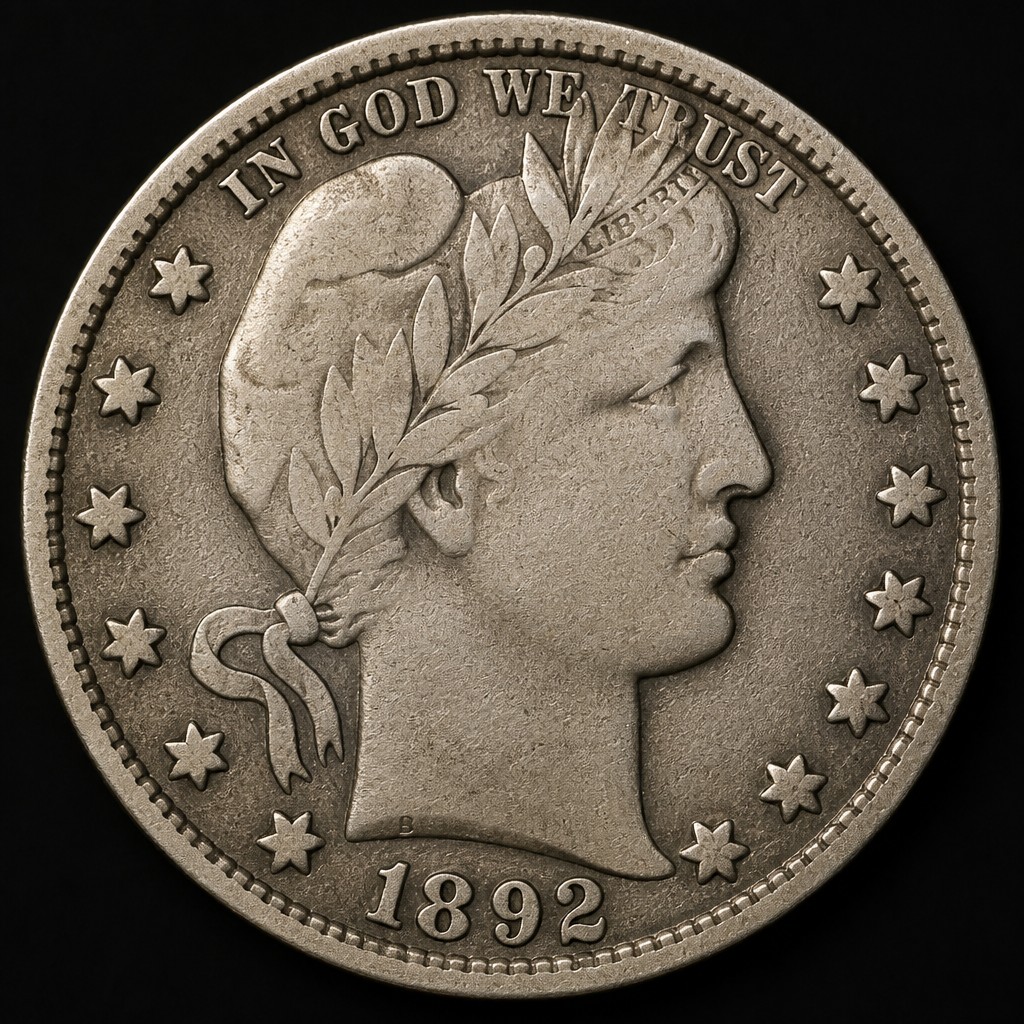
What This Coin Is
The 1892 quarter is the debut issue of Charles E. Barber's design, which replaced the Seated Liberty quarter and ran through 1916. Philadelphia struck the bulk of the mintage that year, with New Orleans also producing coins carrying an "O" mint mark.
Obverse Design
The obverse shows Charles E. Barber's right-facing portrait of Liberty. She wears a Phrygian cap wrapped in a laurel wreath, with a headband inscribed "LIBERTY" running above her forehead. Thirteen stars circle the rim, six to the left and seven to the right, and the date sits at the bottom just above the rim.
Reverse Design
The reverse carries a heraldic eagle with wings spread, a striped shield on its breast, an olive branch in one talon and arrows in the other. "UNITED STATES OF AMERICA" arches around the top rim, and "QUARTER DOLLAR" curves along the bottom.
Size, Weight, Metal, and Edge
Like all Barber quarters, it is struck in 90% silver and 10% copper, weighs 6.25 grams, measures 24.3 mm across, and has a reeded edge. There is no copper-nickel version; any example that doesn't look silver-white on a fresh break or edge should be checked carefully.
Mint Mark Location
Barber quarter mint marks appear on the reverse, in the space below the eagle, just above "DOLLAR"; Philadelphia coins from 1892 show no mint mark, while an "O" indicates New Orleans. Philadelphia coins show no mint mark at all; look closely with a loupe, since a small "S" or "D" can be mistaken for a die mark or dirt if the coin is worn or dirty.
Telling It Apart from Similar Coins
Since 1892 is the first year of the type, there is no earlier Barber quarter to confuse it with, but it can be mistaken at a glance for a worn Seated Liberty quarter from 1891 or earlier if the date is unclear. Barber's design is distinguished by Liberty's cap and headband profile and the heraldic eagle, versus the seated figure and wreath reverse of the earlier type.
Judging Condition at a Glance
Wear shows first on the high points: the hair above Liberty's forehead and the leaves of the wreath on the obverse, and the eagle's breast feathers and the top of the wings on the reverse. A coin that still shows separated hair strands and a mostly complete "LIBERTY" on the headband is in the About Uncirculated to Mint State range; heavy wear that flattens the headband letters and smooths the eagle's breast points to a Good or Very Good grade. As a first-year issue in a design later struck for 24 years, condition and eye appeal matter more to identification confidence than rarity, since Philadelphia and New Orleans mintages that year were fairly substantial.
Authenticity Red Flags
Because several San Francisco-minted Barber quarters carry small mintages and strong premiums, common Philadelphia coins are sometimes altered by adding a fake "S" to the reverse. Warning signs include a mint mark that looks flatter, shinier, or differently shaped than genuine examples, tool marks or a slightly raised halo around the letter, and a font style that doesn't match the coin's era. Comparing the mint mark's size, shape, and position against verified photos of the same date is the most reliable way to check by eye.
Frequently asked questions
Is 1892 the first year of the Barber quarter?
Yes, it is the debut year of Charles E. Barber's design, which continued through 1916.
How do I know if my 1892 quarter is from New Orleans?
Look for a small 'O' mint mark on the reverse below the eagle; a coin with no mint mark there was struck in Philadelphia.
What is the composition and weight?
90% silver, 10% copper, weighing 6.25 grams, with a 24.3 mm diameter.
How can I tell a Barber quarter from a Seated Liberty quarter?
The Barber quarter shows Liberty's head in profile wearing a cap, while the Seated Liberty quarter depicts a full seated figure on the obverse.