
How to Identify the 1885 Trade Dollar
The 1885 Trade dollar is an extreme rarity known only in proof format, with no official mintage record, making it one of the most celebrated coins in American numismatics.
Read the full 1885 Trade Dollar encyclopedia entry →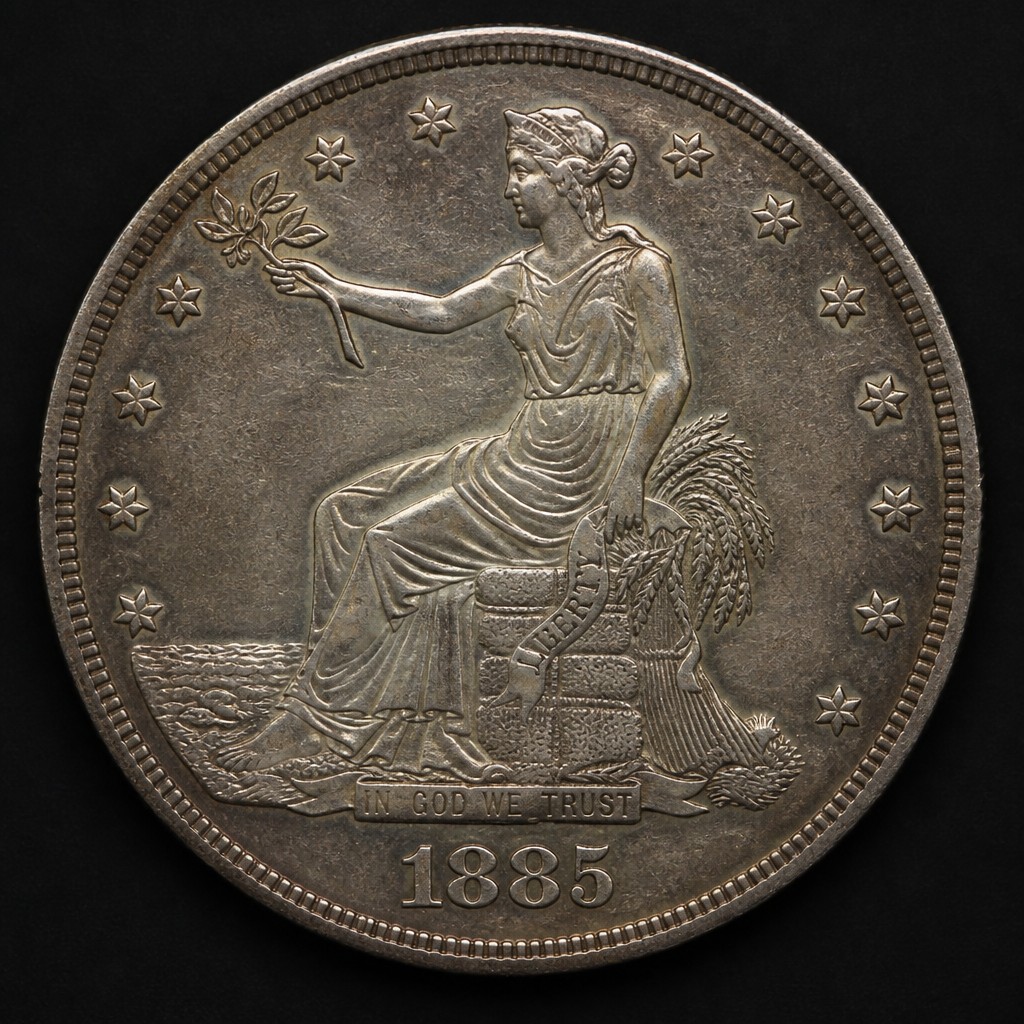
What It Is
The Trade dollar series was struck from 1873 to 1885 primarily for use in trade with Asia, particularly China. The 1885 date is exceptionally rare: only a small number of proof specimens are known, and no official mintage was ever recorded in Mint documents, meaning these coins were apparently struck without formal authorization and only came to light years later.
Obverse Design
Liberty sits facing left on a bale of goods, holding an olive branch, with the ocean and a ship visible behind her, symbolizing trade and commerce. "IN GOD WE TRUST" appears below her, "LIBERTY" is inscribed on a tablet beneath her arm, stars surround the design, and the date sits at the bottom.
Reverse Design
An eagle stands on a bundle of arrows and an olive branch. "UNITED STATES OF AMERICA" arches along the top, "TRADE DOLLAR" appears below, and a ribbon around the eagle reads "420 GRAINS, 900 FINE," a weight and fineness statement included specifically so foreign merchants could trust the coin's silver content.
Size, Weight, and Edge
The coin weighs 27.22 grams (420 grains) at .900 fine silver, larger and heavier than the standard silver dollar of the time, with a diameter of 38.1mm and a reeded edge.
Mint Marks
The known 1885 Trade dollars were struck at Philadelphia and carry no mint mark. Earlier Trade dollar dates included coins from Carson City ("CC") and San Francisco ("S"), but no 1885 examples from those mints are known to exist.
Telling It Apart From Similar Coins
Because 1885 is such a rare date, any candidate should be checked against the small number of documented genuine specimens. Confirm the proof-quality mirrored surfaces expected of this issue, the "420 GRAINS, 900 FINE" ribbon text, and correct positioning of all design elements matching genuine Trade dollars from surrounding years, since the design is otherwise consistent with 1873-1885 issues.
Judging Condition at a Glance
Genuine known examples are proofs with sharp strikes and reflective fields, so a worn or circulated-looking 1885 Trade dollar would be highly inconsistent with the coin's documented history and warrants serious skepticism.
Authenticity Red Flags
Given its extraordinary rarity, an 1885-dated Trade dollar found outside carefully documented collections should be treated with great caution. Altered dates from more common Trade dollar years such as 1878 through 1883 are a known concern, so examine the "5" in the date closely under magnification for any sign of re-engraving, tool marks, or an inconsistent font compared to the other digits.
Frequently asked questions
Why is the 1885 Trade dollar so rare?
No official mintage was recorded for that year, and only a small number of proof specimens are known, suggesting they were struck without formal Mint authorization.
What does the reverse ribbon text mean?
It reads 420 GRAINS, 900 FINE, stating the coin's silver weight and purity so foreign traders could verify its value at a glance.
Does the 1885 Trade dollar have a mint mark?
No, the known examples were struck at Philadelphia and carry no mint mark.
What should raise suspicion about an 1885 Trade dollar?
Circulated wear inconsistent with the coin's known proof-only status, or a date that looks altered from a more common year, both warrant close examination under magnification.