
How to Identify the 1885 Liberty Head V Nickel
How to recognize the 1885 Liberty Head Nickel, a key date in the series known for its low mintage, plus its design and mint identification points.
Read the full 1885 Liberty Head V Nickel encyclopedia entry →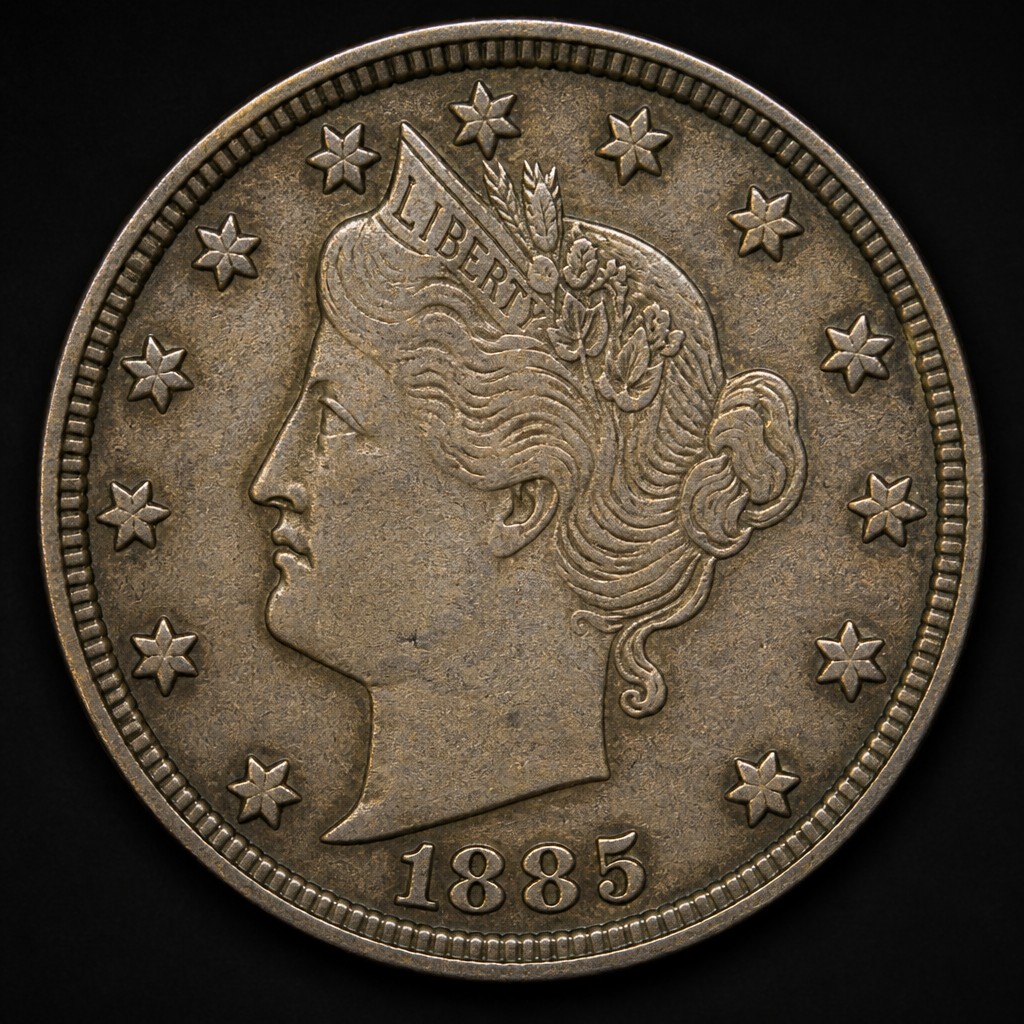
What It Is
The 1885 Liberty Head Nickel, often called the "V Nickel" for the large Roman numeral V on its reverse, is one of the scarcest business-strike dates in the series. It was struck only at the Philadelphia Mint and is prized by collectors as a key date needed to complete a full Liberty Head set, standing alongside the 1912-S and the famously unauthorized 1913 issue as one of the dates that most tests a collector's budget and patience.
Obverse Design
The obverse shows Liberty's head facing left, wearing a coronet inscribed LIBERTY across the front. Stars encircle the portrait near the rim, and the date sits below the bust truncation at the bottom of the coin.
Reverse Design
The reverse is dominated by a large Roman numeral "V" at the center, encircled by a wreath of corn, wheat, cotton, and tobacco leaves reflecting American agriculture. UNITED STATES OF AMERICA arcs around the top border, and the word CENTS appears beneath the wreath at the bottom, a feature added to the design starting in 1883.
Size, Weight, Metal, Edge
The coin measures 21.2mm across, weighs 5.00 grams, and is struck in 75% copper and 25% nickel. The edge is plain, without reeding.
Mint Marks
No mint mark appears on 1885 Liberty Head Nickels, since all examples were produced at the Philadelphia Mint that year. A coin without a mint mark below the wreath ribbon on the reverse is consistent with this date, as Philadelphia coins from this era never carried a mint mark letter.
Telling It Apart from Similar Coins
Because this date is valuable, compare its date numerals carefully to other 1880s Liberty Nickels for signs of alteration, such as an "8" reshaped from another digit or an added final numeral. The wreath and lettering style should match other Liberty Head Nickels of the "with CENTS" type used from 1883 onward; a reverse without the word CENTS indicates an earlier 1883 "No Cents" coin, not a genuine 1885.
Grading at a Glance
Wear shows first on Liberty's hair above the forehead and on the cheek, which are the highest points of the obverse design. On the reverse, check the ribbon bow at the bottom of the wreath and the fine details of the leaves, which wear down quickly with circulation. A coin with a full, well-defined wreath and a sharp numeral V generally grades higher than one with blended, indistinct detail.
Authenticity Red Flags
Because the 1885 is one of the more valuable dates in the series, watch for an altered date, particularly a "3" or other digit reworked to resemble an "8," and for added or re-engraved digits meant to convert a common date into this scarce one. Look under magnification for tool marks, unnatural metal texture around the date, or a mismatch between the wear on the date and the wear on the rest of the coin, which can indicate tampering by someone attempting to pass off a common coin as a key date.
Frequently asked questions
Why is the 1885 Liberty Head Nickel considered a key date?
It has one of the lowest mintages in the series, making original examples scarce and sought after.
Does the 1885 nickel have a mint mark?
No, it was struck only at Philadelphia, which did not use a mint mark at the time.
How is the 1885 reverse different from an 1883 No Cents nickel?
The 1885 reverse includes the word CENTS below the wreath, while the 1883 No Cents version omits it entirely.
What should I check if I suspect an altered date?
Look closely under magnification for tool marks, unnatural texture, or a digit shape that doesn't match the surrounding wear pattern.