
How to Identify the 1878 Twenty-Cent Piece (Proof)
An identification guide to the 1878 twenty-cent piece, the final year of the series and a proof-only issue, covering its design, proof characteristics, and authenticity considerations.
Read the full 1878 Twenty-Cent Piece (Proof) encyclopedia entry →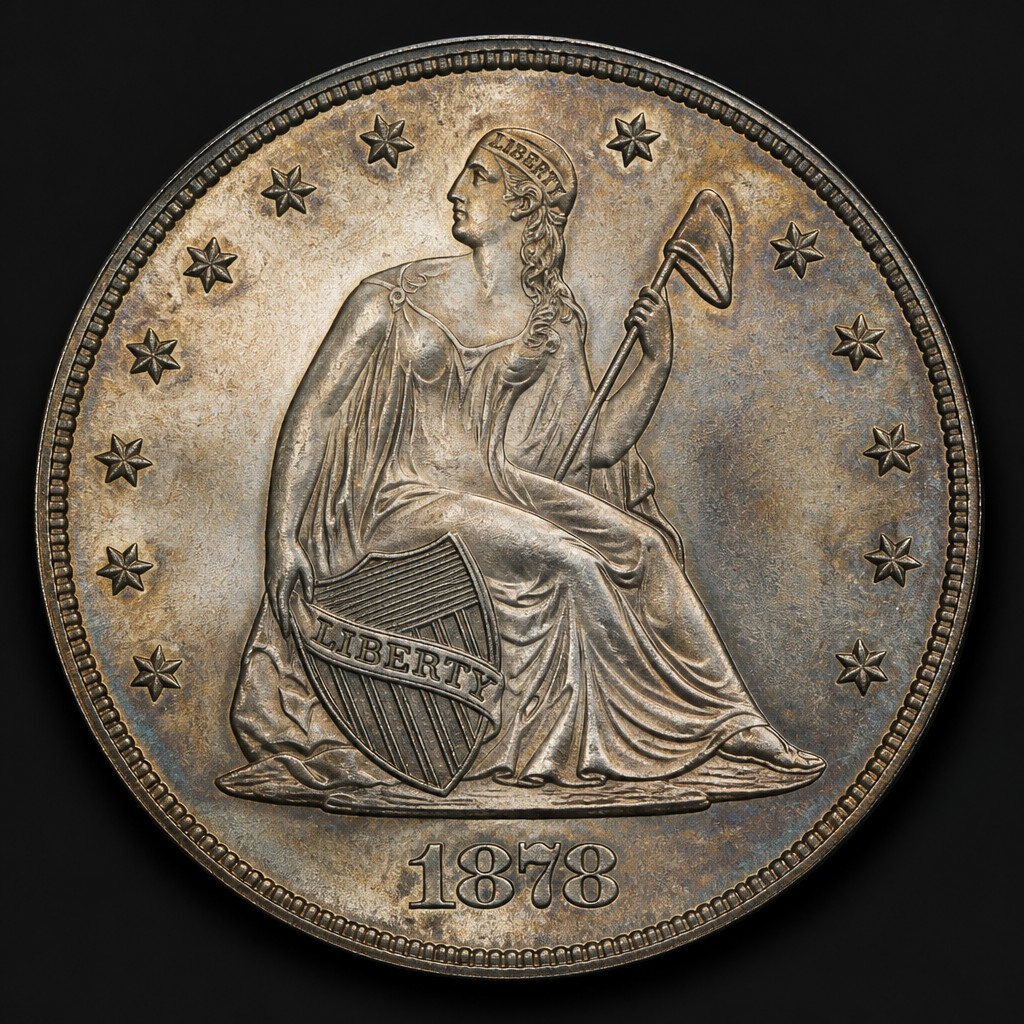
What It Is
1878 was the last year the twenty-cent piece was struck, and like 1877, it was produced only in proof format for collectors, with no coins made for circulation, marking the end of this short-lived and often-confused denomination.
Obverse Design
Liberty sits holding a shield inscribed "LIBERTY," with a liberty cap on a pole behind her, stars around the rim, and the date at the bottom, in the same general style used since the series began in 1875.
Reverse Design
An eagle with spread wings grips arrows and an olive branch, with "UNITED STATES OF AMERICA" around the border and "TWENTY CENTS" below.
Size, Weight, Metal & Edge
The coin is 22mm across, weighs 5 grams, is struck in 90% silver, and has a plain, smooth edge rather than a reeded one, consistent with every other twenty-cent piece in the series.
Mint Marks
There is no mint mark, since the 1878 twenty-cent piece, like the 1877, was struck exclusively at Philadelphia in proof format for collectors only.
Telling It Apart from Similar Coins
As the final year of issue and a proof-only date, any genuine 1878 twenty-cent piece should show unmistakable proof qualities: mirror-like fields, sharp rims, and fully struck details across the design. A worn or dull-surfaced example claiming to be this date would be inconsistent with how it was actually produced, since no circulating coins of this date exist.
Judging Condition at a Glance
Grading focuses on the preservation of the mirrored fields, any cameo contrast between frosted devices and reflective fields, and the presence of hairlines or spots acquired from handling, rather than on wear from circulation, which this issue never experienced.
Authenticity Red Flags
Because this date closed out the series and survives only as a proof issue, watch for coins with soft or blurred design details, incorrect weight or diameter, or toning that appears applied to disguise a non-proof surface underneath. Consistency of strike and surface quality across the whole coin supports authenticity, while any signs of casting, seam lines, or a grainy texture do not and should prompt further scrutiny or professional evaluation.
Frequently asked questions
Was the 1878 twenty-cent piece the last of its series?
Yes, 1878 was the final year the twenty-cent piece was struck before the denomination was discontinued.
Were any 1878 twenty-cent pieces made for circulation?
No, like 1877, only proof coins were struck that year, with no business-strike examples.
Does the 1878 twenty-cent piece carry a mint mark?
No, it was struck only at Philadelphia, which did not use a mint mark during this period.
What proof qualities should I check for authenticity?
Deeply mirrored fields, sharply squared rims, and crisp design details consistent across the whole coin, rather than dull or worn surfaces.
Why was the twenty-cent piece discontinued after 1878?
Ongoing public confusion with the similarly sized quarter dollar led to declining demand, and the Mint ultimately ended the denomination.