
How to Identify the 1877 Twenty-Cent Piece (Proof)
A guide to identifying the 1877 twenty-cent piece, a key date struck only in proof format for collectors, covering its design, proof characteristics, and how to spot a coin misrepresented as a business strike.
Read the full 1877 Twenty-Cent Piece (Proof) encyclopedia entry →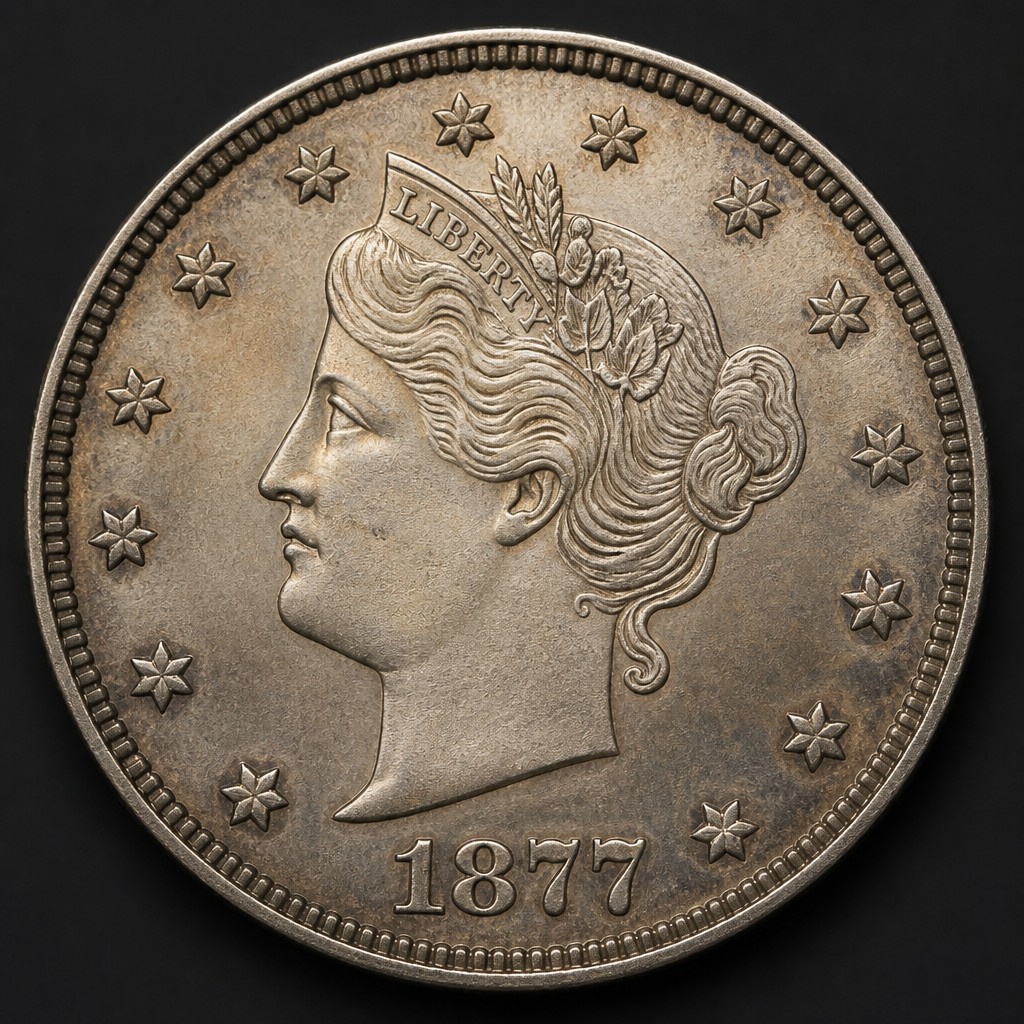
What It Is
By 1877, public and commercial demand for the twenty-cent denomination had largely collapsed, and the Philadelphia Mint struck only a small number of proof coins that year specifically for collectors, with no coins made for general circulation. This makes the 1877 one of the key dates of the series and available only in proof condition.
Obverse Design
The familiar Seated Liberty design appears: Liberty seated, holding a shield inscribed "LIBERTY," with a liberty cap on a pole behind her, stars around the border, and the date at the bottom.
Reverse Design
An eagle with spread wings holds arrows and an olive branch, with "UNITED STATES OF AMERICA" around the rim and "TWENTY CENTS" below, matching the format used throughout the series.
Size, Weight, Metal & Edge
The coin measures 22mm in diameter, weighs 5 grams, is struck in 90% silver, and has a plain, smooth edge rather than a reeded one.
Mint Marks
There is no mint mark, since the 1877 twenty-cent piece was struck only at Philadelphia, and Philadelphia coins of this era did not carry a mint mark of any kind.
Telling It Apart from Similar Coins
Because no business strikes were made in 1877, any genuine example should display clear proof characteristics: deeply mirrored fields, sharply squared rims, and fully struck design elements throughout. A coin claimed to be a circulated 1877 twenty-cent piece is inconsistent with the coin's known production history and warrants closer scrutiny before being accepted as genuine.
Judging Condition at a Glance
Proof coins are evaluated by the quality of their mirrored surfaces, the presence of hairlines or contact marks acquired from handling, and whether any cameo frosting remains on the raised design elements, rather than by traditional circulation wear, since these coins were never meant to pass through commerce.
Authenticity Red Flags
Given the rarity and value of this date, look for reproductions with soft or indistinct design details, incorrect weight or diameter, or artificial toning applied to mask surface flaws or a non-proof finish underneath. Genuine Philadelphia proofs from this era show sharp, consistent strike quality across the entire coin, from the rim denticles to the finest details of Liberty's gown and the eagle's feathers.
Frequently asked questions
Was the 1877 twenty-cent piece struck for circulation?
No, only proof coins were struck in 1877 for collectors; no circulation-strike examples exist.
How can I tell if a coin has genuine proof surfaces?
Look for deeply mirrored, reflective fields, sharply squared rims, and crisp, fully struck design details rather than a dull, satin finish.
Does the 1877 twenty-cent piece have a mint mark?
No, it was struck only at Philadelphia, which did not use a mint mark at the time.
What should concern me if a coin is offered as a worn 1877 example?
Since no business strikes were made that year, a coin showing circulation wear rather than proof surfaces is inconsistent with the known mintage and deserves closer examination.
Why did the Mint stop making twenty-cent pieces for circulation that year?
Public demand for the denomination had dropped sharply due to confusion with the quarter dollar, leading the Mint to strike only limited proof issues for collectors.