
How to Identify the 1877 Shield Nickel (Proof Only)
How to recognize the 1877 Shield Nickel, a proof-only date with no business strikes, and the surface traits that distinguish genuine proofs.
Read the full 1877 Shield Nickel (Proof Only) encyclopedia entry →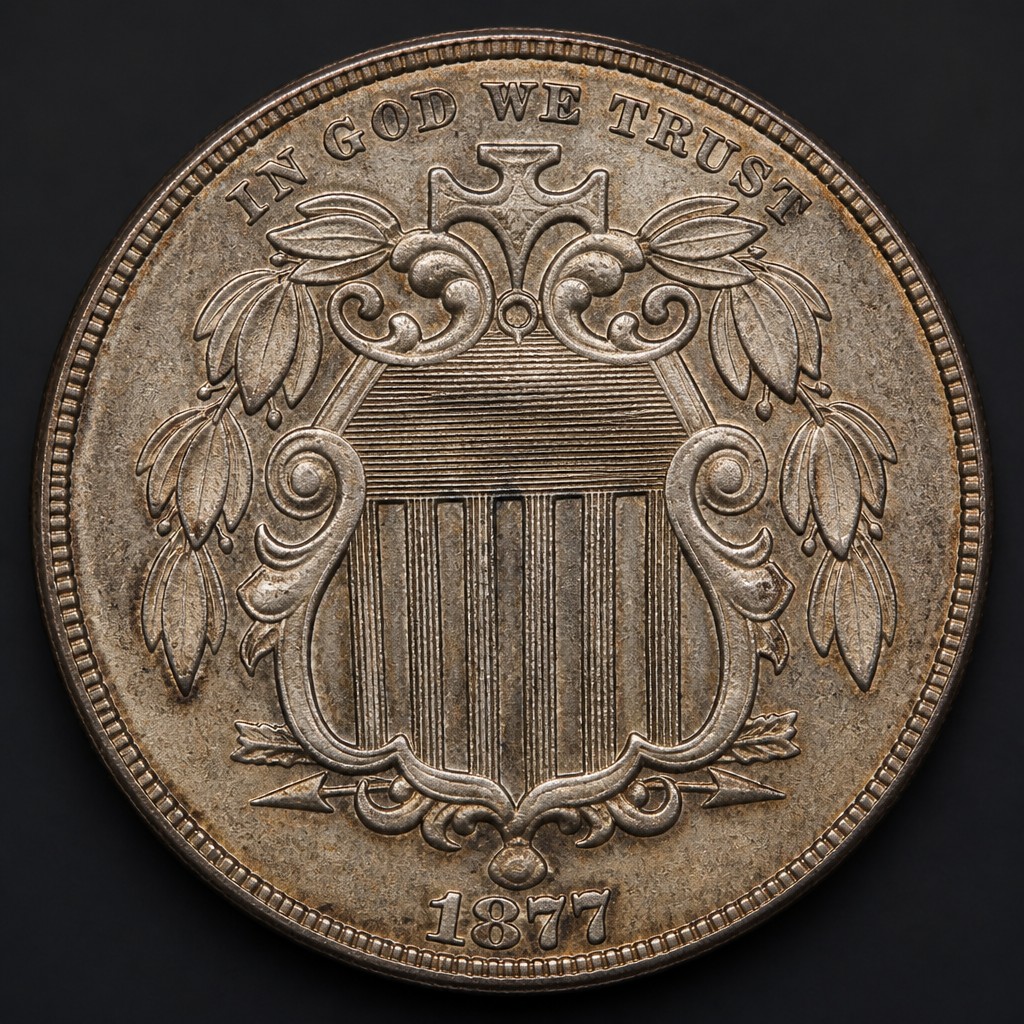
What It Is
The 1877 Shield Nickel is a proof-only date, meaning the Mint produced no coins for general circulation that year, only a small number of proof coins struck specifically for collectors. This makes it one of the key dates in the Shield Nickel series, valued both for its rarity and for the exceptional strike quality that all proof coinage from this era typically shows. Because it was never intended for commerce, any 1877 nickel in existence today has spent its entire life in the hands of collectors rather than in circulation.
Obverse Design
The obverse shows a heraldic shield with vertical stripes below a horizontal band, above crossed arrows and an olive branch, with the date at the bottom edge of the coin.
Reverse Design
The reverse features a large numeral 5 at the center, surrounded by a ring of stars with plain fields and no rays, consistent with the No Rays style used from mid-1867 onward for the remainder of the series. UNITED STATES OF AMERICA arcs around the top.
Size, Weight, Metal, Edge
The coin measures 20.5mm in diameter, weighs 5.00 grams, is composed of 75% copper and 25% nickel, and has a plain edge, the same specifications used across all Shield Nickels regardless of date.
Mint Marks
All Shield Nickels, including the 1877, were struck only at Philadelphia and carry no mint mark, since this series was never produced at any branch mint.
Proof Surface Characteristics
Genuine proofs from this era typically show sharp, squared rims, fully struck design details, and mirror-like or deeply reflective fields, since they were struck multiple times on specially polished planchets with polished dies to achieve that finish. Any 1877 Shield Nickel should show these proof characteristics; a coin with soft details, rounded rims, or a dull, satin-like surface would be inconsistent with a genuine proof-only date and should raise questions.
Grading at a Glance
Because this date exists only as a proof, condition is judged by the presence of hairlines, spotting, or handling marks in the mirrored fields rather than by wear in the traditional sense, since proofs were never intended for circulation in commerce. A coin with clean, undisturbed mirror fields and sharp design elements throughout is considered the higher-quality example.
Authenticity Red Flags
Because 1877 is scarce and valuable, be alert to altered dates on more common Shield Nickels from nearby years, or to coins presented as proofs that actually show circulation wear, weak strikes, or a lack of mirrored fields. A coin lacking the sharp rims and reflective surfaces typical of genuine 19th-century proof coinage warrants closer scrutiny before it is accepted as a legitimate example of this date.
Frequently asked questions
Were any 1877 Shield Nickels made for circulation?
No, only proof coins were struck in 1877; there were no business strikes.
How can I tell if my coin is a genuine proof?
Genuine proofs show sharp, squared rims and mirror-like reflective fields with fully struck design details, unlike coins meant for circulation.
Does the 1877 Shield Nickel have rays on the reverse?
No, by 1877 the design used the No Rays style, with a plain field between the stars.
What should raise concern about an 1877 nickel's authenticity?
Signs of actual circulation wear, weak details, or dull surfaces instead of the mirrored fields expected of a proof-only date.