
How to Identify the 1875-CC Twenty-Cent Piece
A visual identification guide to the 1875-CC twenty-cent piece, covering its Seated Liberty design, plain edge, Carson City mint mark, and how to distinguish it from a quarter dollar.
Read the full 1875-CC Twenty-Cent Piece encyclopedia entry →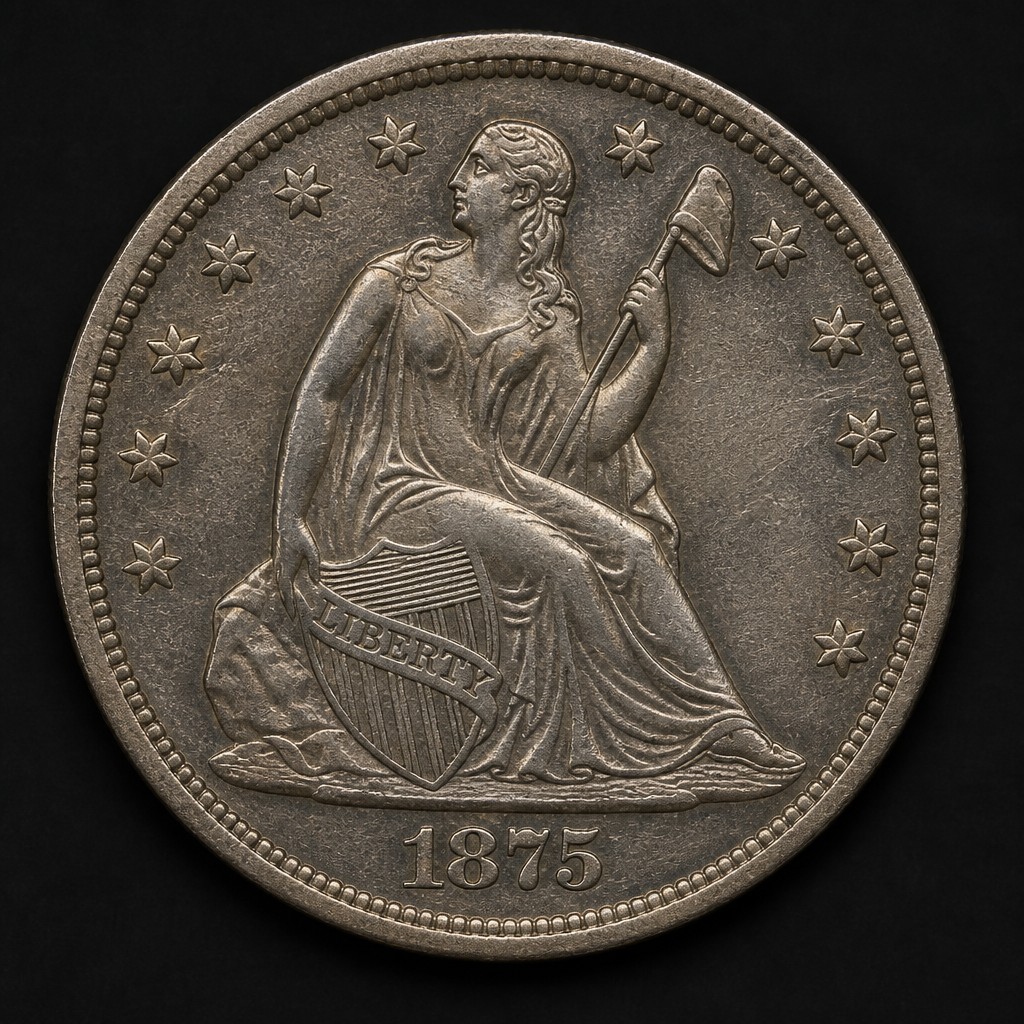
What It Is
The twenty-cent piece was a short-lived denomination struck from 1875 to 1878, created to fill a perceived gap in small change but quickly discontinued because its size was too easily confused with the quarter dollar already in circulation. The 1875-CC was struck at the Carson City mint in Nevada, one of three mints that produced this denomination during its brief run.
Obverse Design
A seated figure of Liberty holds a shield inscribed with "LIBERTY," with a pole and liberty cap resting behind her against her arm. Stars surround the border, and the date sits at the bottom beneath Liberty's feet.
Reverse Design
An eagle with spread wings grips arrows in one talon and an olive branch in the other, with "UNITED STATES OF AMERICA" around the border and "TWENTY CENTS" below. Unlike the quarter dollar of the same period, the twenty-cent piece's reverse does not carry "E PLURIBUS UNUM."
Size, Weight, Metal & Edge
It measures 22mm in diameter, weighs 5 grams, and is struck in 90% silver. Critically, the edge is plain, or smooth, not reeded, a deliberate design choice meant to help the public tell it apart from the quarter, though public confusion persisted anyway and contributed to the coin's quick discontinuation.
Mint Mark Location
The "CC" mint mark appears on the reverse, below the eagle and just above the words "TWENTY CENTS."
Telling It Apart from Similar Coins
The smooth, plain edge is the fastest way to separate a twenty-cent piece from a similarly sized quarter dollar of the era, which always has a reeded edge. The obverse Seated Liberty design is quite similar in overall appearance to the Seated Liberty quarter, so checking the edge type together with the "TWENTY CENTS" wording on the reverse confirms the denomination beyond doubt.
Judging Condition at a Glance
Check Liberty's head, breast, and knee on the obverse, and the eagle's breast and wing tips on the reverse, since these areas flatten first with circulation wear. Well-preserved examples retain sharp detail in the folds of Liberty's gown and the feathers of the eagle's wings.
Authenticity Red Flags
Because of the design's similarity to the quarter, examine the edge type and overall diameter closely to rule out an altered or misidentified coin being passed off as a twenty-cent piece. Watch for an added "CC" mint mark placed on a common Philadelphia twenty-cent piece to inflate its apparent rarity; compare the size, font, and placement of the mint mark to verified Carson City strikes of the era, and look for tooling or surface disturbance around it that would suggest later alteration.
Frequently asked questions
How is the twenty-cent piece different from a quarter?
The most reliable way is the edge: the twenty-cent piece has a plain, smooth edge, while the quarter has a reeded edge.
Where is the CC mint mark located?
On the reverse, below the eagle and just above the words TWENTY CENTS.
Why was the twenty-cent piece discontinued so quickly?
Its size was too close to the quarter dollar, causing frequent public confusion despite the smooth edge meant to distinguish it.
What metal is the 1875-CC twenty-cent piece made of?
It is struck in 90% silver, weighing 5 grams.
What does the reverse motto situation look like compared to a quarter?
The twenty-cent piece reverse omits E PLURIBUS UNUM, which does appear on quarters of the same general period, another useful distinguishing detail.