
How to Identify the 1874-CC Seated Liberty Dime
A guide to the 1874-CC Seated Liberty dime's Arrows-at-date design, Carson City mint mark, and the authenticity checks warranted by its extreme rarity.
Read the full 1874-CC Seated Liberty Dime encyclopedia entry →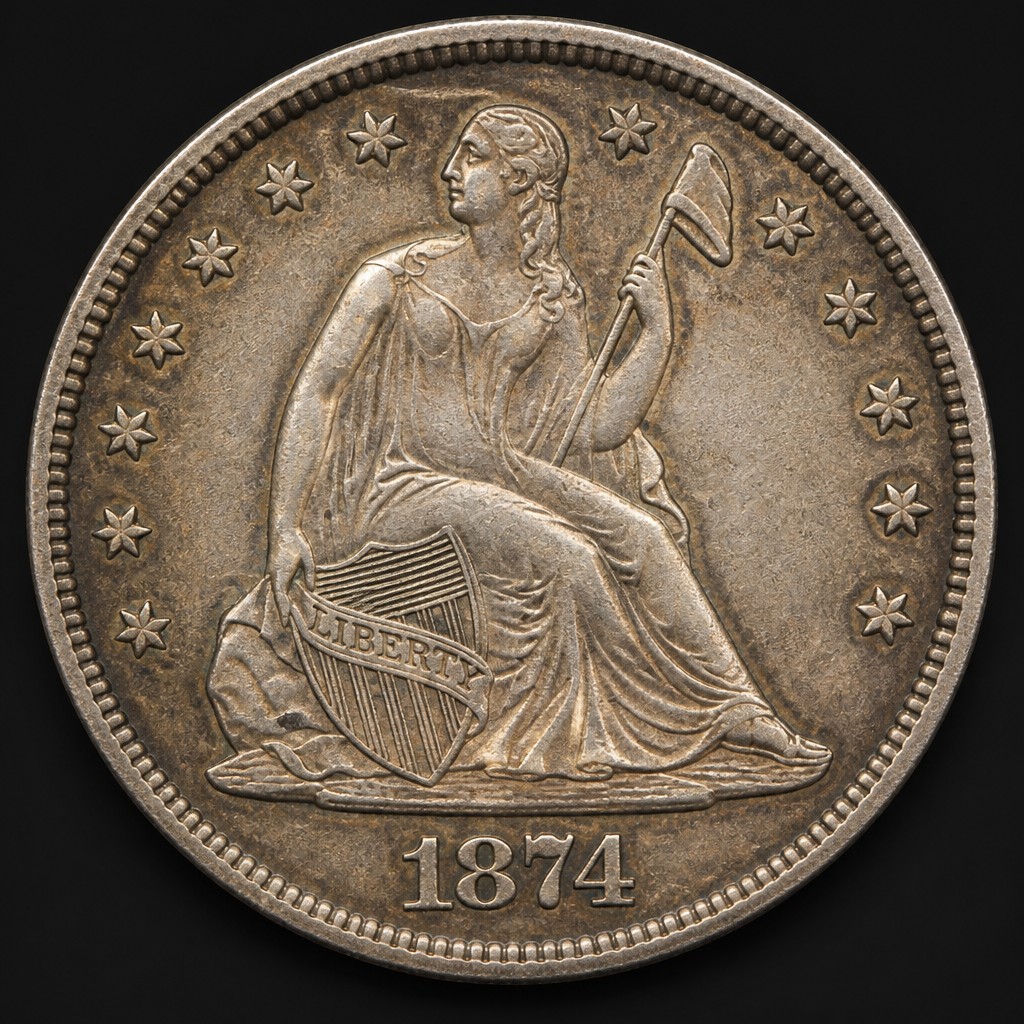
What It Is
The 1874-CC dime is a Seated Liberty dime struck at the Carson City Mint during the brief 1873-1874 "Arrows at Date" period, when a small weight increase to the dime was marked by adding arrows beside the date. It is one of the scarcest Carson City dimes of any date, and it is widely considered one of the great condition rarities among nineteenth-century United States coins.
Obverse Design
Liberty sits on a rock, holding a liberty-cap-topped pole and steadying a shield inscribed LIBERTY. UNITED STATES OF AMERICA appears around the border in place of stars. Small arrowheads flank the date at the bottom, marking the temporary weight change mandated by the Mint Act of 1873.
Reverse Design
The reverse reads "ONE DIME" within a wreath, with the "CC" mint mark in small letters at the base of the wreath.
Size, Weight, Metal, and Edge
The coin measures about 17.9mm in diameter and weighs slightly more than earlier Seated dimes, around 2.5 grams under the revised 1873 standard, with a reeded edge.
Mint Marks
The "CC" mint mark at the base of the reverse wreath identifies Carson City production; this, combined with the arrows beside the date, defines the issue and separates it from Philadelphia and San Francisco strikes.
Telling It Apart From Similar Coins
The arrows beside the date separate 1874-CC from the "No Arrows" 1875-CC and later Carson City dimes, while the CC mint mark separates it from the more available Philadelphia and San Francisco Arrows dimes of 1873-1874. Reading the date directly distinguishes it from the equally rare 1873-CC Arrows dime, since both share the identical design and mint mark placement.
Judging Condition at a Glance
Look for wear on Liberty's knee, breast, and head, and on the wreath ribbon on the reverse. Because the original mintage was extremely small, most known survivors show significant circulation wear, and even modest, problem-free examples are highly desirable to specialists; examples with sharp rims and a full, legible date are especially sought after.
Authenticity Red Flags
Given its extreme rarity and value, the 1874-CC dime is a target for mint mark forgery, typically by adding a fake CC to a Philadelphia or San Francisco Arrows dime of the same date. Examine the mint mark under magnification for correct size, font style, and placement compared to verified genuine examples, checking for file marks, glue residue, or an inconsistent surface texture around the letters. Because of the coin's significant value, authentication by a major grading service is strongly advised before treating any example as genuine, and any coin lacking a documented ownership history should be approached with particular caution.
Frequently asked questions
What do the arrows beside the date mean?
They indicate a brief 1873-1874 increase in the dime's silver weight mandated by federal law; arrows were added to alert the public to the change.
Why is the 1874-CC dime so rare?
It had an extremely small original mintage at the Carson City Mint, and few examples have survived in any condition.
Where is the CC mint mark located?
In small letters at the base of the wreath on the reverse.
How can I tell it apart from the 1873-CC Arrows dime?
By reading the date; the two years share the same design and mint mark placement but are distinguished by the date digits.