
How to Identify the 1871-CC Seated Liberty Dime
A guide to the first-year Carson City dime, its Legend-obverse Seated Liberty design, low mintage, and the authenticity checks its rarity demands.
Read the full 1871-CC Seated Liberty Dime encyclopedia entry →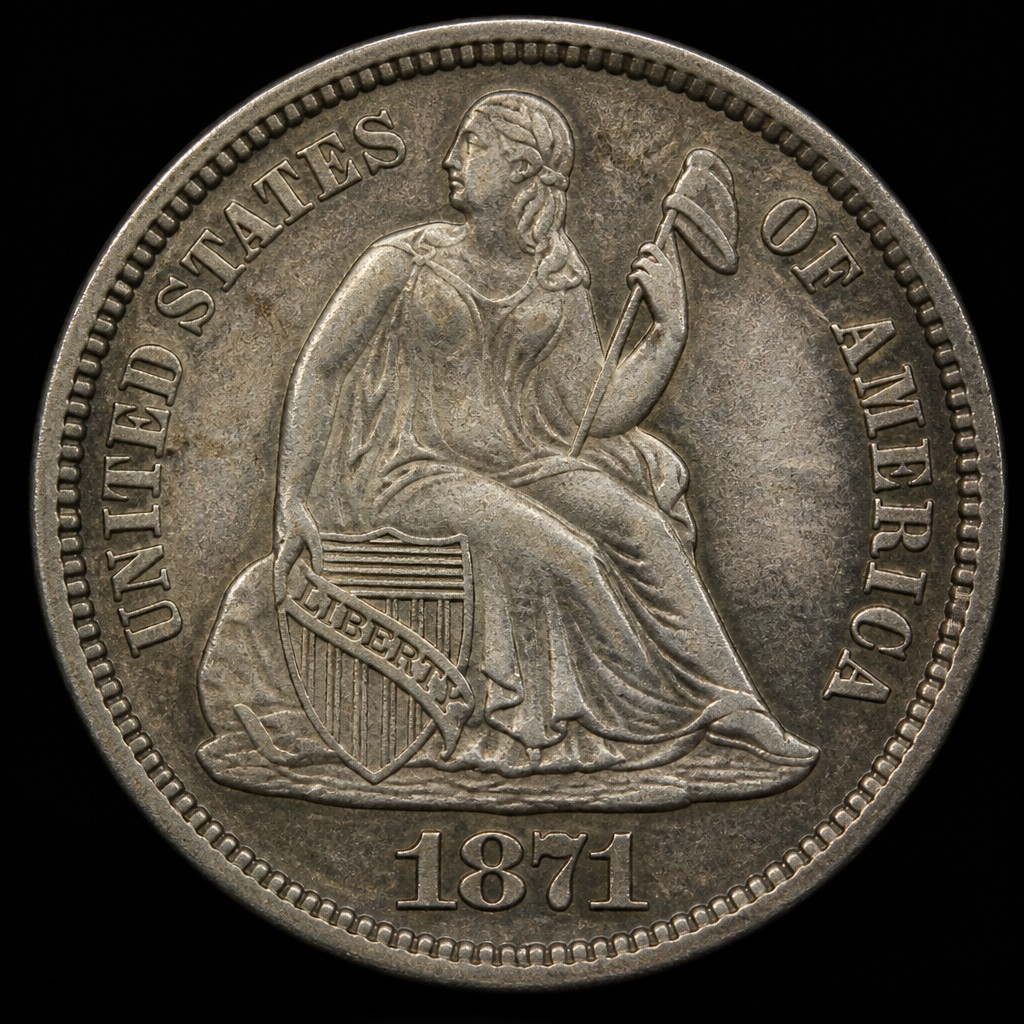
What It Is
The 1871-CC dime marks the first year the Carson City Mint struck the dime denomination. It is a Seated Liberty dime of the "Legend" obverse type used from 1860 onward, and it is one of the great rarities of the entire series due to its very small original mintage, a scarcity made even more pronounced by the heavy use these coins saw in western commerce.
Obverse Design
Liberty sits on a rock, holding a pole topped with a liberty cap in one hand and a shield inscribed LIBERTY with the other. UNITED STATES OF AMERICA circles the border in place of the stars used on earlier Seated Liberty dimes, and the date sits at the bottom with no arrows.
Reverse Design
The reverse reads "ONE DIME" within a wreath, with the small "CC" mint mark placed at the base of the wreath.
Size, Weight, Metal, and Edge
The coin measures about 17.9mm in diameter and weighs approximately 2.67 grams in a silver alloy, with a reeded edge and no edge lettering.
Mint Marks
The "CC" mint mark below the wreath on the reverse identifies this as a Carson City strike, distinguishing it from the Philadelphia (no mint mark) and San Francisco ("S") issues of the same year.
Telling It Apart From Similar Coins
Because 1871 dimes were struck at three different mints, checking for the presence and style of the mint mark below the wreath is the essential step. The Legend obverse (words instead of stars around the border) separates this design era from the earlier "Stars" type Seated Liberty dimes minted before 1860, and comparing overall wear and strike quality to reference photos can help confirm the coin matches genuine Carson City output.
Judging Condition at a Glance
Look at Liberty's knee, breast, and head for the first signs of wear, along with the wreath ribbon on the reverse. Because of the low original mintage and heavy circulation in the frontier economy the coin served, most surviving examples are found in well-worn grades, and coins in mint state are extraordinarily rare.
Authenticity Red Flags
As the first Carson City dime and a recognized key date, the 1871-CC is frequently targeted for mint mark forgery, usually by adding a fake CC to a Philadelphia dime of the same date. Examine the mint mark closely under magnification for correct size, letter style, and position relative to genuine reference examples, watching for tool marks, an uneven surface, or a color mismatch with the surrounding metal. Because of its considerable value, certification from a major grading service is strongly recommended before relying on any example as genuine, particularly since a convincingly added mint mark can be difficult to detect with the naked eye alone.
Frequently asked questions
Why is 1871-CC significant?
It was the first year the Carson City Mint produced dimes, and it had a very low mintage, making it a key date in the Seated Liberty dime series.
Where is the mint mark located?
In small letters ('CC') at the base of the wreath on the reverse.
What is the 'Legend' obverse type?
A Seated Liberty dime design used from 1860 onward where UNITED STATES OF AMERICA appears around the border in place of the 13 stars used earlier.
Why should I be cautious with this date?
Because of its rarity and value, it is a common target for fake mint marks added to more common Philadelphia coins.