
How to Identify the 1870 Victoria Twenty-Five Cents
The first twenty-five cent coin issued for the Dominion of Canada, dated 1870, featuring young Queen Victoria and a maple leaf wreath reverse.
Read the full 1870 Victoria Twenty-Five Cents encyclopedia entry →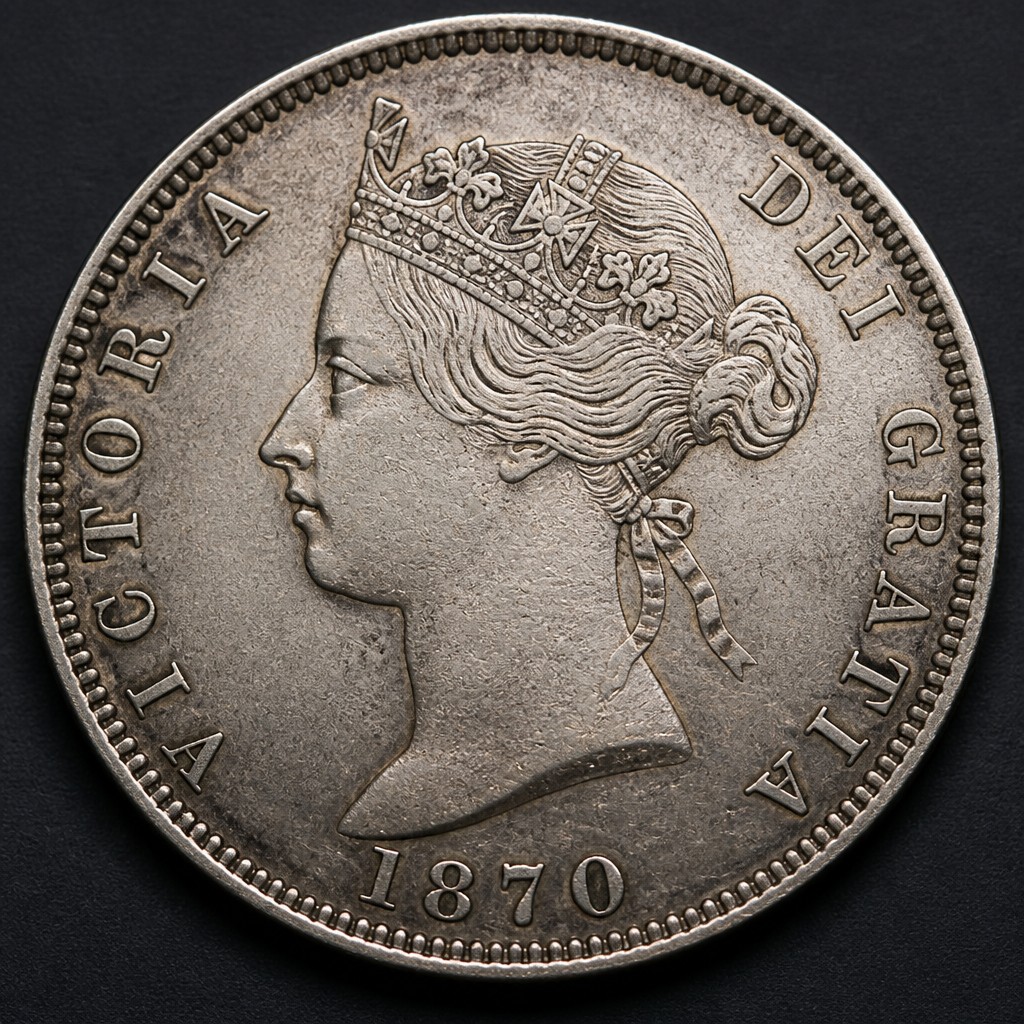
What It Is
This coin represents the first twenty-five cent piece issued for the newly formed Dominion of Canada after Confederation in 1867. It replaced the earlier, short-lived twenty-cent denomination that the Province of Canada had issued in 1858, establishing the twenty-five cent quarter as the standard silver coin of that value going forward.
Obverse Design
The obverse shows a young portrait of Queen Victoria facing left, with the legend VICTORIA DEI GRATIA REGINA CANADA.
Reverse Design
The reverse displays a wreath of maple leaves surrounding "25 CENTS" and the date "1870," with no additional lettering.
Size, Weight, Metal & Edge
The coin is struck in .925 sterling silver, about 23.88mm in diameter and roughly 5.81 grams in weight, with a reeded edge.
Mint Marks
The 1870 issue was produced by the Royal Mint in London and carries no mintmark. Some later Victorian-era quarters from the mid-1870s onward can carry a small "H" for Heaton's Mint.
Telling It Apart From Similar Coins
This coin should not be confused with the earlier, short-lived 1858 twenty-cent piece, which is a different, discontinued denomination; the reverse text ("25 CENTS" versus "20 CENTS") makes the distinction clear. It is otherwise similar in general design style to later Victorian twenty-five cent coins, so the date is the main way to confirm this is the first-year 1870 issue. It should also not be mistaken for the smaller-diameter ten-cent or five-cent pieces of the same design family, since the quarter is noticeably larger and heavier than either.
Judging Condition
Check Victoria's hair curls and the wreath's leaf detail for wear; the highest points of the portrait and the outer edge of the wreath tend to show flattening first. Because this denomination saw heavy commercial use, well-struck examples retaining sharp definition throughout the wreath and portrait are less commonly encountered than moderately worn pieces.
Authenticity Red Flags
Because larger, more valuable silver coins are somewhat more likely to attract counterfeiting than minor denominations, verify diameter and weight against known specifications for any 1870 quarter in question. Look for soft, mushy details or unusual seams that can indicate a cast fake, as opposed to the sharp, crisp lines typical of a genuinely struck coin. Also check the edge reeding for consistency and even spacing, since crudely made counterfeits often show irregular or poorly formed reeding compared to a genuine, mint-struck example.
Frequently asked questions
Why is 1870 significant for this coin?
It was the first year the Dominion of Canada issued a twenty-five cent piece, replacing the earlier twenty-cent coin used before Confederation.
How is it different from the earlier twenty-cent piece?
The reverse text reads '25 CENTS' rather than '20 CENTS,' representing a different, newly introduced denomination.
What metal is it made from?
It is .925 sterling silver, the standard fineness for Canadian silver coinage of that era.
Does it have a mintmark?
No, the 1870 issue was struck at the Royal Mint in London and carries no mintmark.
What should I watch for with a suspected fake?
Check weight and diameter carefully, and look for soft details or odd seams that suggest a cast reproduction rather than a genuinely struck coin.