
How to Identify the 1858 Seated Liberty Quarter
A mid-series Seated Liberty quarter struck without arrows or rays and before the motto was added, representing the design's standard 'regular issue' appearance.
Read the full 1858 Seated Liberty Quarter encyclopedia entry →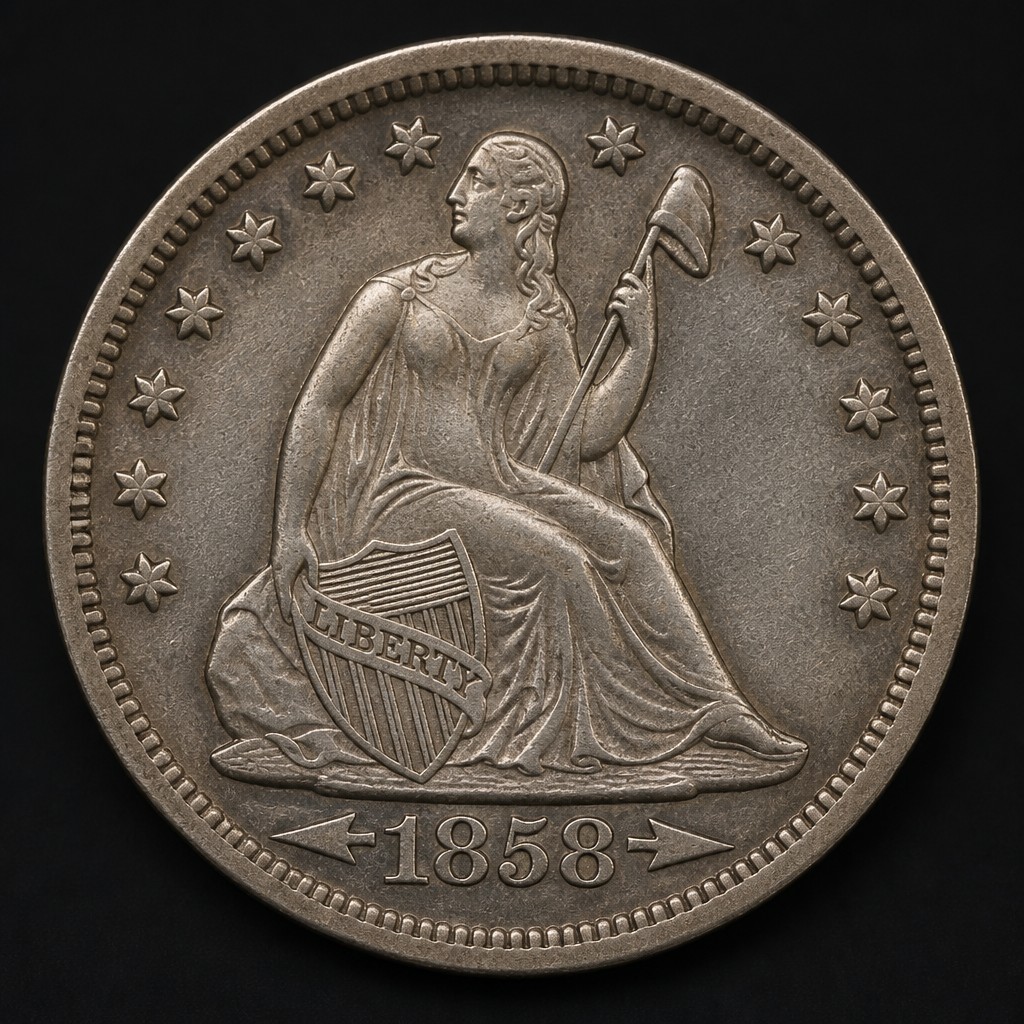
What the Coin Is
The 1858 quarter reflects the standard Seated Liberty design as it appeared for most of the 1850s and 1860s prior to the addition of "IN GOD WE TRUST" in 1866. It falls after the temporary Arrows and Rays (1853) and Arrows-only (1854-1855) design changes, returning to the plain, unadorned style used from 1856 onward, which makes it a good representative example of the "regular issue" Seated Liberty quarter look.
Obverse Design & Inscriptions
Liberty sits on a rock, holding a liberty pole with a cap and a shield inscribed "LIBERTY," with the drapery fold present at her elbow. Stars encircle the figure, with the date "1858" below, presented without any arrows or other special markings beside the numerals.
Reverse Design & Inscriptions
The reverse depicts an eagle with a shield on its breast, an olive branch and arrows in its talons, with no motto ribbon above its head, since this was struck before the motto was introduced. "UNITED STATES OF AMERICA" and "QUARTER DOL." surround the design in the standard layout used throughout this design phase.
Size, Weight, Metal, Edge
The coin is struck in 90% silver and 10% copper, weighs 6.22 grams, measures 24.3 mm in diameter, and has a reeded edge, consistent with the post-1853 weight standard used for the remainder of the Seated Liberty series.
Mint Marks
Check below the eagle on the reverse for a mintmark. A coin with no mintmark was struck in Philadelphia, while an "O" mintmark indicates the New Orleans Mint, which also struck quarters dated 1858 (Philadelphia examples are considerably more commonly encountered than their New Orleans counterparts).
Telling It Apart From Similar Coins
Confirm there are no arrows beside the date, which would indicate an 1853-1855 Arrows variety instead, and no motto ribbon above the eagle, which would indicate a post-1865 issue. The plain reverse without rays or motto, combined with plain obverse date digits (no arrows), points specifically to the standard 1856-1865 style shared by the 1858 issue and several neighboring dates.
Judging Condition at a Glance
Check Liberty's knee, breast, and head, and the eagle's wing feathers and shield lines for wear, the standard high points on this design. A well-struck coin should show clear separation in the folds of Liberty's gown and distinct feather detail on the eagle even in moderately circulated grades, while worn examples will show these details flattened or merged together.
Authenticity Red Flags
Inspect the date and any mintmark for consistent, natural styling compared to genuine references, watching for signs of alteration such as uneven digit spacing or filing marks. Surface graininess, weak design details, or an irregular edge would suggest a cast counterfeit rather than a genuine struck coin, and an incorrect weight is another simple check worth performing.
Frequently asked questions
Does the 1858 quarter have arrows or rays?
No, those were temporary features used only from 1853 to 1855; the 1858 issue has the plain, standard design without them.
Does it carry the 'IN GOD WE TRUST' motto?
No, the motto was not added to the reverse until 1866, so the 1858 quarter's reverse has no ribbon above the eagle.
Which mints struck the 1858 quarter?
Philadelphia (no mintmark) and New Orleans ('O' mintmark) both struck quarters dated 1858.
What are the main wear points to check?
Liberty's knee, breast, and head, along with the eagle's wing feathers and shield lines.